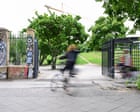
The dirt under the sycamore trees is always dry by June. If you sit on the grass in Görlitzer Park just as the sun drops behind the brick towers of the old Emmauskirche, the ground still holds the heat of the afternoon. You can smell the summer: charcoal smoke, cheap pilsner, crushed weed, and the distinct, sharp scent of dry earth kicked up by hundreds of feet.
For decades, this patch of green in Berlin’s Kreuzberg district has stayed open. Always. It does not have gates that slam shut at midnight. It does not have a watchman with a heavy ring of keys. It is a basin that catches everyone the city throws into it—the Turkish grandmothers watching toddlers on the swings, the techno-revellers winding down from a three-day weekend, the punks, the tourists, and the young men from West Africa standing quietly under the streetlamps.
Now, a fence is coming.
Berlin’s conservative mayor wants to ring-fence the park’s fourteen hectares, install heavy gates, and lock the public out between the hours of midnight and early morning. The justification is simple, spoken in the clipped, clean language of municipal governance: security, order, drug control. Görli, as everyone here calls it, has become a symbol of urban decay in the evening news, a place where dealers outnumber families and where a high-profile sexual assault last year sparked national outrage.
But look closer at the dirt. This is not just a fight over a park. It is a battle for the soul of a city that built its modern identity on being beautifully, stubbornly broken.
The Living Room of the Left-Behind
To understand why a metal fence can cause a small riot in Berlin, you have to understand how people live here. Berlin is a city of renters. It is a city of old tenement buildings with high ceilings, creaking wooden floors, and no balconies.
Let us invent a resident to illustrate what this means. Call her Marta. She is twenty-eight, works a precarious freelance gig in graphic design, and lives in a forty-square-meter apartment on Falckensteinstrasse, just three blocks from the park. In July, her flat turns into an oven. The air gets thick and stagnant. She does not have air conditioning; almost no one in Berlin does.
When the walls start closing in at 11:00 PM, Marta does not stay inside. She grabs a blanket and a cold bottle of beer from the Späti—the corner kiosk—and walks to Görli. She sits on the grass. She breathes. She meets three friends she didn't plan on seeing because everyone eventually wanders down to the lawn.
"Görli is our garden," the locals say. It is a cliché, but it happens to be literal. When you private-finance the housing market and squeeze people into smaller, more expensive spaces, the public park ceases to be a luxury. It becomes the communal living room. It is where you go to fight with your partner, to make up, to celebrate, or to simply exist without the obligation to buy a seven-euro oat-milk latte.
If you lock the gates at midnight, Marta does not suddenly go to sleep. She stays on the pavement. The crowd spills onto the residential streets, into the narrow alleyways, outside the bedroom windows of the people who voted for the fence in the first place. The pressure inside the pressure cooker does not disappear just because you put a lid on it. It just finds a weaker seam to blow.
The Geometry of a Scar
The geography of Görlitzer Park explains its wildness. It is long, narrow, and sunken below street level, built on the tracks of an old railway station that was bombed to pieces during the Second World War. For decades during the Cold War, the Berlin Wall ran just feet from its eastern edge. It was a dead zone. A gray, forgotten no-man's-land where the police rarely bothered to go.
When the Wall fell, the neighborhood claimed it. They didn't want a manicured French garden with "Keep Off the Grass" signs. They wanted a wilderness.
That history matters because it created a culture of fierce local ownership. When Mayor Kai Wegner announced the plan to build a two-meter-high perimeter fence at a cost of several million euros, he wasn't just proposing a security measure. He was drawing a line through a neighborhood that spent thirty years tearing lines down.
Consider the logic of the fence. It assumes that crime is a liquid that can be contained by a bucket. If you put up walls, the dealers—many of them undocumented migrants with no legal right to work in Germany and no access to social housing—will not vanish into thin air. They will move two hundred meters to the left, into the quiet residential squares, onto the steps of the kindergartens, or into the nearby subway stations.
The local district government, led by the Green Party, knows this. They have fought the state-level government tooth and nail, arguing that the fence is an expensive illusion. A optical illusion designed to make conservative voters in the leafy suburbs of West Berlin feel like something is being done about the "dangerous" inner city.
The local mayor of the district has openly refused to cooperate with the construction. In response, the Berlin Senate bypassed the local authority entirely, seizing control of the project by invoking a law meant for matters of "urgent city-wide importance."
The state broke through the local defense. The work began anyway.
The Weight of the Dark
It would be dishonest to pretend that Görli is a paradise. It isn't.
If you walk through the central entrance on a Friday afternoon, you will be approached three, four, five times by men murmuring "Marijuana? Cokie?" It can be exhausting. For parents with young children, the presence of used needles in the bushes near the playgrounds is a constant, terrifying reality. The sexual assault of a young woman by a group of men in the summer of 2023 changed the conversation completely. It weaponized the fear. It gave the politicians the mandate they needed.
Even the most radical left-wing residents acknowledge that something is broken. The disagreement is not about whether a problem exists; it is about how we treat the human beings inside the frame.
The fence is a cosmetic solution to a systemic collapse. It treats the park as the disease rather than the symptom. The men selling drugs under the trees are there because the global asylum system is broken, because German bureaucracy leaves thousands of people in legal limbo for years without the right to earn an honest living, and because there is a massive, insatiable demand for narcotics from wealthy Berliners who want to party until Tuesday morning.
A gate does not solve homelessness. It does not cure addiction. It just pushes the ugly parts of our society into the shadows where we don't have to look at them while we walk the dog.
The Irony of Safety
There is a strange, cold irony in the idea that locking a park makes it safer.
Sociologists have pointed out for decades that the safest public spaces are those that are heavily used by a diverse mix of people. It is called "eyes on the street." When a park is full of teenagers playing music, couples arguing, elderly men playing chess, and joggers running loops, it is very difficult to commit a violent crime unobserved.
When you lock the gates, you clear out the normal users. You create a dark, silent void. The determined criminals, the desperate, and the people with nowhere else to go will always find a way over a two-meter fence. But Marta won't. The families won't. The students won't.
By clearing out the public, the city risks creating the very thing it claims to fear: a genuinely lawless enclave, completely hidden from the view of passersby on the street.
During recent protests against the closure, hundreds of residents gathered along the perimeter. They brought tables, chairs, sofas, and floor lamps. They set up a giant communal living room right on the pavement where the fence is scheduled to go. They drank tea, argued with the police, and played music.
It was a classic Berlin performance, a piece of political theater meant to show that the community can regulate itself if it is allowed to stay together. But the police stood watch in heavy boots, their vans idling at the curb, a reminder of who holds the ultimate authority over the asphalt.
The Final Threshold
The sun is completely gone now. The lights of the Schlesisches Tor subway station flicker through the trees in the distance.
A group of teenagers is laughing near the concrete amphitheater, their voices carrying through the cool night air. A few meters away, a man sits alone on a bench, his head buried in his hands, staring at a discarded paper cup between his sneakers. Two police officers walk past, their flashlights cutting long, white beams through the darkness under the bushes. The dealers don't run; they just step back into the shadows, waiting for the uniforms to pass.
This is the park as it is: messy, tense, beautiful, unsafe, and fiercely alive.
If you come back here in a few months, the view might be different. You might see heavy steel bars cutting through the view of the trees. You might see a security guard checking IDs or shooing away the last stragglers as the clock ticks toward midnight.
The city will look cleaner on paper. The statistics in some municipal report will show a drop in crime inside the designated zone. The politicians will claim victory in the war for public order.
But the people who live in the apartments around the perimeter will know exactly what was lost. They will look out their windows at a locked gate, standing alone in the dark, keeping the city out of its own garden.