Silence.
That is the first thing you notice when you step off the limestone levees and wade into the sawgrass prairies of South Florida, a heavy, pressing quiet where a symphony of croaks, rustles, and bird calls used to live. For anyone who grew up along the edges of the Everglades, that silence feels less like peace and more like a crime scene. You walk for miles through shin-deep water, the sawgrass slicing at your sleeves, and you do not see a single marsh rabbit bolt from the reeds, nor do you hear the sharp bark of a raccoon along the canal banks. The swamp is still green, the water still moves in its slow, ancient sheet toward Florida Bay, and the sun still beats down with merciless heat—yet the pulse of the place has gone missing.
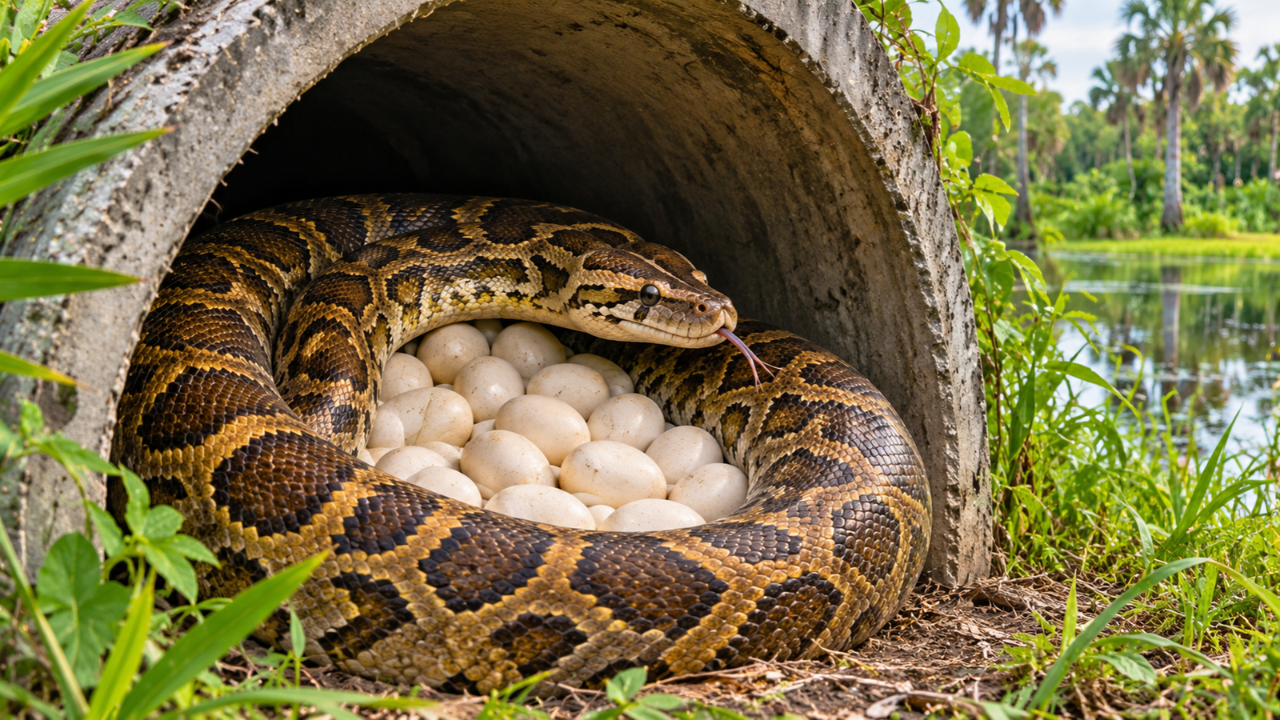
To understand how an entire ecosystem goes quiet, you have to crawl into the dark. Specifically, you have to peer inside a discarded concrete drainage pipe half-buried in the muck of southern Florida, where wildlife biologists recently uncovered a reality that makes even seasoned trackers go pale. Coiled tight in the damp blackness was a massive female Burmese python, her patterned scales glistening like wet river stones in the beam of a headlamp. Beneath her heavy, muscular loops lay ninety-six leathery white eggs.
Ninety-six.
Pause and let that number settle into your chest. Wildlife officials have spent decades pulling invasive snakes out of the Florida brush, and for years, a clutch of forty or fifty eggs was enough to make local headlines and keep conservationists awake at night. When researchers documented a female carrying ninety-six eggs inside an abandoned piece of human infrastructure, it shattered the old math of the Everglades invasion. Every single one of those eggs represented a future apex predator, each capable of growing past fifteen feet, each wired by millions of years of Southeast Asian evolution to eat anything that moves in the warm southern dark.
The Architecture of an Invasion
People outside of Florida often view the Burmese python crisis as a bizarre regional novelty, the kind of headline you scroll past over morning coffee before forgetting it entirely. They picture a few escaped pets sunning themselves on golf courses, an exotic nuisance easily handled by a handful of guys with snake hooks and pickup trucks. Having spent years tracking the fallout of invasive species across the American South, I can tell you that this mental picture is dangerously backward. What is happening in the River of Grass is not a localized wildlife quirk; it is an ecological collapse unfolding in slow motion, and that abandoned concrete pipe is the blueprint for how it works.
Consider a hypothetical scenario to see the math clearly. Suppose a single female python lays ninety-six eggs in a hidden culvert, and suppose, conservatively, that half of those hatchlings survive their first brutal year of dodging hawks, alligators, and wading birds. Forty-eight young pythons slip into the surrounding marsh, invisible in the dappled shadows of cypress knees and mangrove roots. Within three to four years, roughly half of those survivors are mature females, each capable of finding her own dark pipe, hollow log, or abandoned burrow and laying another sixty to ninety eggs. You do not need a degree in population biology to recognize an exponential curve when it is coiled around your ankles.
The concrete pipe itself tells a story we rarely like to admit. Pythons are ambush predators, built for patience and concealment, and human debris gives them fortified bunkers that nature never intended. Out in the open marsh, a nesting mother faces fluctuating water levels, fire ants, and the rare predator bold enough to test a twelve-foot constrictor. Inside a forgotten concrete culvert left behind by decades-old drainage projects, she gets a climate-controlled vault. The thick concrete buffers the brutal midday heat, keeps out rising summer floodwaters, and hides her scent from the few animals left in the swamp. In a twist of bitter irony, the very concrete we poured to tame and drain the Everglades now serves as an incubator for the creature erasing its native wildlife.
What Vanishes When the Apex Arrives
If you have never stood on a levee at dusk in Everglades National Park, it is hard to grasp what we are actually losing. When the Burmese python first established breeding populations in the late twentieth century—likely sparked by reckless pet owners releasing oversized snakes into the wild, and worsened when Hurricane Andrew tore apart a breeding facility in 1992—the native animals of South Florida had zero evolutionary memory of a giant constrictor.
Think of it like leaving the front door of a house wide open in a neighborhood that has never known theft. Native mammals did not recognize the thick, blotched coils lying motionless beside a game trail as mortal danger. A marsh rabbit, a fox squirrel, or an opossum does not smell a python and bolt; it walks right up to the ambush. By the time the snake strikes, hooking backward-curving teeth into flesh and wrapping heavy coils around the ribcage, the outcome is already decided. Pythons do not crush their prey to powder as old cartoons suggest; they squeeze just tight enough that every time the prey exhales, the coils tighten a fraction more, cutting off blood flow to the brain and heart within minutes.
The biological data gathered over the last twenty years reads like an obituary. Peer-reviewed studies conducted by researchers from the U.S. Geological Survey and Davidson College revealed staggering declines in mammal sightings along park roads between 1997 and 2012. Raccoon populations dropped by more than ninety-nine percent. Opossums vanished by nearly ninety-nine percent. Bobcats plummeted by more than eighty-seven percent. Marsh rabbits, cottontails, and foxes—animals that once darted across every country road at twilight—simply disappeared from vast stretches of the park.
Where did they go? They were converted, pound by pound, into snake muscle and eggs.
And the hunger does not stop at small mammals. Biologists have opened the stomachs of captured pythons to find full-grown white-tailed deer, great blue herons, endangered wood storks, and even six-foot American alligators. Every native predator in South Florida—from the endangered Florida panther to the indigo snake and the barred owl—now has to compete for scraps in a pantry that has been stripped bare. When you remove the mid-sized mammals from an ecosystem, you pull the linchpin out of the entire food web. Ticks lose their hosts, scavengers starve, seed dispersal halts, and the quiet creeps in a little deeper every season.
The Human Toll on the Edge of the Sawgrass
Ask anyone who lives in Homestead, Everglades City, or along the Tamiami Trail what this invasion feels like up close, and you will hear a mixture of frustration, grief, and stubborn resolve. For families whose livelihoods depend on hunting, fishing, and eco-tourism, the loss of native wildlife is not an abstract environmental metric; it is a hole torn straight through their culture and income.
Imagine, as a grounded example of what local guides face every week, a third-generation airboat captain launching his rig at dawn with a family of tourists eager to see wild Florida. Twenty years ago, he could guarantee them a glimpse of raccoons foraging along the sawgrass edges, rabbits darting through the pines, and deer standing knee-deep in the morning mist. Today, he has to steer harder and look closer just to find a handful of wading birds, all while scanning the banks for the unmistakable, diamond-like pattern of an invasive giant that does not belong there. People do not fly across the country to stare at empty mudbanks.
Then there is the quiet psychological weight carried by the state biologists, contractors, and citizen hunters who spend their nights patrolling the levees with high-powered spotlights. It is grueling, unglamorous work. You drive at ten miles an hour along narrow gravel roads bordered by pitch-black canals, eyes aching from scanning every blade of grass and patch of gravel for a shadow that looks slightly too thick, slightly too straight. When you find a big female—say, fourteen or fifteen feet long, weighing over a hundred pounds—there is no Hollywood glamour to the capture. You have to pin the head before she can wrap a coil around your arm or leg, wrestle sixty pounds of pure, thrashing muscle out of tangled brush or deep water, and humanely euthanize an animal that never asked to be brought halfway across the world and dumped in a swamp.
I have spoken with trackers who admit that the work breaks your heart even as you know it is necessary. The python is not evil; it is simply doing what millions of years of biology designed it to do—survive, eat, and reproduce. The villain in this story is human carelessness, plain and simple. Yet standing over a dead snake filled with ninety-six developing eggs, you feel a cold shiver of urgency. If you miss one female in one concrete pipe, you have lost ground you may never get back.
Why Hunting Alone Cannot Empty the Ocean
Whenever a record-breaking python makes the news, the public response is almost always the same: Why don't we just hire more hunters? Why don't we put a bigger bounty on them and wipe them out?
It is a fair question, and honestly, the scale of the Everglades makes it a terrifyingly hard one to answer. To grasp why traditional hunting struggles against the Burmese python, picture trying to find a single camouflage-painted garden hose dropped somewhere inside a flooded forest the size of Rhode Island. The Greater Everglades ecosystem spans roughly two million acres of impenetrable sawgrass, cypress domes, mangrove estuaries, and flooded tree islands. Over ninety percent of that terrain has no roads, no trails, and no easy access by boat or foot.
Even the best python trackers on earth estimate they detect only a tiny fraction—perhaps one or two percent—of the snakes living near the roadways they patrol. The rest stay deep in the interior marsh, invisible beneath duckweed and tangled roots, moving silently through water where humans can barely walk. You can remove ten thousand pythons from the levees—and state contractors have already pulled well over that number from the wild—and the breeding population hidden in the backcountry barely blinks.
This is the part where honesty matters more than false optimism. We are never going to eradicate every last Burmese python from South Florida. Anyone who tells you otherwise is selling wishful thinking. The snake is permanently woven into the geography of the southern peninsula now, much like the starling or the feral hog across the rest of North America.
Turning the Tide with Science and Scout Snakes
Yet admitting we cannot erase them entirely is not the same as surrendering the Everglades. Over the past few years, researchers and wildlife managers have shifted from simple brute-force hunting to something far smarter: turning the python's own biology against it.
The most effective weapon in that fight is the "scout snake" program, a strategy developed by biologists at the Conservancy of Southwest Florida and state agencies. Instead of wandering blindly through two million acres hoping to stumble across a nesting female, scientists capture large male pythons, surgically implant tiny radio transmitters beneath their skin, and release them back into the wild. During the winter breeding season, those males become relentless bloodhounds. Driven by ancient hormonal cues, a scout snake will swim through miles of sawgrass and crawl into hidden concrete pipes, leading researchers straight to the largest, most fertile females in the region.
One scout male, tracked over multiple seasons, can lead biologists to dozens of breeding females—and thousands of potential eggs—before those clutches ever hatch. Combined with emerging technologies like environmental DNA sampling, which detects trace genetic material shed by pythons in canal water, and near-infrared cameras designed to spot the subtle thermal signature of a cold-blooded snake against cool night pavement, the hunt is slowly moving from guesswork to precision.
Consider what happens next when science meets relentless fieldwork: every ninety-six-egg clutch intercepted inside a concrete culvert saves thousands of native mammals, birds, and reptiles over the coming decade. Every breeding female pulled off a nest buys time for the marsh rabbits and raccoons in surrounding preserves to breed, disperse, and reclaim their territory. In pockets of the western Everglades where scout snake teams have worked aggressively for years, field cameras are finally starting to capture small, hopeful flickers of life—a bobcat trotting down a trail at midnight, an opossum foraging near a cypress slough, a marsh rabbit freezing in the beam of a headlamp.
The Choice Written in Concrete
That abandoned pipe in southern Florida is more than a bizarre wildlife anecdote; it is a mirror held up to how we treat the natural world. We built the roads, dug the canals, poured the concrete culverts, and imported the exotic pets that started this cascade. For decades, we treated the Everglades like an infinite backyard that could absorb whatever we threw at it without breaking.
Ninety-six eggs coiled in the dark prove that nature keeps its own ledger, and the interest compounds fast. Saving what remains of the River of Grass will require more than occasional headlines when a record-setting snake is dragged from a culvert. It demands sustained funding for biological research, stricter oversight of the exotic pet trade before the next invasive predator slips into a backyard canal, and the stubborn humility to clean up the messes we leave behind in the mud.
Somewhere out beyond the levees tonight, beneath a humid South Florida sky thick with stars, the sawgrass bends in a warm breeze over dark, slow-moving water. In the beam of a biologist's headlamp, the mouth of another forgotten concrete pipe yawns open in the reeds, cool and silent and waiting to see who finds it first.