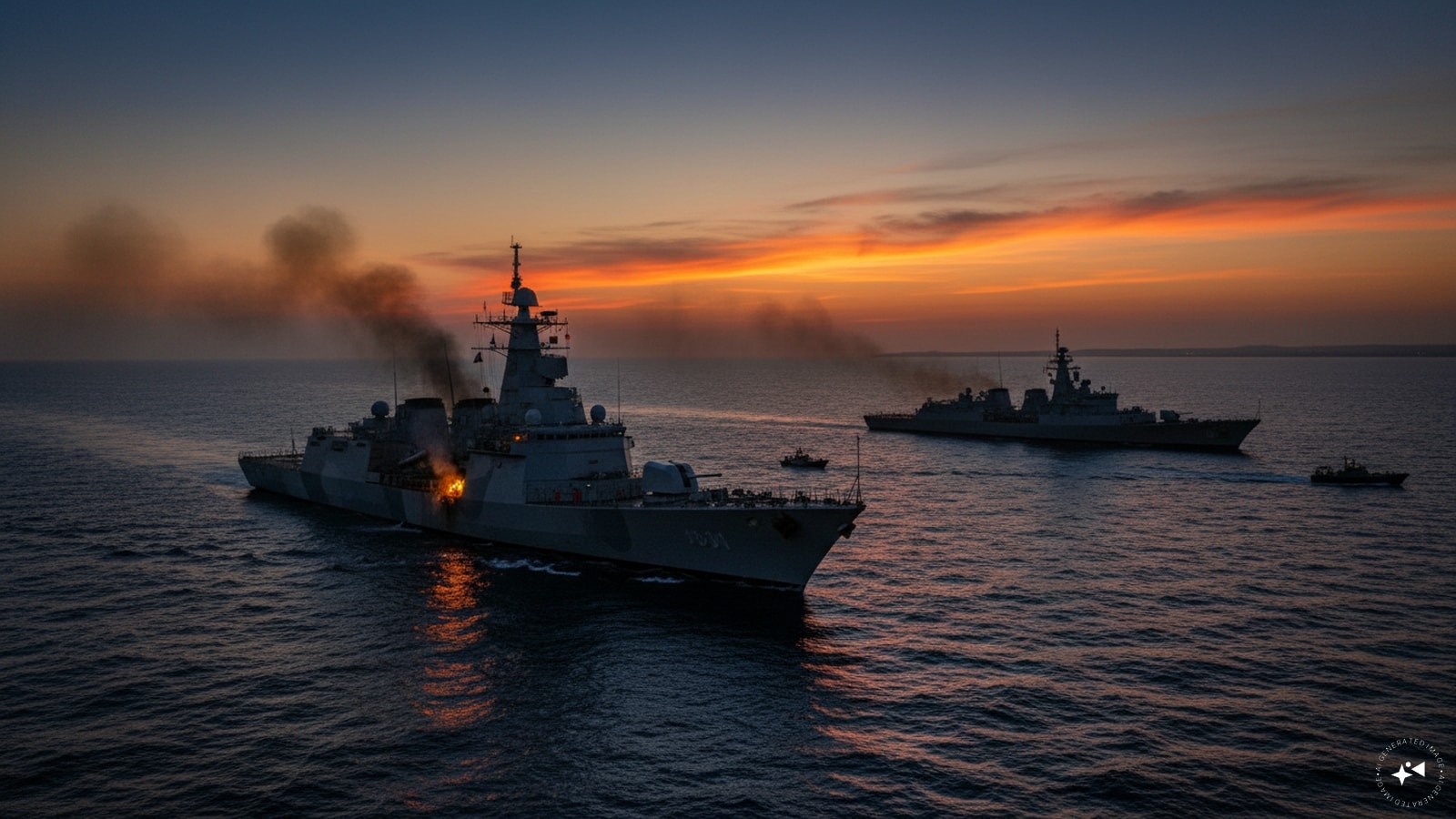
Maritime mishaps happen. But when a frontline Indian Navy warship and a Pakistani naval vessel bump into each other in international waters, it stops being a simple navigational error. It becomes a diplomatic flashpoint.
On the evening of September 15, 2026, a routine surveillance mission in the North Arabian Sea turned tense. While details trickled out slowly, the immediate political fallout was swift. New Delhi didn't wait to exchange polite notes. They hauled in Pakistan's top diplomat. If you found value in this post, you might want to look at: this related article.
If you look past the standard diplomatic theater, this incident exposes the fragile reality of military operations in crowded maritime corridors. Let's break down what actually happened, why governments care so much, and what this means for regional stability moving forward.
What Went Down in the North Arabian Sea
The collision itself was minor. No catastrophic damage or sinking was reported. Both vessels survived the brush. But international waters are vast. Ships don't just accidentally bump into each other unless something is fundamentally broken in communication or maneuvering discipline. For another perspective on this event, refer to the latest coverage from TIME.
According to reports, the Indian warship was conducting routine surveillance. On the other side, Pakistan pointed out that its naval vessel was participating in its biennial military exercise, known as Seaspark-26. When a surveillance patrol crosses paths with a live naval exercise, things get complicated fast. Islamabad claimed the Indian vessel made an aggressive maneuver. New Delhi argued the exact opposite, pointing the finger squarely at the Pakistan Navy for unprofessional conduct.
When two rival militaries operate in close proximity without transparent communication channels running smoothly, physics takes over.
Why New Delhi Summoned the Envoy
Diplomatic summons are heavy tools. Governments don't call in foreign envoys over a simple paint scratch on a hull unless they want to make a loud political point.
India's Ministry of External Affairs moved fast because the collision violated specific bilateral understandings. Specifically, New Delhi cited Article 10 of the 1991 Agreement on Advance Notice on Military Exercises, Maneuvers, and Troop Movements. That treaty exists precisely to prevent accidental clashes at sea or near borders by requiring transparent advance notices and safety margins.
By accusing the Pakistani crew of ignoring these established guardrails, India framed the incident not as a random accident, but as a breach of protocol. Simultaneously, instructions went out to India's Charge d'Affaires in Islamabad to register a parallel protest with Pakistan's Ministry of Foreign Affairs. It is a tit-for-tat diplomatic dance, but one rooted in real security concerns.
The Broader Geopolitical Context
You can't separate military encounters between India and South Asian neighbors from the heavy historical baggage they carry. Decades of strategic distrust mean that a minor scrape at sea carries massive symbolic weight.
Both nations maintain diplomatic missions led by chargés d'affaires rather than high commissioners—a status that has persisted since 2019. Trust is already practically non-existent. When naval units come into physical contact, it triggers immediate fears of escalation.
Public opinion in both countries treats these flashpoints as football matches. Social media pundits scream about aggression while experts quietly pray that standard operating procedures prevent a minor collision from sparking a shooting war. History shows that accidental military friction has historically preceded major crises. Even though both sides confirmed no major damage, the political machinery cranked into high gear immediately.
Understanding Maritime Rules at Sea
Why do international waters feel so crowded? The North Arabian Sea is a vital economic and strategic artery. Cargo ships, oil tankers, and warships share narrow corridors.
When naval exercises take place, standard protocol dictates clear communication zones. International maritime law relies heavily on the Convention on the International Regulations for Preventing Collisions at Sea, known as COLREGS. These rules govern right-of-way, speed limits, and evasive actions.
When state navies get involved, bilateral confidence-building measures layer on top of international law. The 1991 agreement between India and Pakistan was designed to add an extra layer of safety. When those rules fail, military planners get nervous. A surprise collision tests the reflexes of command structures on both sides. Did local commanders fail to communicate? Were transponders ignored? Those questions remain under internal review by defense analysts, even if public statements remain locked in standard blame games.
What Happens Next
Nothing catastrophic is going to erupt tomorrow over a minor hull scrape. Both navies know the stakes are too high for an accidental tactical clash to spiral out of control.
Yet, the diplomatic fallout leaves a mark. Expect stricter posturing during future naval exercises. Intelligence units will monitor movements in the Arabian Sea with an even finer microscope. Diplomatic channels will stay frosty, punctuated by formal demarches and public posturing.
The real takeaway here is how fragile peace is on the water. It doesn't take a declaration of war or a major missile launch to rattle regional stability. Sometimes, it just takes two ships getting too close for comfort in the dark.
Watch coverage of the diplomatic response and naval collision on YouTube
This video provides a detailed news broadcast and analysis regarding the diplomatic summons and the naval incident in the Arabian Sea.