Three in the morning is a terrible time for diplomacy.
The blue light of a secure smartphone cuts through a dark bedroom in Tokyo, or New Delhi, or Canberra. Outside, the city sleeps. Inside, a prime minister stares at a glowing screen, calculating the distance between a reassuring promise spoken in Washington and the cold, gray water of the South China Sea. If you liked this post, you might want to read: this related article.
"My phone is always open."
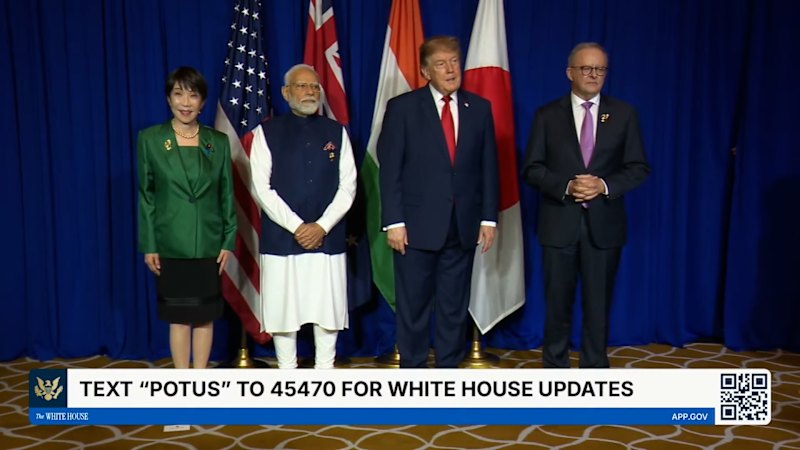
Donald Trump offered those five words to the leaders of the Quadrilateral Security Dialogue—the Quad—as a bridge across eleven time zones. On paper, it reads like standard diplomatic boilerplate, the kind of brisk, transactional reassurance that fills briefing books and disappears by the next news cycle. Yet when you sit with the weight of those words, stripped of press-release polish, they reveal the central anxiety of modern statecraft. For another angle on this story, refer to the latest update from NBC News.
Diplomacy is rarely decided in marble halls. It happens in the quiet hours when a coast guard cutter scrapes against a disputed reef, when an undersea fiber-optic cable goes dark, or when a regional commander has four minutes to decide whether a radar blip is a weather balloon or a provocation. In those moments, alliances are not treaties. They are phone calls.
The Weight of a Ringing Phone
To understand why an open phone line matters—and why it simultaneously terrifies the people invited to call it—you have to leave the podiums of Washington and step onto the deck of a hypothetical fishing trawler drifting fifty miles off Palawan.
Call the captain Mateo. He does not read foreign policy journals. He knows the price of diesel, the migration patterns of yellowfin tuna, and the exact hull number of the gray-painted maritime militia vessels that have spent the last six months shadowing his boat. When a water cannon shatters his wheelhouse glass at dawn, Mateo is not thinking about the Quadrilateral Security Dialogue. He is trying to keep his crew alive.
Yet Mateo’s shattered glass is the exact reason the Quad exists.
Born out of the chaotic aftermath of the 2004 Indian Ocean tsunami, the Quad began as an ad-hoc rescue mission. Four democracies—the United States, Japan, India, and Australia—realized that when the ocean rises or order collapses, no single nation possesses the reach to hold the line alone. Over two decades, that humanitarian reflex hardened into something far more consequential: a counterweight to Beijing’s expanding footprint across the Indo-Pacific.
Today, the Quad accounts for roughly a quarter of the global population and more than a third of the world’s economic output. Its joint naval exercises, maritime domain awareness networks, and supply-chain initiatives form the invisible scaffolding that keeps global trade moving through the Strait of Malacca and the Taiwan Strait. More than sixty percent of global maritime trade passes through these waters. Every semiconductor in your pocket, every lithium battery in your garage, and every shipping container stacked at the Port of Los Angeles depends on those sea lanes remaining open.
When Trump tells the leaders of Japan, India, and Australia that his phone is always open, he is speaking directly to the fragility of that scaffolding.
Personal Chemistry Versus Institutional Memory
I have spent years watching how foreign ministries operate during a crisis, and there is a physical sensation you never quite forget: the sudden drop in stomach temperature when an ally’s institutional machinery stalls.
Traditional diplomacy relies on buffers. Before a president and a prime minister speak, desk officers draft talking points, ambassadors test the waters, and national security advisors quietly sand down the sharp edges of disagreement. The system is slow, deliberate, and predictable. It is designed to prevent a midnight misunderstanding from spiraling into a regional war.
Trump’s style obliterates the buffer.
By placing personal access at the center of the Quad relationship, he replaces institutional predictability with direct, leader-to-leader chemistry. For a leader like India’s Narendra Modi, who has cultivated his own brand of high-stakes personal diplomacy, or for leaders in Tokyo and Canberra navigating shifting domestic coalitions, an open line to the Oval Office is both a lifeline and a gamble.
Consider the trade-off. An open phone line means speed. If a crisis erupts in the East China Sea or along the Himalayan border, you do not have to wait three days for the State Department to clear a cable. You pick up the receiver, and you reach the person who holds the keys to the world’s most powerful military.
But personal access cuts both ways. What happens when the line is open, yet the terms of engagement are renegotiated on every call?
Think of the Quad not as a rigid military alliance like NATO—it has no mutual defense clause, no Article 5 binding one nation to bleed for another—but as a shared neighborhood watch. For a neighborhood watch to deter a burglar, everyone on the block has to believe that if a window breaks at 2:00 AM, the neighbors will actually step outside with flashlights, rather than arguing over who paid for the batteries.
The Invisible Ledger of Trust
Ask any senior diplomat in Tokyo or Canberra what keeps them awake at night, and they will rarely mention Beijing’s latest destroyer launch. They already know the ship counts. China’s navy is now the largest in the world by hull count, surpassing 370 ships and submarines, with projections pushing past 400 before the end of the decade. The math is public.
What keeps them awake is the invisible ledger of American resolve.
In the Indo-Pacific, credibility is currency, and it fluctuates faster than any exchange rate. During Trump’s first term, his administration actually revived the Quad after years of dormancy, elevating it from a hesitant bureaucratic dialogue to a ministerial-level forum. That history gives his latest outreach genuine weight. Allies remember that Washington took the threat seriously when others preferred polite silence.
At the same time, those same allies carry the scars of tariff threats, abrupt troop withdrawal debates, and transactional demands over defense spending. When a U.S. president says, "My phone is always open," a seasoned diplomat in New Delhi hears two sentences at once. The first is an invitation to partner. The second is an unspoken reminder that every partnership comes with an invoice.
Let us be honest about the uncertainty here. Nobody—not the intelligence analysts in Langley, not the strategists in Canberra, and certainly not the commentators on cable news—knows with absolute certainty how a personal-first approach to the Quad will hold up under sustained pressure. Anyone who claims otherwise is selling false comfort. Statecraft at this altitude is an experiment conducted in real time, with billions of lives riding on the outcome.
What People Miss About the Indo-Pacific
When Western audiences hear about the Quad, the conversation almost always defaults to warships, fighter jets, and hypothetical blockades. That framing misses ninety percent of the actual contest.
The real battle for the Indo-Pacific is being fought in fiber-optic trenches, rare-earth processing plants, and coastal weather stations.
Take the Quad’s Indo-Pacific Partnership for Maritime Domain Awareness. On the surface, it sounds like dry bureaucratic jargon. In practice, it uses commercial satellite data and radio-frequency tracking to strip away the cloak of invisibility from "dark vessels"—ships that turn off their transponders to fish illegally in sovereign waters or map sensitive seabed terrain. For a small island nation in the Pacific with a coast guard consisting of two patrol boats, that shared satellite feed is the difference between sovereignty and helplessness.
Or consider critical minerals. Today, China controls roughly sixty percent of global rare-earth mining and nearly ninety percent of the refining capacity required to turn raw ore into the magnets inside F-35 fighter jets and wind turbines. The Quad’s quietest, hardest work involves building an alternative supply chain—linking Australian mines, Japanese refining technology, Indian manufacturing scale, and American capital—so that a single export ban in Beijing cannot paralyze four democracies at once.
None of that work makes for a flashy soundbite. You cannot fit a rare-earth processing plant into a five-word quote. Yet without those unglamorous, multi-year commitments, an open phone line at three in the morning is just an empty gesture. You cannot improvise a supply chain during a crisis.
The Anatomy of Deterrence
Deterrence is a strange, psychological beast. Unlike a bridge or a dam, you never see deterrence working. You only see it when it fails.
When deterrence holds, nothing happens. A cargo ship passes through the Taiwan Strait without incident. A survey vessel turns back before crossing an exclusive economic zone. A border patrol stops fifty meters short of a disputed ridge. The headlines stay quiet, the markets stay calm, and ordinary people go to work without ever knowing how close the gears came to grinding together.
To keep those gears turning smoothly, the Quad relies on a delicate balance between reassurance and ambiguity.
If Washington leans too hard into unilateral demands—treating allies like contractors rather than sovereign partners—the coalition fractures from within. India, fiercely protective of its strategic autonomy, will quietly pull back toward non-alignment. Southeast Asian nations watching from the sidelines will conclude that hedging toward Beijing is the safer bet.
Conversely, if Washington projects hesitation, the vacuum fills overnight. History shows that great powers rarely stumble into conflict because they are too clear about their red lines; they stumble when an adversary convinces itself that the phone will ring in Washington, and nobody will pick up.
The Echo on the Line
Step back into that dark bedroom in Tokyo, or New Delhi, or Canberra.
The glowing screen is still there. In an era where the post-World War II order is groaning under the weight of regional wars, fractured trade routes, and relentless technological disruption, direct communication between the leaders of four major democracies is not a trivial thing. Personal rapport can cut through bureaucratic paralysis. A direct conversation can de-escalate a maritime collision before pride turns a tactical mistake into a national humiliation.
Yet a phone line is only a conduit. It carries whatever conviction, preparation, and shared sacrifice the people on both ends bring to the call.
Five miles off the coast of Palawan, the sun is coming up over the water. Mateo sweeps the broken glass from the floorboards of his trawler, checks his compass, and starts the engine. He will never dial the direct line to the Oval Office. He will never sit at a Quad summit table. He will simply steer his boat back toward the fishing grounds, trusting that somewhere beyond the horizon, the people who promised to keep the sea open meant every word they said.