The Failure Modes of Linear Response in Exponential Epidemics
Epidemiological containment relies on a fundamental mathematical reality: the rate of transmission ($R_0$) must be driven below 1.0 before local healthcare capacity undergoes systemic collapse. When a high-mortality pathogen like the Ebola virus emerges in an isolated or politically unstable geography, the standard public health playbook emphasizes speed. However, statements urging organizations to "move fast" confuse velocity with structural readiness. Velocity without systemic infrastructure yields operational friction, misallocated capital, and localized resistance.
An effective containment strategy requires converting a reactive, narrative-driven crisis response into a predictable, multi-layered logistical framework. The traditional approach fails because it treats containment as a medical crisis rather than an adversarial supply-chain problem. To disrupt transmission chains under extreme constraints, operations must solve for three distinct bottlenecks: logistical velocity, behavioral alignment, and resource-allocation mechanics.
The Three Pillars of Pathogen Containment Logistics
To evaluate the structural integrity of an outbreak response, the deployment must be broken down into three interdependent operational pillars. If any single pillar lacks the necessary capacity, the entire containment apparatus defaults to failure.
1. The Diagnostic and Surveillance Latency Function
The time delta between initial symptom onset and definitive molecular confirmation dictates the growth trajectory of a transmission cluster.
$$\text{Latency} = T_{\text{onset}} \rightarrow T_{\text{reporting}} \rightarrow T_{\text{collection}} \rightarrow T_{\text{transport}} \rightarrow T_{\text{amplification}}$$
In under-resourced regions, this chain frequently breaks at the transport and amplification phases. If sample transport relies on irregular ground infrastructure across difficult terrain, biological samples degrade, or testing is delayed by days. During this window, the suspected patient remains either within the community or in a non-isolated triage zone, multiplying secondary attack rates.
Minimizing this latency requires decentralized diagnostic architecture. Deploying mobile RT-PCR units or validated rapid antigen assays directly to forward triage points removes the transport variable entirely.
2. Isolation Vector Mechanics and Contact Tracing Density
Once a positive case is identified, containment depends on a binary objective: isolating the active vector and tracing 100% of first-degree contacts within 24 hours. The operational burden scales exponentially, not linearly, with every day of delayed isolation.
- Contact-to-Case Ratio: In dense or highly communal environments, a single index case can generate between 20 and 50 unique contacts requiring daily monitoring for 21 days.
- Surveillance Labor Requirements: Tracking 500 contacts requires a disciplined field team capable of navigating physical insecurity, linguistic barriers, and local distrust.
- Quarantine Compliance Infrastructure: Forcing individuals into quarantine without replacing their lost economic output or providing basic caloric intake guarantees non-compliance. Individuals will evade surveillance to seek food or income.
3. Biosecurity Supply Chain Integrity
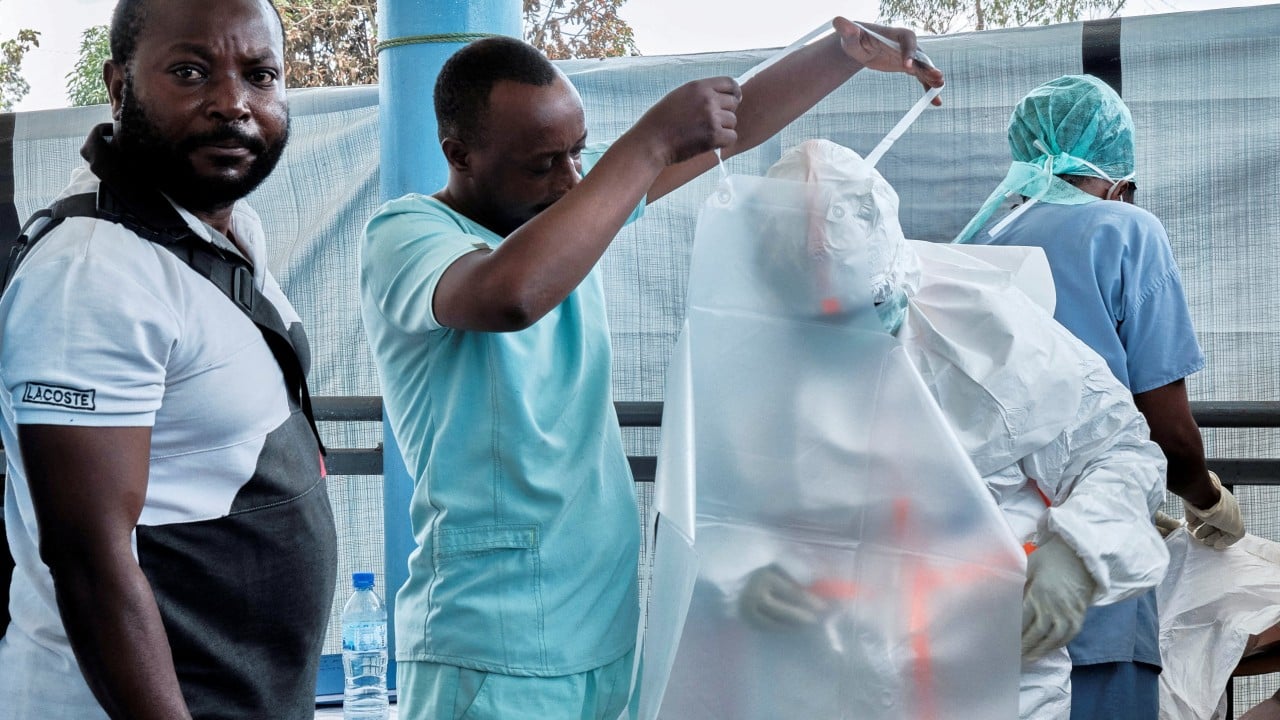
The consumption rate of Personal Protective Equipment (PPE), chlorine concentrates, and specialized therapeutics (such as monoclonal antibodies) is highly volatile during the acceleration phase of an outbreak. A standard Ebola Treatment Unit (ETU) consumes hundreds of PPE ensembles daily.
Supply chain failures manifest when procurement teams treat the medical supply chain as a just-in-time system. Disruptions at international border crossings, flight availability constraints, or localized customs bottlenecks can halt the supply of critical inputs, rendering an ETU non-functional and exposing healthcare workers to lethal viral loads.
The Behavioral Alignment Equation
The primary point of failure for international health interventions is the misalignment between epidemiological directives and local socio-economic realities. High-downward-authority mandates from foreign entities routinely spark community resistance, driving the outbreak underground.
                  [ epidemiological directive ]
                               │
            ┌──────────────────┴──────────────────┐
            ▼                                     ▼
[ economic alignment ]                 [ cultural alignment ]
(replaces lost income during           (adapts burial customs via
 isolation/quarantine)                  trusted local leaders)
            │                                     │
            └──────────────────┬──────────────────┘
                               ▼
                [ sustained compliance ]
The Cost Function of Local Compliance
Compliance with biosecurity protocols is an economic and cultural calculation for the local population. For an individual living in a subsistence economy, entering an ETU carries significant downside risk:
- Economic Death: Total cessation of income for the dependent family unit.
- Social Stigmatization: Permanent exclusion from community networks due to the perceived curse or contamination of the facility.
- High Perceived Mortality: Because patients often present at ETUs during late-stage disease, the local population witnesses a high volume of corpses leaving the facility, leading to the logical but incorrect deduction that the ETU causes death.
To shift this cost function, containment operations must embed economic stabilization directly into the health strategy. This means providing direct cash or commodity transfers to the families of isolated individuals and guaranteed compensation for those in mandatory quarantine.
Deconstructing Burial Transmission Dynamics
Traditional funerary practices involving washing and touching the deceased represent one of the most potent amplification vectors for filoviruses, given the extreme viral load present in post-mortem tissues. Direct enforcement of "safe and dignified burials" by armed personnel or visibly sterile, alienated teams frequently provokes intense hostility.
The structural solution requires co-opting the local social hierarchy rather than bypassing it. Trusted religious and community figures must be trained to modify the rituals so that they preserve theological or cultural validity while maintaining strict physical distance from the corpse. If the community does not co-author the intervention protocol, they will hide bodies, resulting in unmonitored transmission chains that completely invalidate official data models.
Resource Allocation Paradoxes in Crisis Environments
When international agencies flood a crisis zone with capital, they often trigger secondary systemic failures due to a lack of absorptive capacity in the target environment.
The Specialized Personnel Bottleneck
Money cannot instantly manufacture a trained infectious disease physician, an experienced epidemiologist, or a biosecurity logistics expert. Funding surges often lead to aggressive poaching of local medical talent from routine healthcare systems (such as maternal health and malaria clinics) to staff the high-paying intervention response. This internal brain drain causes a spike in non-outbreak mortality, frequently dwarfing the direct casualties of the epidemic itself.
Capital Absorbency and In-Country Logistics
Pouring millions of dollars into procurement is useless if the physical infrastructure cannot absorb the volume.
- Airfield Saturation: Small regional airstrips cannot handle back-to-back cargo flights, leading to holding patterns and delayed deliveries.
- Cold-Chain Degradation: Advanced therapeutics and vaccines require strict ultra-low temperature storage. Without reliable power grids, back-up generators, and fuel supply chains, expensive vaccine doses will spoil before reaching the field.
- Absence of All-Weather Road Networks: During rainy seasons, unpaved supply routes turn into mud, stranding critical vehicles and isolating remote transmission zones.
Defining the Operational Boundary Conditions
An expert response mechanism must recognize that certain variables cannot be optimized in real-time. Strategic design must adapt around these fixed constraints.
| Variable | Nature of Constraint | Mitigation Vector |
|---|---|---|
| Incubation Period | Fixed Biological Window (2–21 Days) | Extended, non-negotiable 21-day active surveillance tracking cycles. |
| Local Infrastructure | Fixed Physical Reality | Transition to air-dropped assets, ruggedized off-road transport fleets, and decentralized point-of-care diagnostics. |
| Geopolitical Security | Dynamic Volatility / Armed Conflict | Integration of neutral humanitarian actors; decentralized triage to minimize large target profiles. |
The Strategic Blueprint for Next-Generation Containment
To move past reactive platitudes and establish a highly rigorous operational stance, international health authorities and regional governments must execute a structural overhaul of their deployment blueprint.
Establish Pre-Positioned Strategic Diagnostic Rings
Instead of waiting for an outbreak to occur and then building supply lines, regional hubs in high-risk ecological zones must maintain permanent, warm-status diagnostic laboratories. These hubs must possess gene-sequencing capabilities to immediately differentiate between known endemic strains and novel mutations, stripping days out of the early latency phase.
Weaponize Data Interoperability
Field data is routinely captured on paper logs, fragmented spreadsheets, or siloed proprietary applications. The result is a fractured operational picture where contact tracers are working off week-old information. The deployment protocol must mandate a single, offline-first, encrypted digital surveillance architecture where contact notifications, diagnostic confirmations, and bed-availability metrics update in near-real-time across all active agencies.
Institutionalize Localized Logistics Franchising
The international community must stop operating as an invading logistical force. The primary supply chain should be designed to plug directly into existing commercial distribution networks—such as beverage distributors or local transport syndicates—that already know how to navigate the terrain, checkpoints, and local social dynamics. This creates an immediate economic incentive for local businesses to support containment infrastructure rather than view it as an occupying force.
The deployment of leadership into an active outbreak zone should not be treated as a political or public relations event. It is an engineering intervention designed to audit, debug, and accelerate a complex, socio-biological machine. Success is measured exclusively by the systemic reduction of the reproduction number, achieved through ruthless operational discipline and the absolute elimination of logistical friction.