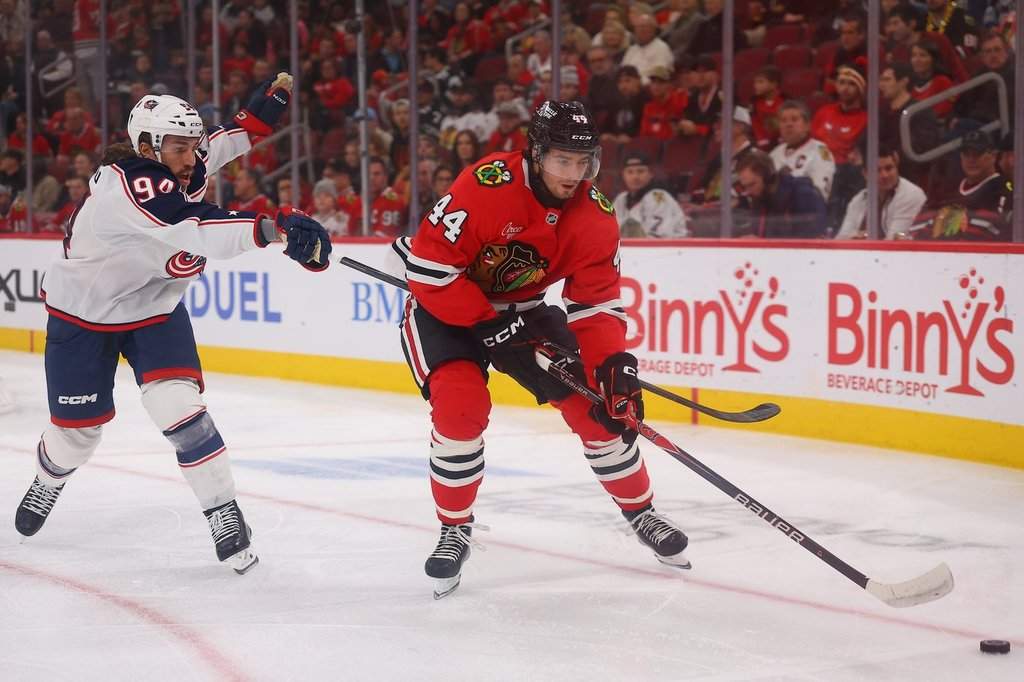
A three-game suspension in the National Hockey League is never merely a disciplinary slap on the wrist; it is a forced multi-variable shock to a roster’s salary cap mechanics, defensive deployment matrix, and asset development curve. Standard sports reporting treats the suspension of Chicago Blackhawks defenseman Wyatt Kaiser as an isolated infraction—a timeline of the on-ice incident, the Department of Player Safety hearing, and the final ruling. That surface-level framing misses the structural realities governing front-office decision-making. When a young, developing defenseman is removed from a rebuilding lineup for three games, the primary friction occurs not in the penalty box, but in the coaching staff's matchup tolerances, the general manager's emergency recall flexibility, and the player's own risk-calibration model.
To evaluate the true impact of a three-game ban on a defenseman like Wyatt Kaiser, analysts must separate the emotional narrative of player safety from the cold mechanics of roster management. The league's Collective Bargaining Agreement (CBA) and the Department of Player Safety (DoPS) operate on codified incentives and deterrent thresholds. Understanding how a three-game absence ripples through an NHL organization requires breaking down the disciplinary framework, the financial forfeiture formulas, the tactical reallocation of ice time, and the long-term behavioral adjustments required of a young blueliner.
The Structural Anatomy of a Three-Game NHL Suspension
The NHL Department of Player Safety does not assign suspension lengths arbitrarily. Every ruling is the output of a multi-tiered evaluation matrix designed to balance on-ice deterrence with Collective Bargaining Agreement precedents. When a player like Wyatt Kaiser faces supplemental discipline, the league evaluates three distinct variables before arriving at a three-game threshold: the mechanics of the infraction, the injury outcome, and the player’s disciplinary history.
1. The Mechanics of the Infraction
The DoPS categorizes infractions by examining the point of contact, the angle of approach, and the degree of force applied. In cases involving boarding, cross-checking, interference, or high hits, video analysts dissect the frame-by-frame sequence to determine whether the offending player had an opportunity to minimize impact or alter their trajectory. A three-game suspension indicates that the league classified the play as reckless rather than purely accidental, yet stopped short of labeling it a predatory intent-to-injure violation, which typically triggers five or more games and an in-person hearing.
2. The Injury Multiplier
Under CBA rules, the presence or absence of an injury to the opposing player is not supposed to determine whether an infraction occurred, yet it explicitly dictates the severity of the punishment. If an illegal check results in a documented injury—such as a concussion, laceration, or upper-body trauma that removes the opponent from the game—the baseline suspension length scales upward immediately. A three-game ruling frequently reflects a scenario where a borderline dangerous play was compounded by an adverse physical outcome for the victim, pushing the penalty past the standard one-to-two-game warning tier.
3. Disciplinary History and Repeat Offender Status
The CBA defines a "repeat offender" strictly as a player who has been suspended within the preceding 18 months. However, the DoPS maintains an informal institutional memory that extends beyond that window, factoring in prior fines and unpenalized warnings. For a young defenseman early in his NHL tenure without a formal suspension record, receiving three games rather than one signals that the specific mechanics of the hit crossed a bright line that first-time offender leniency could not offset.
Financial Forfeiture and Salary Cap Mechanics
Public coverage of NHL suspensions routinely treats the financial penalty as a footnote, yet the economic mechanics reveal critical differences between entry-level contracts, standard deals, and repeat offenders. Under the NHL Collective Bargaining Agreement, suspended players forfeit salary, and that forfeited money is directed to the Players’ Emergency Assistance Fund rather than returning to the team's coffers.
The exact calculation depends entirely on the player's repeat-offender status:
- First-Time Offender Formula: Salary forfeiture is calculated based on the number of days in the regular season, not the number of games played. The player loses
1 / Total Days in Seasonof their annual salary for each day they are suspended. Because an NHL regular season typically spans roughly 190 to 200 days, a three-game suspension spanning six or seven calendar days costs a first-time offender roughly 3.0% to 3.7% of their annual base salary. - Repeat Offender Formula: If a player has been suspended within the previous 18 months, the penalty shifts to a per-game calculation:
1 / 82of their annual salary per game suspended. For a three-game ban, a repeat offender forfeits3 / 82(or 3.66%) of their pay, regardless of how many calendar days pass between games. - Cap Hit Persistence: Crucially for the franchise, a suspended player’s salary cap hit remains completely intact on the team’s books during the suspension. The Blackhawks receive zero cap relief while Kaiser sits in the press box. Furthermore, the suspended player continues to occupy one of the 23 active roster spots. A team cannot place a suspended player on Injured Reserve or assign them to the American Hockey League (AHL) to clear a roster spot or bury the cap hit until the suspension is fully served.
This roster freeze creates a localized bottleneck. If the Blackhawks are carrying the maximum 23 players and suffer a simultaneous injury to another defenseman, they cannot simply swap Kaiser out on paper. They would be forced to waive another player or utilize an emergency recall exception, which comes with strict salary cap thresholds and administrative hurdles.
Defensive Deployment Shock and Matchup Cascade
Removing a regular defenseman from an NHL lineup for three games forces an immediate redistribution of workload across the remaining six blueliners. In modern NHL systems, defensive pairs are constructed around complementary skill sets—typically pairing a puck-moving, transitional skater with a stay-at-home, crease-clearing defender. Wyatt Kaiser’s primary operational value to Chicago lies in his skating efficiency, zone-exit retrievals, and transition mobility.
When a mobile, puck-retrieving defenseman is removed from the third or second pair, the coaching staff faces a zero-sum deployment problem across three distinct phases of play:
Even-Strength Zone Exits
Without a strong transitional skater on the bottom pair, opposing forecheckers alter their tactical approach. Coaches instruct their F1 (first forechecker) to angle aggressively toward the replacement defenseman’s weak side, knowing the puck retrieval speed has dropped. The replacement player—often a slower, veteran depth defenseman or an emergency AHL call-up—is forced into low-percentage rim plays up the boards rather than controlled tape-to-tape exits through the middle of the ice. This increases defensive zone time and suppresses shot-attempt share (Corsi) for the forward lines deployed behind that pair.
Special Teams Cascading Fatigue
Even if Kaiser is not the primary quarterback on the first power-play unit, removing a defenseman from the regular rotation compresses the rest intervals for the top four blueliners. A defenseman who normally averages 16 to 18 minutes of even-strength ice time must suddenly absorb an extra three to four minutes per night. Over a compressed three-game stretch—especially if those games occur within a five-night window—this incremental fatigue degrades decision-making in the third period. Top-pair defensemen forced to kill penalties without their standard rotation relief experience higher rates of late-game turnovers and positional breakdowns.
The Right-Side/Left-Side Asymmetry
NHL coaches obsess over handedness on the blue line because playing on one's off-side compromises puck protection along the half-wall and slows down one-timer execution at the offensive blue line. Losing a left-shot defenseman like Kaiser forces the coaching staff to either insert a seventh defenseman of matching handedness—who may have been sitting idle in the press box for two weeks—or shift an existing defenseman to their off-side, disrupting established pair chemistry across the entire defensive corps.
The Developmental Friction for Young Defensemen
For a rebuilding franchise like the Chicago Blackhawks, the primary objective of any regular-season stretch is asset valuation and player development, not short-term standings points. In that context, a three-game suspension carries a distinct developmental cost that differs sharply from suspending a 32-year-old veteran.
Young defensemen in the NHL operate on a steep cognitive learning curve. The processing speed required to read forechecking pressure, gap up at the defensive blue line, and execute physical box-outs against elite NHL forwards takes roughly 150 to 200 regular-season games to stabilize. Interrupting that rhythm with a forced three-game layoff breaks the feedback loop of game-speed repetition.
More importantly, supplemental discipline introduces psychological hesitation. Young blueliners rely on aggressive gap control—closing space quickly on opposing wingers entering the neutral zone—to compensate for any lack of massive physical size. When a player is suspended for a physical infraction, their natural instinct upon returning to the lineup is to overcorrect. They give opposing forwards an extra two feet of cushion at the blue line to avoid taking a penalty or risking another disciplinary review. In the NHL, two feet of extra space is all an elite forward needs to cross the blue line with speed, set up an offensive cycle, and tilt the ice.
The coaching staff must actively manage this post-suspension recalibration. Video sessions during the three-game absence cannot simply focus on the illegal hit; they must isolate the three seconds prior to the hit. Usually, an illegal check by a young defenseman is the symptom of an earlier positioning error—a poor angle in the neutral zone or a lost puck battle that forced the defender to scramble and use reckless force to recover. Fixing the positioning error eliminates the desperation that causes the suspension.
Evaluating the Limitations of NHL Deterrence Models
While the Department of Player Safety frames three-game suspensions as corrective measures designed to protect player health and modify on-ice behavior, the league's deterrent model suffers from structural inconsistencies that limit its predictive reliability.
First, the definition of a "hockey play" versus a reckless infraction remains subjective despite public video explanations. Players and coaches routinely struggle to map DoPS rulings onto real-time decision-making because identical physical mechanics often yield wildly different outcomes—ranging from no supplemental discipline to a fine to a multi-game ban—based purely on whether the receiving player turned at the last millisecond or sustained an injury.
Second, suspending a player on a non-contending team carries minimal competitive deterrence for the franchise itself. While the player loses salary and game reps, a rebuilding organization does not suffer the existential playoff-seeding damage that a contender faces when losing a top-four defenseman in March. Consequently, the organizational pressure to curb borderline physicality is lower during a rebuild than during a championship window.
Third, short suspensions rarely alter the underlying systemic incentives of NHL roster construction. Teams actively seek defensemen who play with "edge" and physical deterrence in front of the net and along the boards. Until a player crosses the threshold into repeat-offender status, front offices largely view an occasional two- or three-game suspension as an acceptable operational variance—the cost of doing business when developing physical defensive habits at the highest level.
Tactical Protocol for Managing the Three-Game Window
When a front office and coaching staff absorb a three-game suspension to a developing defenseman, operational execution during the layoff determines whether the team loses momentum or extracts developmental value from the downtime.
- Enforce High-Intensity Conditioning Blocks: Because a suspended player cannot participate in games, their cardiovascular conditioning drops rapidly relative to active teammates. Strength and conditioning coaches must schedule high-output anaerobic skating sessions on game days to replicate the metabolic load of 18 minutes of NHL shifts, ensuring the player does not return with heavy legs in Game 4.
- Conduct Pre-Contact Angle Audits: Video coaches should isolate ten clips from the player's previous five games showing successful, legal gap closures alongside the suspended play. Demonstrating how early stick placement and body angling neutralize a forward without requiring high-impact collisions prevents the player from becoming overly passive upon return.
- Deploy Protected Third-Pair Minutes Upon Return: In the first game back from a suspension, the coaching staff should shelter the returning defenseman with high offensive-zone start percentages (above 60%) and pair them with a steady, communicative veteran. Rebuilding on-ice timing in low-stress territorial deployments restores confidence before reintroducing heavy defensive-zone matchups against top-six opposition.