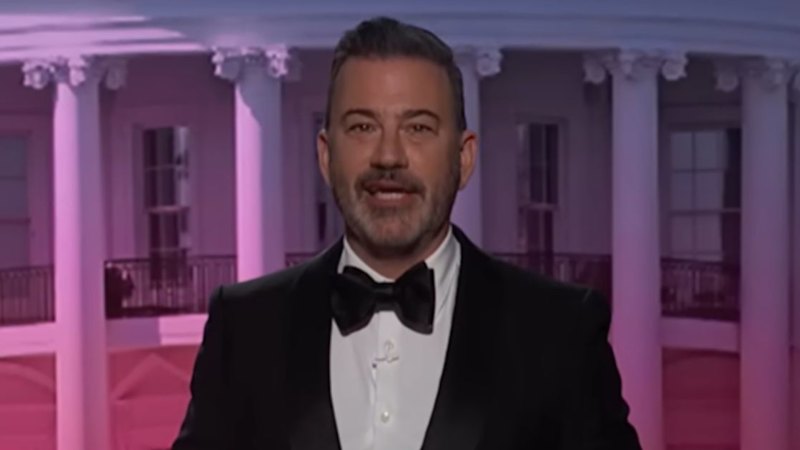
Late-night comedy is dead. Not because it isn't funny—though that is a separate, painful conversation—but because it has mutated into a feedback loop designed to manufacture "backlash" for clicks. The recent cycle involving Jimmy Kimmel’s jokes about Melania Trump isn't a cultural moment. It isn't a political stand. It is a calculated piece of algorithmic bait that everyone, from the pearl-clutching critics to the loyal viewers, swallowed whole.
The standard narrative suggests that a comedian "crossed a line" and "sparks fly" as a result. That is a lie. There is no line. There is only a business model that requires a specific level of friction to remain profitable in a fractured media market. If you enjoyed this article, you might want to look at: this related article.
The Myth of the Brutal Joke
Most entertainment reporting focuses on the content of the joke. They analyze the wording, the delivery, and the immediate social media reaction. They treat it like a spontaneous event. I have spent enough time in the orbit of media production to tell you that nothing about this is spontaneous.
When Kimmel targets Melania Trump, he isn’t punching up or punching down. He is punching the "Engagement Button." For another perspective on this story, check out the recent coverage from E! News.
The "brutal" nature of the joke is a requirement, not an accident. If the joke were subtle, it wouldn’t trigger the outrage machine. To survive, late-night hosts need the conservative ecosystem to react with indignation. They need the "Melania Trump fans are furious" headlines. Without that friction, the clip dies on YouTube with 200,000 views. With the backlash, it hits 5 million.
The backlash isn't the problem for the network; the backlash is the product.
The False Premise of Late Night Accountability
We are told that these moments matter because they hold the powerful accountable. This is the "lazy consensus" of the modern media critic. Let’s dismantle that immediately.
- Zero Political Conversion: Nobody watched Kimmel’s monologue and changed their mind about the former First Lady.
- Preaching to the Choir: The audience for late-night is an ideological monolith. You are watching a high-budget pep rally.
- The Buffer Effect: By turning political figures into caricatures, these shows actually insulate them from real, substantive critique. It is much easier to defend against a joke about an accent or a dress than it is to defend against a policy failure.
When you focus on the "brutality" of a joke, you are engaging in a distraction. You are debating the aesthetics of the criticism rather than the substance of the subject.
Why Both Sides Are Winning (And You Are Losing)
There is a symbiotic relationship between the late-night writer's room and the outrage-driven news cycle. They need each other to justify their budgets.
Imagine a scenario where a comedian makes a joke and nobody gets offended. The writers would be fired within a month. Their job is to create "viral moments." In the current digital economy, "viral" is synonymous with "divisive."
When the "backlash" begins, the host gets to play the role of the brave truth-teller. Meanwhile, the pundits on the opposing side get forty minutes of "content" to fill their morning broadcasts, rail against the "coastal elites," and solicit donations. It is a closed-loop economy where the only currency is your anger.
The Mechanics of Manufactured Outrage
The process is formulaic. It follows a precise trajectory that hasn't changed in a decade:
- The Catalyst: A joke is made that targets a protected or polarized figure.
- The Amplification: Small-scale Twitter accounts (often bots or professional agitators) are quoted as "the public."
- The Aggregation: Outlets like Yahoo, Breitbart, and CNN write articles about the "firestorm."
- The Double-Down: The comedian addresses the backlash in the next monologue, creating a second wave of content.
This isn't journalism. It’s a theatrical production where the script is written by an algorithm that knows exactly what makes your blood pressure rise.
The Hypocrisy of the "Line"
People love to talk about "the line."
"He went too far this time."
"She’s a private citizen/mother/spouse; she should be off-limits."
The reality? There is no line. There is only a sliding scale of what your specific demographic finds acceptable. The same people who scream about "civility" when Melania is the target were often the same people laughing at jokes about the previous administration’s family. And vice versa.
The obsession with the "brutality" of the joke is a shield used to avoid discussing the fact that we have replaced political discourse with schoolyard bullying. We have traded $M_{debate}$ for $M_{insult}$, where $M$ represents the mass of public attention.
Breaking the Loop
If you actually want to "fix" the state of public discourse, you have to stop rewarding the behavior.
Stop clicking on the "backlash" articles. Stop sharing the clips of the "epic takedown." When you engage with these stories, you are telling the advertisers that you want more of this. You are funding the very thing you claim to hate.
We are currently living in an era where the most successful media strategy is to be as loud and offensive as possible to the "wrong" people. It is a race to the bottom that has no finish line.
The Truth About Celebrity Sensitivity
Let’s be brutally honest: Melania Trump doesn't care about Jimmy Kimmel’s jokes.
The idea that these public figures are sitting in their gold-plated living rooms weeping over a monologue is a fantasy fed to the audience to make them feel powerful. These are people with private security, massive wealth, and a detachment from reality that the average viewer cannot comprehend.
The only people actually hurt by this cycle are the viewers who are being conditioned to see their neighbors as enemies based on which late-night millionaire they find more relatable.
Stop Asking the Wrong Questions
The question isn't "Did Kimmel go too far?"
The question isn't "Should Melania be off-limits?"
The question you should be asking is: "Why am I being told to care about this?"
You are being manipulated into a state of perpetual indignation because an indignant person is a predictable consumer. You are being fed a diet of low-calorie conflict to keep you from noticing that the actual power structures in this country are completely unaffected by anything said on a stage in Hollywood.
The next time a "brutal joke" sparks "backlash," recognize it for what it is: a commercial. It is an advertisement for a brand of politics that requires no thought, no action, and no soul. It is the junk food of the information age.
Turn off the TV. Close the tab. Regain your attention.
Stop participating in a fight where the only winners are the people selling you the tickets.