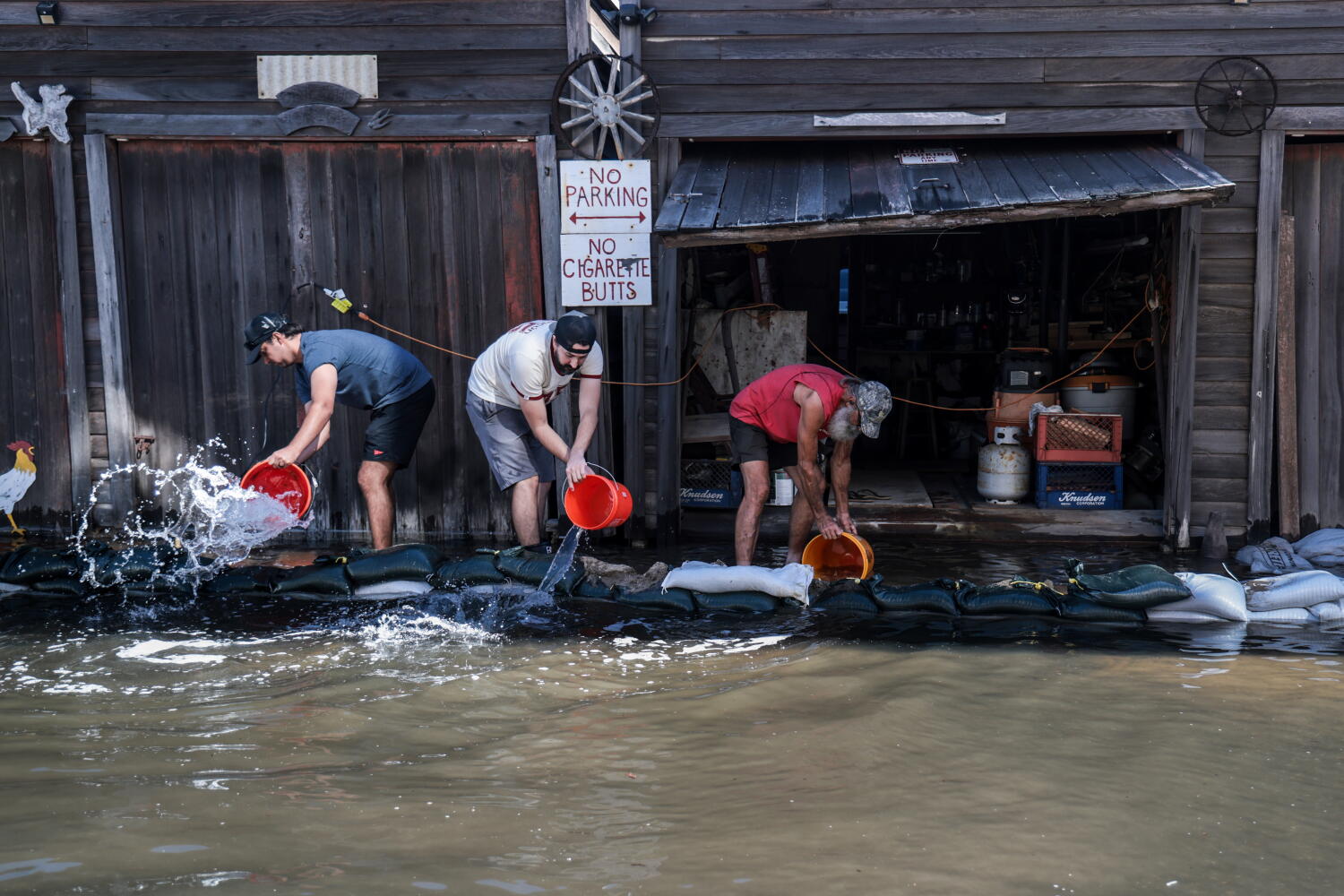
Saltwater smells different when it is pooling around the legs of a mahogany barstool.
Out on the sand, the Pacific carries that sharp, clean bite of kelp, cold brine, and open air. Inside a crowded coastal tavern at dusk, mixed with spilled IPA, floor wax, and the greasy heat of a flat-top grill, it smells like a warning.
I stood in two inches of it once in Seal Beach, watching a bartender named Marcus—a composite character drawn from dozens of real hospitality workers along the Southern California coast—try to sweep the ocean back out toward the Pacific Coast Highway with a standard yellow push-broom. He was twenty-six, wearing Vans that were rapidly turning into sponges, and laughing with the brittle, high-pitched edge people get when their livelihood is actively dissolving beneath their ankles. Every time a swell broke past the temporary sandbag wall outside, a dark sheet of water slid under the cedar threshold, carrying a line of foam and crushed seashells straight toward the walk-in cooler.
"This is the worst it's been," a regular at the corner table muttered, lifting his boots onto the brass footrail without taking his eyes off the Lakers game on the overhead screen.
That exact phrase has become the unofficial winter anthem from Imperial Beach to Santa Barbara. Every December, January, and February, the local news vans roll up to the boardwalks. Anchors in bright windbreakers stand ankle-deep in frothy surf, pointing at flooded patios and floating trash cans while explaining that "king tides" have returned to Southern California. Viewers in inland valleys watch for thirty seconds, marvel at the surfers riding waves directly into beachfront parking lots, and change the channel.
They miss the real story. They miss the quiet panic happening behind the swinging kitchen doors, the ledger books bleeding red ink in the back offices, and the slow, mathematical certainty that the California Dream was built on a foundation of sand that is currently being subtracted one winter swell at a time.
The Gravity Trap
To understand why a Tuesday evening can turn a thriving taco stand into an indoor tide pool, you have to look up before you look out at the water.
King tides are not storms. There is no howling wind, no dramatic lightning, no hurricane churning offshore to blame. They are, in the strictest scientific sense, completely predictable astronomical events—known formally as perigean spring tides. Think of the Earth, the moon, and the sun as three dancers linked by invisible elastic bands of gravity. Twice a month, during a new or full moon, those three bodies line up in a straight row, combining their gravitational pull to tug the oceans a little higher than usual.
Now, add one more variable. The moon does not orbit the Earth in a perfect circle; it travels in an oval. Once a month, it reaches its closest point to our planet, a position astronomers call perigee. When a full or new moon aligns with perigee—and happens to coincide with the Earth reaching its closest annual approach to the sun, known as perihelion, which occurs every January—all those gravitational ropes pull in the exact same direction at maximum tension.
The ocean bulges.
Along the Southern California coastline, where normal high tides usually peak around five or five-and-a-half feet, a king tide pushes the water line up past seven feet. Two extra feet of vertical water sounds negligible when you say it out loud. Measure two feet with your hands right now. It is barely the height of a coffee table.
Except that two feet of vertical rise does not stay vertical when it hits a gently sloping beach. On a flat shoreline like Newport Beach, Venice, or Cardiff-by-the-Sea, a two-foot vertical jump translates into hundreds of feet of horizontal invasion. The water marches past the dry sand, over the seawalls, through the storm drains, and right up to the thresholds of businesses that were built fifty years ago under the assumption that the Pacific knew its boundaries.
The Invisible Ledger
Consider what happens next when that water crosses the threshold.
If you run a beachfront restaurant in Laguna or a dive bar in Ocean Beach, your margins are already razor-thin. Commercial rent on the California coast is among the most punishing real estate costs in the country. You survive on volume, tight labor scheduling, and equipment that runs sixteen hours a day without failing.
Now picture a hypothetical owner—let’s call her Elena—who poured her life savings into a forty-seat seafood spot just steps from the pier. Elena knows the king tides are coming; the National Oceanic and Atmospheric Administration publishes the tide charts months in advance. So three days before the peak swell, her staff spends four hours hauling fifty-pound sandbags from the city yard, stacking them in neat, staggered rows across the patio entrance.
It costs her six hundred dollars in extra labor before a single customer orders a fish taco.
Then the tide peaks at 8:15 AM, just as her prep cooks arrive. Even without a storm, the Pacific swell pushes over the sandbags. Water seeps up through the floor drains because the municipal pipes are already choked with seawater. For four hours, nobody can use the restrooms. The health department rules on raw sewage backup and standing water in food-prep zones are absolute, and rightly so: if seawater touches the floor near the fryers or the prep tables, you close.
Elena loses the entire lunch rush. That is four thousand dollars in revenue vanished into thin air, while she still pays her staff to mop brine off the tile and haul ruined cases of dry goods out to the dumpster.
And the real damage does not show up until April. Saltwater is a patient, merciless assassin. Unlike freshwater from a burst pipe, which dries out and leaves behind a musty smell, seawater leaves behind microscopic salt crystals inside drywall, electrical conduits, and the compressor coils of ten-thousand-dollar commercial refrigerators. Those crystals pull moisture out of the coastal air every single night, quietly corroding copper wiring and steel frames from the inside out. Six months after a king tide, an ice machine suddenly dies on a Saturday night in July, or an electrical panel shorts out, and the insurance adjuster refuses the claim because standard commercial policies almost universally exclude flood damage—and federal flood insurance rarely covers the slow, creeping ruin of equipment corrosion.
We tend to think of coastal erosion and rising water as dramatic, cinematic events: cliffs crumbling in Pacifica, mansions dangling over the void in Dana Point. Those images make great headlines. They also obscure the truth. The real economic casualty of the changing Pacific is the slow suffocation of the small businesses that give these beach towns their soul.
A Preview of the Baseline
Why does it feel worse now than it did twenty years ago? Ask any surfer who has paddled out at Trestles or Malibu since the nineties, and they will tell you the beaches are narrower. The dry sand where families used to spread blankets in July is gone by November, scoured away by winter swells and never fully replaced because dams and concrete river channels inland trap the sediment that once flowed naturally down to the coast.
Beneath that missing sand lies a sobering number. Over the past century, global sea levels have risen by roughly eight to nine inches, driven by warming oceans expanding and land ice melting into the sea. Eight inches. Again, it sounds small enough to step over.
Yet in coastal physics, baseline sea level is the launchpad for every wave. When you raise the floor of the ocean by eight inches, a routine king tide suddenly reaches heights that used to require a massive El Niño storm. According to data from the California Coastal Commission and Scripps Institution of Oceanography, Southern California is projected to see another foot of sea level rise by 2050—less than twenty-five years from today.
That means the terrifying, sandbag-breaching king tides that currently force bars to close for three days every winter will soon become the ordinary, everyday high tide. Twice a day. Every single month.
The ocean is not throwing a tantrum. It is sending a postcard from the future.
The Illusion of the Wall
Walk down the strand in almost any Southern California beach community during a winter swell, and you will see humanity’s oldest, most stubborn reflex: we build walls.
We stack boulders into jagged riprap levees. We pour concrete seawalls ten feet thick. We bulldoze massive berms of wet sand across the shoreline, sculpting temporary fortresses to protect boardwalks, parking lots, and beachfront patios.
For a few years, the walls work. They give us the comforting illusion that we have drawn a line in the sand and the Pacific has agreed to respect it.
But physics does not negotiate, and water always collects its debt somewhere else. When a ten-foot wave slams into a vertical concrete seawall, the energy cannot dissipate gently across a sloping beach. Instead, it shoots straight down, scouring out the sand at the base of the wall, and blasts sideways, accelerating erosion on the unprotected properties next door. By saving the tavern on the corner, the seawall starves the beach in front of it until there is no beach left at all—just deep water slapping against grey concrete at high tide.
I have stood on seawalls in Del Mar watching waves explode twenty feet into the air, showering the street behind me with salt spray while surfers paddled in water where children used to build sandcastles. It is thrilling to watch for ten minutes. It is deeply unsettling when you realize what it costs.
Adaptation on the Edge
So what happens to the places we love? Do we simply abandon the coast, board up the beachfront bars, and retreat inland?
Some communities are realizing that fighting the ocean head-on is a losing bet, and they are quietly rewriting the rules of coastal survival. In places like Cardiff and Imperial Beach, engineers and marine biologists are experimenting with "living shorelines"—replacing sterile concrete barriers with restored coastal dunes, native grasses, and cobblestone berms that mimic natural beaches, absorbing wave energy like a giant sponge rather than deflecting it like a shield.
Other towns are facing the harder, more emotional reality of managed retreat and structural adaptation. New commercial buildings along vulnerable stretches of the coast are increasingly required to elevate their foundations on deep pilings, sacrificing the ground floor to parking or open-air breezeways so the actual business sits safely above the flood line. Some historic beachfront restaurants are retrofitting their doors with marine-grade aluminum floodgates—heavy, watertight bulkheads that slide into tracks along the doorframe in ten minutes, turning the building itself into the hull of a boat when the tide rises.
Yet technology and engineering only solve half the problem. They cannot easily rescue a seventy-year-old cinderblock dive bar operating on a month-to-month lease, nor can they replace the easy, unhurried magic of stepping straight off warm sand onto a wooden deck for a cold drink at sunset.
That magic depended on a stable coastline—a brief, extraordinarily lucky geological pause that lasted just long enough for us to build a civilization right up to the water's edge.
The Last Call
Late on the second night of the king tide, long after the news crews had packed up their tripods and driven back toward the interstate, I walked past that same tavern in Seal Beach.
The peak swell had passed. Outside, the bulldozers were already idling in the dark, waiting for dawn so they could push the scattered sand back into neat, futile walls. Inside, the neon beer signs buzzed softly against the condensation on the front windows. Marcus was still there, leaning on his broom near the door, staring down at the dark tide line staining the base of the cedar paneling.
He wasn't angry anymore. He just looked tired, the way people look when they finally accept that a relationship has changed forever and no amount of effort is going to put things back the way they used to be.
He turned off the neon signs, stepped over the damp sandbags stacked across the threshold, and pulled the heavy wooden door shut behind him—locking up for the night while the Pacific kept breathing softly against the concrete just ten feet away.