Silence in a royal court is never empty. It is heavy, deliberate, and calibrated to the millimeter. When the palace of Negeri Sembilan finally spoke up to deny rumors that its ruler had asked the state's chief minister to remain in office, the statement itself was brief, almost clinical. Yet for anyone who has ever watched Malaysian politics from the ground up, that single denial landed like a stone dropped into a very still, very deep well.
Listen. Recently making waves lately: Asymmetric Political Signaling and the Economics of Executive Austerity.
In the humid afternoons of Seremban, where the Minangkabau roofs of government buildings curve upward like buffalo horns against a bruised monsoon sky, politics is rarely conducted through megaphones. It moves through coffee shops, WhatsApp forwards, half-whispered conversations outside mosques, and the sudden, inexplicable stillness of official corridors. A rumor does not merely spread here; it curdles into assumed truth before breakfast is cold.
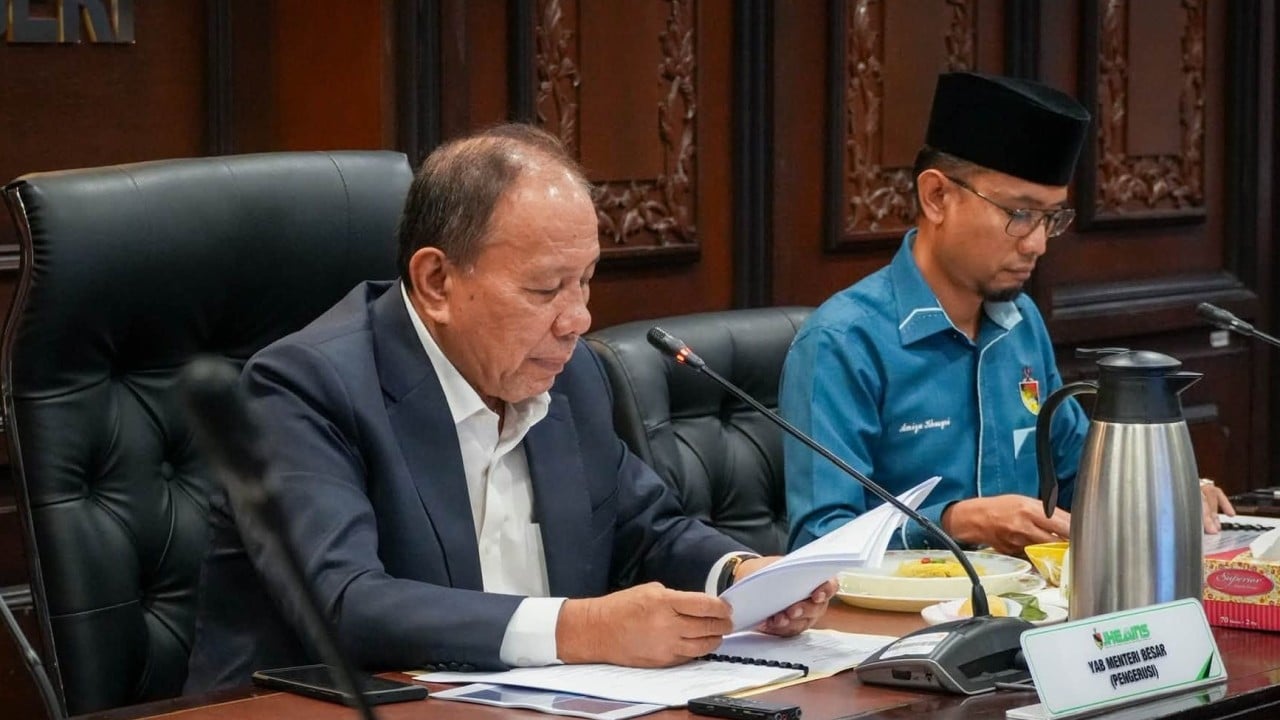
For days, the whisper mill had been churning with a specific, seductive story: that the Yang di-Pertuan Besar of Negeri Sembilan, Tuanku Muhriz ibni Almarhum Tuanku Munawir, had personally intervened to keep Menteri Besar Aminuddin Harun in his seat. To the casual observer scrolling past headlines on a commuter train, it sounded like just another piece of political trivia. To those who live under the shade of Malaysia's constitutional monarchy, however, it touched a raw, historical nerve. Further details into this topic are explored by BBC News.
The Anatomy of a Whisper
To understand why a three-paragraph palace statement matters, you first have to picture the mechanics of power in a Malaysian state.
Imagine a hypothetical civil servant—let us call him Hafiz—sitting at a Formica table in a corner kopitiam in Kuala Pilah, stirring the condensed milk at the bottom of his glass. Across from him sits his retired uncle, a man who remembers every state election since the 1970s. When a viral message lights up Hafiz's phone claiming the palace has handpicked or retained the Menteri Besar, Hafiz does not read it as a dry constitutional anomaly. He reads it as a shift in the tectonic plates beneath his livelihood.
If the ruler has spoken, the thinking goes, the political game is over. Alliances freeze. Ambitions are shelved. Dissent becomes not merely unwise, but borderline disrespectful.
That is the invisible currency of royal rumors in Malaysia. Politicians know it. Strategists exploit it. By attaching the prestige of the throne to a partisan survival story, a political camp borrows an aura of inevitability that ballot boxes alone can never confer. And because royal institutions traditionally guard their dignity through restraint, those who fabricate or amplify such whispers often bet on the palace staying quiet.
This time, the bet failed.
Istana Besar Seri Menanti did not let the narrative harden into folklore. Through an official clarification, the palace made it unmistakably clear that Tuanku Muhriz had issued no such directive, made no such request, and offered no endorsement keeping the chief minister in office. The denial was crisp, unambiguous, and pointed directly at the rumor's core.
Why Constitutional Boundaries Feel So Fragile
There is a reason Malaysians react so viscerally whenever the line between the palace and the state assembly blurs. History has taught us that constitutional conventions are not self-enforcing walls; they are agreements maintained only by constant, mutual discipline.
Under Malaysia's Westminster-inspired system, a Menteri Besar or Chief Minister holds office because he commands the confidence of the majority of elected representatives in the State Legislative Assembly. The ruler appoints him, yes, and ceremonial consent is indispensable. Yet in healthy times, the monarch stands above the rough-and-tumble of party survival, acting as a constitutional anchor rather than a political referee blowing the whistle mid-match.
Think of the relationship like a suspension bridge spanning a fast-moving river. The elected government is the roadbed—constantly vibrating under the weight of traffic, weather, and daily friction. The monarchy is the twin towers anchored into bedrock, holding the cables taut so the span does not collapse into the water. If the towers suddenly begin swaying with the traffic, or if drivers start claiming the towers are steering their cars, the entire structure loses the very stability it was built to provide.
I have sat in press rooms during Malaysian political crises when that bridge began to groan. You can feel it in the air before a single official statement drops. Reporters stop joking. Phone batteries drain by noon. Every constitutional lawyer in Kuala Lumpur suddenly gets booked on evening talk shows to parse single words like may, shall, and discretion. You realize, watching adults argue over grammar while a state government hangs in the balance, how frighteningly thin the veneer of political certainty really is.
When people are uncertain about who actually holds authority, cynicism fills the vacuum. Voters begin to ask a corrosive question: if outcomes are decided behind palace gates rather than on the floor of the assembly, why bother lining up in the heat to cast a ballot?
The Unique Gravity of Negeri Sembilan
To appreciate the full weight of this episode, you cannot treat Negeri Sembilan as just another state on the map. It has a political DNA unlike anywhere else in the federation.
Long before modern parliamentary democracy arrived on the Malay Peninsula, Negeri Sembilan operated under Adat Perpatih—a matrilineal social and governance system rooted in consensus, consultation, and bottom-up legitimacy. In this tradition, leadership is not simply imposed from a pinnacle; it rises through tiers of clan chiefs, the Undang and Luak leaders, who themselves select the Yang di-Pertuan Besar.
Authority here has always been understood as a trust bound by custom and mutual accountability.
That cultural memory lingers even in modern bureaucratic life. Residents of Negeri Sembilan carry a quiet pride in the notion that power in their state is meant to be balanced, consultative, and resistant to arbitrary whims. Tuanku Muhriz himself has long cultivated a reputation as a ruler deeply mindful of constitutional propriety, legal order, and institutional neutrality—a monarch who speaks rarely, chooses his words with surgical care, and avoids entanglement in day-to-day party maneuvering.
So when rumors circulated suggesting he had stepped down into the political arena to prop up Aminuddin Harun, the claim did not merely misrepresent a meeting or misquote an aide. It cut directly against the grain of both modern constitutional law and Negeri Sembilan's own governing ethos.
The Temptation of Borrowed Authority
Why do these stories keep emerging in Malaysian politics? Honestly, because the temptation is almost irresistible.
Consider what happens when a chief minister faces internal party pressure, coalition friction, or murmurs of a confidence challenge. Survival in coalition politics is exhausting. Every morning brings another negotiation over state executive council seats, district appointments, or grassroots allocations. In that environment, the rumor of royal backing acts like a political sedative for one's rivals. It tells challengers: Stand down. Even if you gather the numbers, the palace wants him to stay.
We have seen variations of this playbook across multiple states over the past decade. Sometimes the rumor is planted deliberately by operatives testing the waters. Sometimes it is born from a misread photograph—a routine weekly audience between a Menteri Besar and a ruler spun online as an intimate endorsement. Other times, supporters genuinely confuse ceremonial courtesy with political preference.
Let us be candid: from the outside, the choreography of Malaysian statecraft can look opaque, even intimidating. Weekly audiences before state cabinet meetings are standard constitutional practice. A chief minister briefs the ruler on administration, development projects, and state affairs. To an ordinary citizen watching a thirty-second clip on social media of two leaders smiling at a palace doorway, it is easy to project drama onto routine governance.
Yet the difference between a routine audience and a royal request to remain in office is the difference between a weather report and a command to change the climate.
By stepping forward to deny the rumor, the Negeri Sembilan palace refused to let routine courtesy be weaponized as partisan armor. It forced the political class back onto its own feet. If the chief minister is to remain in office, his mandate must come from the elected assembly, the cohesion of his coalition, and the trust of the voters—not from an imagined nod behind palace walls.
What Happens When a Rumor Dies in Daylight
Watch closely what changes in the hours after an official denial like this lands.
First, the temperature in the political room drops. The exaggerated whispers lose their oxygen. Commentators who spent the previous evening spinning grand theories about royal intervention quietly delete their boldest posts or pivot to safer topics.
Second, accountability snaps back to where it belongs. Without the shield of alleged palace preference, every political actor in Negeri Sembilan—government and opposition alike—has to deal in hard realities again. Numbers in the state assembly. Policy delivery on the ground. Flood mitigation in rural districts, water supply reliability, industrial investment in Nilai and Sendayan, the cost of groceries in Seremban's central market.
Third, and perhaps most quietly, public trust in the institution of the monarchy gets reinforced.
There is a paradox at the heart of constitutional monarchy that outsiders often miss: a ruler preserves moral authority precisely by declining to exercise political power where it does not belong. Every time a palace resists the urge to pick winners, or corrects the record when someone tries to drag the throne into a partisan trench, the institution grows stronger. It signals to citizens of every background that the crown belongs to the entire state, not to the faction currently holding the microphones.
Of course, skepticism never disappears overnight. In a media ecosystem saturated with anonymous blogs, Telegram channels, and algorithm-driven outrage, a formal palace denial travels at the speed of official press releases, while a juicy conspiracy travels at the speed of thumb-swipes. Some people will always mutter that where there is smoke, there must be fire. That doubt is human, and pretending otherwise would be naive.
Yet silence would have been far worse. Had the palace ignored the chatter, the lie would have calcified into conventional wisdom within a week, distorting political calculations for months to come.
The Weight of a Closed Door
Back in that hypothetical kopitiam in Kuala Pilah, Hafiz sets his spoon down beside his empty glass as the afternoon rain finally breaks over the tin roof outside. The notification from a major news portal pops onto his screen: the palace has denied the claim.
His uncle reads the headline over his spectacles, gives a short nod, and goes back to folding his newspaper. No speeches. No grand declarations about constitutional jurisprudence. Just a quiet recalibration of reality. The rules of the game are still intact. The boundary still holds.
Across Malaysia, democracy often feels like an unfinished argument conducted in a crowded room—noisy, improvised, occasionally exhausting, and perpetually vulnerable to those who would rather borrow authority than earn it. Against that noise, the clarity of a single institutional boundary matters more than we usually admit.
The palace doors in Seri Menanti remain closed to partisan bargaining, the rain washes the dust off the Minangkabau eaves, and the burden of governing returns squarely to the shoulders of those who asked for the people's votes.