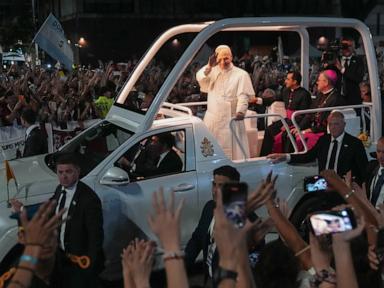
Pope Leo XIV concludes his historic apostolic journey to Argentina by visiting a correctional facility and a major Marian shrine before departing for his adoptive homeland of Peru. While wire reports treat these final stops as routine ceremonial bookends to a high-profile diplomatic tour, Vatican observers recognize them as deliberate ideological markers. Pairing an overcrowded detention center with a site of popular Catholic devotion signals a calculated alignment with the marginalized, deliberately bypassing Argentina's entrenched political and economic elite on the final day of a long-awaited papal visit.
To understand the weight of this closing schedule, one must look at the mechanics of modern Vatican diplomacy. Papal itineraries are never assembled by accident or simple logistical convenience. Every square kilometer of a pontiff's motorcade route is negotiated months in advance between the Vatican Secretariat of State, the local apostolic nunciature, and the host government. When a pope chooses to spend his final, highest-visibility hours behind prison walls and among working-class pilgrims rather than in a presidential palace or a metropolitan cathedral, the message to both the local hierarchy and the global church is unmistakable.
The Theology of the Peripheries in Practice
For over a decade, Catholic social teaching in Latin America has been defined by a push toward the geographic and existential margins of society. This approach, deeply rooted in the pastoral model developed in the slums of Buenos Aires and the mission dioceses of northern Peru, rejects the traditional alliance between the altar and the throne. By placing a prison visit at the climax of the Argentine tour, the papacy reinforces a specific pastoral priority that views incarcerated individuals not merely as subjects of charity, but as the primary recipients of the church's institutional attention.
Prisons across Argentina face severe structural crises. Overcrowding, prolonged pretrial detention, and deteriorating infrastructure have turned many facilities into flashpoints for human rights organizations and judicial reformers. When a pontiff steps inside these walls, the cameras of the international press corps follow. Suddenly, conditions that local activists struggle to put on the front page of Buenos Aires dailies become global news.
Yet this strategy carries inherent friction. Conservative critics within the Argentine church and secular political commentators frequently argue that high-profile prison visits risk romanticizing criminal behavior while neglecting the victims of violent crime. In a country grappling with persistent economic volatility and public anxiety over urban security, a papal embrace of inmates is a politically charged act. It forces the local episcopate to defend a posture of radical mercy in a social climate increasingly demanding punitive law and order.
The Mechanics of a Papal Prison Visit
Unlike a stadium Mass or a diplomatic reception, a papal stop at a correctional facility operates under strict security and liturgical protocols designed to strip away institutional hierarchy.
- Controlled intimacy characterizes the guest list, which typically excludes high-ranking political officials in favor of inmates, prison chaplains, and correctional staff.
- Liturgical simplicity replaces grand ceremonial vestments with standard pastoral attire, often incorporating gestures like the washing of feet or individual blessings that emphasize personal dignity over institutional authority.
- Media restrictions are usually enforced during private conversations, allowing detainees to speak candidly with the pontiff without fear of immediate retaliation from prison authorities or exposure in the national press.
This curated environment creates a stark visual contrast to the earlier days of an apostolic tour. Where the opening stages of a visit require formal addresses to heads of state, ambassadors, and business leaders, the closing prison stop strips away the trappings of statecraft. The optics are engineered to linger in the public memory long after the papal plane has lifted off.
The Shrine as a Counterweight to Clericalism
If the prison visit addresses the structural failures of the state, the subsequent stop at a Marian shrine speaks directly to the internal dynamics of the Catholic Church. In Latin American Catholicism, popular piety—expressed through massive pilgrimages to shrines dedicated to the Virgin Mary—often operates independently of formal parish structures and clerical oversight.
Shrines like Our Lady of Luján have historically served as the spiritual anchor for Argentina's working class. Millions walk miles each year to stand before the image, bypassing theological debates and institutional bureaucracy in favor of direct, emotional devotion. By concluding the trip at a shrine, the pope validates this grassroots expression of faith. It is a subtle rebuke to clericalism, reminding bishops and priests that the vitality of the church resides in the pews and on the pilgrimage roads rather than in chancery offices.
Historically, Argentine leaders across the political spectrum have attempted to co-opt Marian symbolism to bolster their own legitimacy. From mid-twentieth-century populist movements to modern political campaigns, the imagery of national shrines has been deployed to claim moral authority. A papal visit reclaims that sacred space. It temporarily suspends partisan ownership of the shrine, re-establishing it as a neutral ground where the church speaks directly to the populace without political intermediaries.
Navigating the Political Minefield of Buenos Aires
No papal trip to Argentina happens in a political vacuum. The relationship between the Vatican and the Casa Rosada has historically oscillated between cautious cooperation and overt ideological tension. Argentine presidents have frequently sought photo opportunities with the pontiff to shore up domestic approval ratings during periods of economic austerity or social unrest.
The Vatican Secretariat of State is acutely aware of this dynamic. Scheduling a prison and a shrine on the final day serves as an effective firewall against political manipulation. Neither venue offers an easy backdrop for a politician seeking to project strength, economic competence, or partisan triumph. Instead, both locations center the narrative on social vulnerability, repentance, and spiritual endurance.
| Itinerary Element | Primary Audience | Implicit Diplomatic Message | Political Risk |
|---|---|---|---|
| Presidential Palace | Heads of state and diplomatic corps | Institutional respect and bilateral cooperation | Perceived endorsement of current economic policies |
| Metropolitan Cathedral | Local clergy, bishops, and civic elites | Continuity of church governance and tradition | Criticism of excessive clericalism and insularity |
| Correctional Facility | Inmates, chaplains, and marginalized families | Solidarity with the outcast and critique of punitive systems | Backlash from crime victims and security-focused voters |
| Marian Shrine | Working-class pilgrims and lay movements | Validation of popular piety over institutional bureaucracy | Potential co-optation by populist political factions |
This matrix illustrates how Vatican planners balance competing demands. You give the state its formal due at the beginning of the trip, satisfy the local hierarchy in the middle, and reserve the emotional and moral climax for the periphery at the end.
The Peruvian Connection and the Return Home
The final leg of the journey—departing Argentina to head home to Peru—adds a distinct biographical layer to the itinerary. While Argentina represents the broader regional context of Southern Cone Catholicism, Peru holds the formative missionary identity of a pontiff who spent decades serving in dioceses like Chiclayo, Trujillo, and Callao before being called to Rome.
For a pope whose pastoral instincts were forged in the Andean foothills and coastal parishes of Peru, returning there after engaging the complex urban and political realities of Argentina is deeply symbolic. The transition from Buenos Aires to Lima underscores a broader shift in the center of gravity within global Catholicism. The church is no longer directed solely from European centers of power, nor is it defined exclusively by the intellectual currents of Argentina's capital. Instead, it is increasingly shaped by the lived realities of missionary territories in the Global South.
In Peru, the challenges mirror those in Argentina yet carry their own distinct regional character. Issues of rural poverty, indigenous rights, environmental degradation in the Amazon basin, and chronic political instability define the daily reality of the Peruvian church. Heading back to Peru after walking through an Argentine prison and praying at an Argentine shrine creates a continuous narrative thread. It links the struggles of the urban marginalized in the south with the rural and coastal communities of the Andean region.
What Wire Reports Miss About Final Days
Standard news coverage of papal travel tends to suffer from fatigue by the final day of a tour. Reporters filing on tight deadlines often treat the closing events as color pieces—human-interest vignettes meant to wrap up a week of heavy political speeches and massive public Masses. This approach fundamentally misunderstands how the Vatican communicates.
In papal diplomacy, the final image is the thesis statement. Speeches to diplomats are forgotten within weeks, buried in archival transcripts. Photographs of a pope embracing a prisoner or standing silently before a venerated shrine circulate for years on prayer cards, parish bulletins, and social media feeds. These visuals become the primary pedagogical tools through which ordinary Catholics interpret the priorities of a pontificate.
Furthermore, the logistical strain of placing these events at the end of a grueling schedule is itself a form of communication. By the final day of an international tour, an aging pontiff is visibly exhausted. Choosing to expend the last reserves of physical energy on inmates and pilgrims rather than resting before an international flight reinforces the authenticity of the gesture. It signals that these encounters are not merely obligations to be checked off a list, but the core purpose of the journey itself.
The Limits of Symbolic Diplomacy
Even the most carefully calibrated papal itinerary faces hard realities once the motorcade departs. A two-hour visit to a correctional facility does not build new cell blocks, hire additional public defenders, or reform a sluggish judicial system. Similarly, a prayer service at a Marian shrine does not lower inflation, create jobs, or heal deep-seated social polarization.
Skeptics within Argentina's legal and sociological circles point out that the emotional catharsis of a papal visit can sometimes mask a lack of structural follow-through. Local dioceses are left behind to manage expectations raised by the pontiff's presence. Prison chaplains must continue working with severely limited resources, and parish priests must navigate the same economic pressures affecting their congregations.
The Vatican operates on a timeline measured in decades rather than news cycles. From Rome's perspective, the role of the papacy is not to legislate policy or administer state budgets, but to shift the moral imagination of a society. By forcing the public gaze onto a prison and a shrine, the pope alters the terms of the national conversation, even if only temporarily. Whether the local church and civil society possess the institutional will to translate that symbolic moment into tangible reform remains an open question.
As the papal aircraft leaves Argentine airspace for Peru, the contrast between the opening pomp and the closing humility defines the legacy of the tour. The politicians return to their legislative battles, the bishops return to their diocesan administration, and the pilgrims return to their daily routines, leaving behind a clear record of where the church chose to stand when the world was watching.


