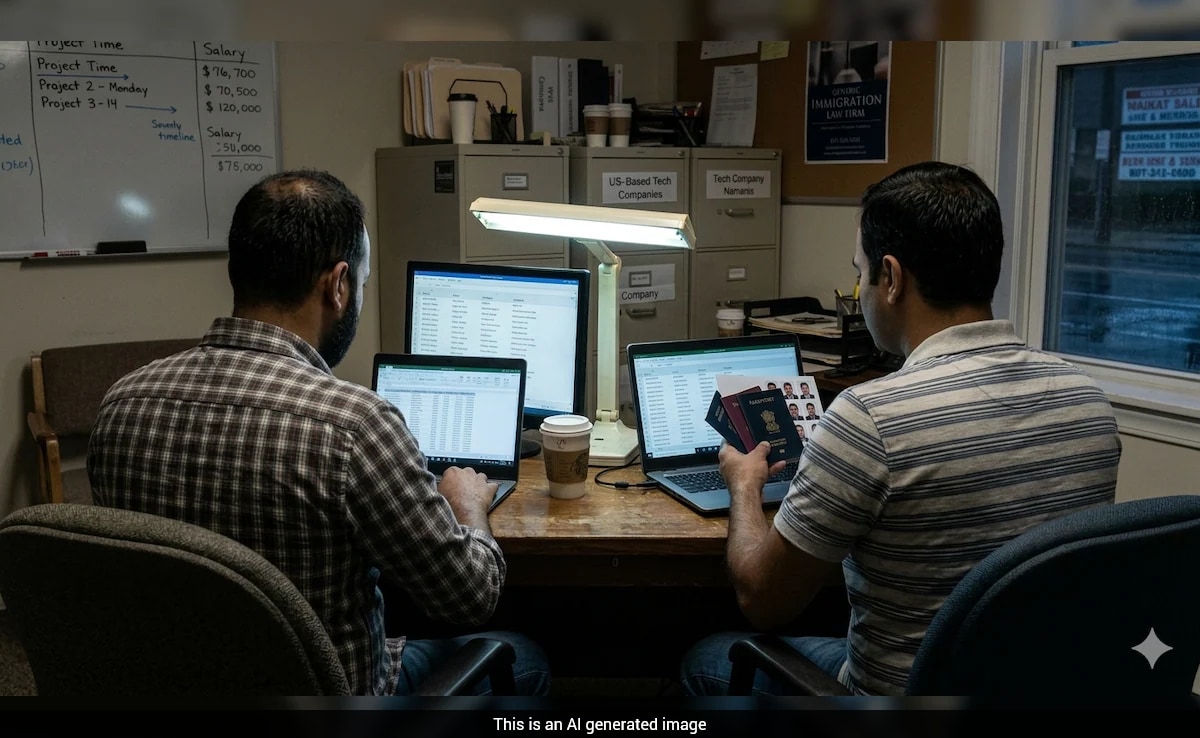
The fluorescent lights of an immigration office don’t flicker like they do in the movies. They hum. It is a steady, clinical vibration that settles into your bones while you wait for a stranger to decide if your life has a zip code or an expiration date. For thousands of hopeful engineers, that hum is the soundtrack to the American Dream. But for two men in California, it was the background noise to a multimillion-dollar shell game.
Kishore Dattapuram and Kumar Aswapathi didn’t just run a staffing firm. They ran a factory that manufactured illusions.
The federal government recently pulled back the curtain on a scheme that sounds like a corporate thriller but feels like a betrayal to anyone who has ever played by the rules. These two men, leading a firm called Nanosemantics, were just sentenced for their roles in a massive H-1B visa fraud conspiracy. They weren’t just filing paperwork. They were editing reality.
The Architecture of a Lie
To understand the weight of this crime, you have to understand the H-1B. It is the golden ticket. It is a non-immigrant visa that allows U.S. companies to employ foreign workers in specialty occupations. It is designed for the brilliant, the specialized, and the essential. Because the demand is so high, the government uses a lottery. It is a game of chance where the stakes are entire careers, families, and futures.
Dattapuram and Aswapathi found a way to rig the deck.
The scam was deceptively simple. Nanosemantics would submit H-1B petitions for workers, claiming they had specific jobs waiting for them at end-client companies. On paper, it looked perfect. The worker had a destination. The company had a need. The Department of Labor had a justification.
But the jobs didn’t exist. They were ghosts.
Imagine a young developer in Hyderabad or Bangalore. Let’s call him Arjun. He is a hypothetical composite of the dozens of workers caught in this web. Arjun has spent years mastering Java and Python. He has a degree that his parents sacrificed their savings to fund. When Nanosemantics offers him a path to Silicon Valley, he doesn't see a conspiracy. He sees a door opening.
He arrives in the U.S. expecting a desk, a mentor, and a project. Instead, he finds himself in a "bench" system. He is told to wait. He is told that the "end-client" is still finalizing the contract. In reality, Nanosemantics was using these workers as a standing army of talent, ready to be farmed out the moment a real job appeared. They were skipping the line, securing visas for people they had no immediate work for, just so they could have a monopoly on the labor pool when the market got hot.
The Paper Trail of Deception
The trial revealed that the deception wasn't a one-time lapse in judgment. It was a calculated, sustained operation. The defendants submitted "Labor Condition Applications" stating they would pay prevailing wages for work that wasn't happening. They created fake offer letters. They coached workers on what to say if an immigration officer ever knocked on the door.
This is where the human cost becomes visceral.
The H-1B program is built on a foundation of trust. When a company says they need a specialized worker, the government assumes there is a gap in the local workforce that needs filling. By flooding the system with "ghost" applications, Nanosemantics didn't just break the law. They poisoned the well.
Every fake application they submitted took a spot away from a legitimate company and a legitimate worker. Somewhere, a startup was waiting for a data scientist they couldn't get. Somewhere, another "Arjun"—one who actually had a job waiting—was rejected because the lottery cap had been reached by ghosts.
The numbers are staggering. Dattapuram was sentenced to over a year in prison; Aswapathi received a similar fate. They were ordered to pay hundreds of thousands in restitution. But the money is almost secondary to the systemic damage.
The Weight of the "Bench"
In the world of tech staffing, being "on the bench" is a known purgatory. You are employed but not working. You are legal but not productive. For a legitimate firm, the bench is a financial drain. For Nanosemantics, the bench was the product.
They were essentially "warehousing" human beings.
Think about the psychological toll on a worker living in a foreign land under these conditions. Your legal status is tied to a company that lied to get you there. You are living in a temporary apartment, checking your email every ten minutes, wondering if the next knock on the door is a job offer or a deportation notice. You are a pawn in a game you didn't know was being played.
The defendants argued, as many in these cases do, that they were simply navigating a complex system to help workers find roles. They tried to frame it as a service. But the court saw it differently. Judge Edward Davila noted the "sophistication" of the scheme. This wasn't a clerical error. It was an end-run around the sovereignty of a nation’s borders and the integrity of its labor market.
The Ripple Effect
When news like this breaks, it creates a ripple effect that touches every corner of the tech industry. It fuels skepticism. It gives ammunition to those who want to shut down high-skilled immigration entirely. It makes life harder for the honest HR manager at a mid-sized firm in Ohio who just wants to hire the best engineer in the world.
The real tragedy is that the H-1B program is a vital artery for American innovation. It has brought us the founders of some of our most iconic companies. It has fueled the R&D departments that gave us the smartphones in our pockets and the vaccines in our arms.
When we allow fraudsters to turn that artery into a back alley for human trafficking-lite, we lose more than just a few lottery spots. We lose the moral high ground of being a meritocracy.
The investigation was a massive undertaking, involving Homeland Security Investigations and U.S. Citizenship and Immigration Services. It required untangling years of emails, bank records, and testimony. It was a message sent to every "body shop" operating in the shadows of the Bay Area: the ghost jobs are being haunted by the law.
The Silence After the Gavel
Dattapuram and Aswapathi will go to prison. Nanosemantics will likely fade into a cautionary footnote. But the "Arjuns" remain.
The workers who were brought over under false pretenses often face the harshest fallout. Their visas, obtained through fraud, can be revoked. They can be barred from entering the country again. They are the collateral damage of a greed that disguised itself as opportunity.
They came looking for the hum of progress, for the chance to build something that mattered. Instead, they were trapped in a paper labyrinth built by two men who saw humans as line items and visas as currency.
As the sun sets over the Santa Clara Valley, the offices of Nanosemantics sit quiet. The ghosts are gone. But the lesson lingers in the air, thick as the morning fog. The American Dream is a robust, beautiful thing, but it is fragile. It relies on the idea that the rules apply to everyone, and that a job is more than a signature on a fraudulent form.
In the end, you can’t build a future on a foundation of ghosts. You can only build a cage.
The lights stay on in the immigration offices. The hum continues. Somewhere, a young engineer is packing a suitcase, heart full of hope, praying that the hand reaching out to help him is attached to a person with a conscience, not just a plan.