Midnight on Playa Pejeperro smells of salt, wet sand, and the ancient, heavy breath of the Pacific. The dark line of the jungle meets an even darker expanse of water, broken only by the rhythmic crash of white foam. For human researchers standing ankle-deep in the tide, this Costa Rican beach is a laboratory under siege by humidity and sandflies. For an olive ridley sea turtle hauling her armored bulk ashore, it is an ancestral obligation.
She rises from the surf, a shadow moving against the slope. Every inch of forward progress is a war against gravity. Her flippers carve heavy, sweeping arcs into the granular earth, lifting a shell burdened not just by the weight of eggs, but by an impossible secret.
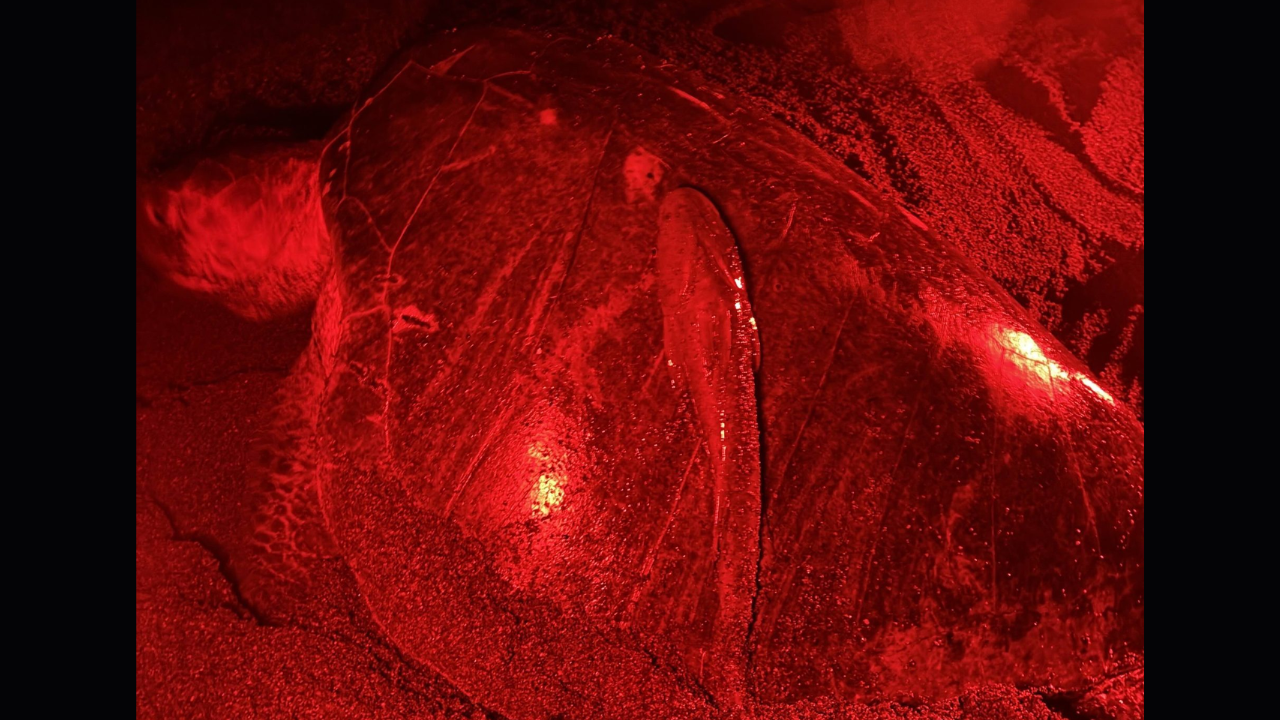
Clinging to her second and third left costal scutes is a passenger.
It is a common remora, a suckerfish measuring a foot or more, locked onto the turtle's carapace with the terrifying efficiency of biological engineering. In the ocean, this is an old story of convenience. The fish rides the host to conserve calories, snapping up scraps and clearing away parasites while the turtle slices through the blue. But the ocean has stopped. The safety of water is gone. The physics of life have entirely inverted. Yet the fish does not let go.
Consider what happens next: the turtle heaves herself further up the dry beach, past the high-tide line, entering an alien world of oxygen and burning air.
Most fish suffocate in minutes. Without the dense medium of water to prop open the delicate lamellae of their gills, the respiratory organs collapse under their own weight, sticking together like wet tissue paper. Suffocation is swift, brutal, and absolute.
Yet this remora remains.
Researchers Megan Bullock, Vicente Peña Eisele, and Emily Yeager, monitoring the nesting ground, stare in quiet disbelief. This is not a fleeting glitch in animal behavior. Hundreds of thousands of sea turtles crawl onto tropical shores every single year, yet field biologists almost never document a remora making the terrestrial trip. It is a phantom phenomenon. Something seasoned conservationists have never even heard whispered over midnight coffee.
Minutes tick by on a stopwatch. Five. Ten. Fifteen.
The turtle begins her nesting ritual, digging a meticulous flask-shaped chamber in the sand with her rear flippers, her eyes weeping excess salt to protect them from the coastal air. Throughout it all, the remora clings to the shell. It does not thrash in panic. It does not drop off into the dry sand. Its body remains remarkably still, save for the rhythmic, steady pulsing of its opercula—its gill coverings—flexing in the open air.
It is breathing. Somehow, against all biological expectation, it is extracting what little moisture and oxygen it can manage from the heavy coastal atmosphere, or perhaps surviving on a staggering metabolic tolerance for hypoxia that science is only beginning to comprehend.
Nineteen minutes pass.
To measure the turtle accurately, the research team finally intervenes. A assistant reaches out and gently pries the suction disk loose from the scutes. The moment the vacuum seal breaks, the fish is tossed back into the churning edge of the surf.
There is no sluggish recovery. There is no drifting to the surface belly-up. The moment the salt water embraces its scales again, the remora comes alive with violent, electric energy, writhing and shooting away into the dark breakers with ferocious speed. It was not dying. It was merely waiting.
The mechanics of this survival lie in a bizarre evolutionary adaptation. The remoras suction disc is not a mouth part; it is a heavily modified dorsal fin, grown broad and ribbed with fleshy slats that create a vacuum chamber of astonishing strength. In the water, a shark or a turtle can accelerate to high speeds, and the fish remains anchored without expending a single muscle twitch. On land, that same vacuum fights gravity itself, resisting the downward pull of a 90-pound shell tilted at an angle on a sandy slope.
Why did the fish stay?
To answer that is to peer into the blind, unthinking loyalty of symbiosis. The remora does not possess a map of the world. It does not know where the ocean ends and the land begins. It knows only one fundamental truth of its universe: Do not detach from the host. The host is food, shelter, momentum, and safety. Break the seal, and you enter a hostile void alone. For this tiny traveler, the risk of holding on through an impossible, suffocating dry-land excursion was somehow less terrifying than the risk of letting go.
Nature is rarely a neat diagram of clean categories. It is messy, overlapping, and stubbornly bound to habits forged over millions of years. Sometimes, those habits survive places they were never meant to go.
The turtle finishes her work, covers her hidden cache of white, leathery eggs with damp sand, and turns her heavy frame back toward the sound of the crashing waves. She slips into the black water and disappears into the depths, carrying the ancient rhythm of her kind back into the sea, leaving behind only the footprints of witnesses who saw a fish refuse to give up its ride.