Cold. That is the first thing you notice when the wind comes off Lake Michigan and hits South Adams Street in Chicago. It slices straight through a wool coat and reminds you that this city has shoulders, teeth, and a memory that refuses to sit quietly.
Step inside the corner diner near the start of Route 66, though, and the air smells of burnt coffee, bacon grease, and wet wool steaming off boots. Outside, the news cycle screams about Donald Trump, red states versus blue states, tariffs, courts, culture wars, and an America splitting along jagged, irreconcilable lines. Inside, two people sit three stools apart, both staring into mugs of dark roast as the radiators hiss against the chill.
I have spent years traveling back roads and listening to people talk about politics when the cameras are off. Often, those conversations are exhausting. People reach for talking points like armor. They speak in slogans designed to win an argument rather than understand a neighbor. Yet every so often, right where a famous highway begins its long, improbable crawl toward California, you hear something that makes you stop mid-sentence and rethink everything you assumed about how a fractured country actually holds together.
At the Chicago starting line of Route 66, a quiet proposition hangs in the morning steam: not every question has to become a blood feud. Not every issue has to tear a table in two.
The Myth of Total Fracture
Walk down almost any main street in America today and you can feel the hum of permanent outrage. Cable news frames every election, every executive order, every courtroom clash as an existential war between two incompatible nations. If you live on the coasts, you are told the heartland is unrecognizable. If you live in a small town where the factory closed twenty years ago, you are told big cities despise everything you value.
I used to buy into that picture more than I care to admit. Traveling across the country with a notebook and a tank of gas, I caught myself looking for fault lines everywhere. Every bumper sticker felt like a declaration of war. Every silence at a gas station pump felt charged with unspoken hostility.
Then I sat at a counter in Chicago and watched a regular argument never quite catch fire.
Consider this hypothetical scene, drawn directly from the kinds of real conversations that happen along the Midwest stretch of Route 66. Let us call the man on the left Arthur, a retired union machinist from Joliet who voted for Donald Trump and keeps a folded copy of a local newspaper beside his plate. Let us call the woman two stools down Maya, a high school history teacher from Chicago’s South Side who votes Democrat, worries fiercely about democratic norms, and orders oatmeal every morning regardless of the weather. (To be clear, Arthur and Maya are composite characters invented here to capture real voices and tensions I have encountered along the route, though the political realities they navigate are grounded in documented American divides.)
If the television above the bar is showing a heated debate over Trump’s policies or federal power, Arthur might mutter about government overreach or border enforcement or the cost of groceries. Maya might push back on executive authority, rhetoric, or protections for marginalized students. For a minute, the air tightens. You brace for the familiar script: interruption, eye-rolling, retreat into digital echo chambers.
Instead, something stranger happens. Arthur complains about the price of a replacement part for his truck. Maya nods because her brother’s delivery van just broke down on I-55. Neither of them suddenly agrees on Donald Trump or the future of the presidency. Their fundamental disagreements do not evaporate in a puff of sentimental fog.
What changes is the temperature in the room.
Politics treats human beings like voting blocs wearing team jerseys. Real life puts us in the same line at the post office.
Why Every Topic Becomes a Battleground
Why does modern American politics turn almost everything—from energy policy and inflation to school curricula and national identity—into a zero-sum brawl?
Part of the answer is incentive. Outrage sells. Algorithms reward anger. Politicians on every side know that fear and grievance mobilize turnout far faster than nuance. When a figure as polarizing as Donald Trump dominates the center of gravity in American life, every policy debate gets pulled into his orbit. A disagreement over trade tariffs stops being a technical argument about supply chains and manufacturing; it becomes a loyalty test. A debate over immigration stops being a conversation about labor markets, humanitarian obligations, and local municipal budgets; it becomes a referendum on who belongs.
Think of it like a crowded house where someone turns up the stereo to maximum volume in every single room. You cannot hear your spouse asking where the keys are. You cannot hear the kettle whistling on the stove. Every minor annoyance feels like an assault because the baseline noise is already deafening.
During my own trips along the old highway corridor, I have seen how that constant volume distorts ordinary reality. A couple running a small motel in Illinois might disagree sharply about Trump’s style of leadership, yet share the exact same anxiety over property taxes, insurance premiums, and whether young people will stay in town or leave for bigger cities. When media coverage zooms in exclusively on the loudest clash, it erases the wide middle ground where people are simply trying to keep their roofs from leaking.
That does not mean the divisions are fake. They are very real. Voters hold deeply conflicting views on the economy, the role of the federal government, courts, and social change. Pretending those differences do not exist is dishonest and patronizing.
Yet assuming that every single issue requires total ideological warfare is just as dishonest. It hands over everyday common sense to people whose livelihoods depend on keeping us angry.
The Road That Never Truly Ends
Route 66 is famous for romance—neon signs, vintage diners, desert horizons, and the promise of reinvention. Historically, it was commissioned in 1926 to link Chicago to Los Angeles, stitching together small towns and major hubs across eight states. Over time, interstate highways bypassed parts of it, leaving stretches weathered and quiet, yet stubbornly alive in the American imagination.
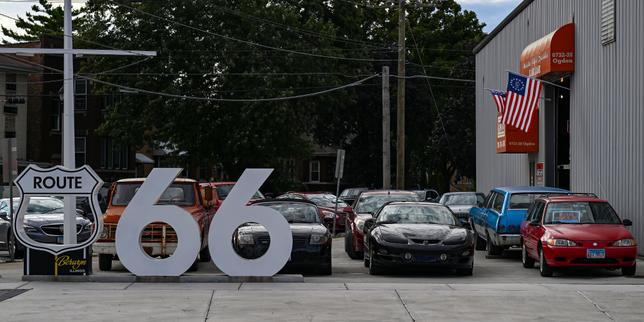
In Chicago, the trail begins at a modest brown sign on Adams Street. No fanfare. No velvet rope. Just pavement stretching west toward the prairie.
That quietness matters. A highway is a metaphor—and yes, let us name it plainly as a metaphor here—for how a country moves forward without driving off a cliff. If you treat every mile of road as a battlefield, you never get anywhere; you just spin your tires and chew up the asphalt.
When people in Chicago talk about the United States under or around Donald Trump’s influence, they are not living in a bubble untouched by national events. Chicago is a major American city with deep ties to global trade, immigrant communities, federal funding debates, and fierce political competition. Residents here feel the shockwaves of Washington just as acutely as anyone else.
Still, there is a difference between arguing fiercely about who should lead the country and believing that your neighbor across the street is an enemy of the republic.
I have made that mistake myself—reading a harsh political opinion online and projecting malice onto the person who wrote it. It is remarkably easy to caricature strangers when you only meet them through a screen. It is much harder when you are standing next to them waiting for a train in the sleet and someone offers you half their umbrella because yours just flipped inside out.
Shared Stakes Beneath Loud Headlines
If we strip away the cable-news theatrics, what are the things that actually touch daily life along a route starting in Chicago and heading southwest?
Start with work and wages. Whether someone supports Donald Trump’s economic approach or criticizes it sharply, almost everyone cares whether a paycheck covers rent, groceries, health care, and a bit of breathing room at the end of the month. A factory worker in the Midwest and a service worker in the city may argue over tariffs, interest rates, or union rules, yet both know what it feels like to watch prices climb faster than take-home pay.
Look next at infrastructure and local survival. Roads, bridges, water pipes, schools, and clinics do not care about partisan memes. When a bridge needs repair or a rural hospital struggles to stay open, concrete and steel do not ask how you voted. Fixing tangible problems often requires boring, practical cooperation across lines that look unbridgeable on television.
Consider also the exhaustion people feel. Talk honestly with folks across the political spectrum and you will hear a surprising refrain: I am tired of fighting about everything. Many Americans feel pushed into corners, forced to take a stand on every breaking news alert before they have even finished their morning coffee.
Not every subject has to divide us. Let that sink in for a second.
Some questions genuinely involve competing values where compromise is hard. People disagree deeply on abortion, gun policy, immigration enforcement, and the limits of executive power. You do not solve those tensions with a platitude.
Other questions, however, are practical puzzles hijacked by tribalism. How do we keep small businesses afloat? How do we help young people afford a home? How do we keep public spaces safe and clean? How do we talk to one another without assuming the worst possible motive?
On those questions, treating every disagreement as treason is not strength. It is laziness.
Listening Without Surrendering Your Convictions
People often worry that stepping back from constant outrage means giving up their principles. If I listen to someone who backs Donald Trump—or someone who fiercely opposes him—am I betraying what I believe?
No. Listening is not surrender. Understanding why another person sees the world the way they do does not force you to adopt their conclusions.
Think of it like learning how another driver handles rain on a steep hill. You do not have to drive their car or take their exact route to see that they are gripping the wheel tightly because the road is slick. Recognizing someone else’s fear or priority simply gives you a clearer map of the terrain.
In my own reporting and conversations across different parts of the country, the most surprising moments rarely come from sudden conversions. Nobody changes their entire worldview over a plate of hash browns. Instead, the shift happens when someone says, "I don't agree with you on that, and here's why," without treating the other person like garbage.
Back in our hypothetical Chicago diner, Maya finishes her oatmeal and folds her napkin. Arthur takes the last sip of his coffee. Outside, a bus rumbles past, sending a faint vibration through the floorboards.
They still see Donald Trump differently. They still read different news sources. They will almost certainly cast different ballots when the next election rolls around.
Yet when Maya drops a few extra dollars on the counter for the waitress and Arthur nods in approval because the server has been working double shifts to pay for nursing classes, a small, stubborn truth remains intact. The country is loud. The country is divided. The country is complicated.
And it is still shared.
What Survives the Noise
History has a way of humbling people who think the current crisis is the final chapter. The United States has survived depressions, civil war, industrial upheaval, cultural earthquakes, and bitter political realignments before. None of those eras were easy. Many left deep scars. Yet beneath the headlines, ordinary people kept showing up to coach Little League, run corner stores, teach classrooms, bury their dead, celebrate births, and argue about the weather.
Starting a journey on Route 66 in Chicago reminds you of scale. The sign says the road goes all the way to the Pacific, more than two thousand miles away. You do not cover that distance in a single leap, and you do not do it by screaming at the windshield every time you hit a pothole.
You take one stretch at a time. You keep your eyes on the road ahead. You remember that the other cars sharing the highway are full of people trying to get somewhere, too.
Politics will keep roaring. Screens will keep glowing. Arguments over Donald Trump and the direction of the United States will keep rolling like thunder across the plains.
Let them roar. Out on the pavement, the wind is cold, the coffee is hot, and the road ahead is still wide enough for more than one kind of story.