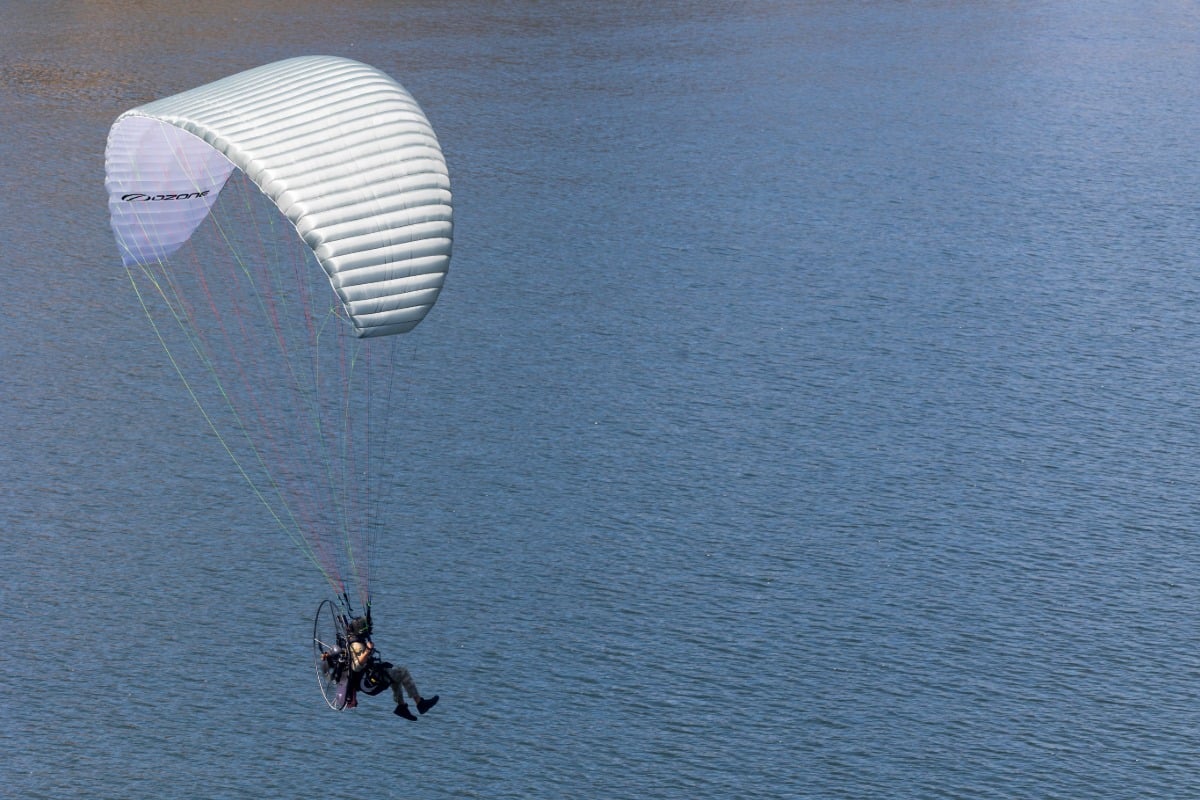
The United States Air National Guard is pursuing a procurement contract for motorized paragliders intended for low-signature, silent infiltration missions. This acquisition targets powered parachutes to insert small combat elements behind enemy lines without detection by traditional radar or acoustic surveillance arrays.
Gravity cares very little about defense procurement budgets.
Military aviation history is littered with the wreckage of cheap, unconventional ideas that looked brilliant on a whiteboard in Virginia and disastrously fragile over contested ground. The Air National Guard wants a low-cost aerial infiltration tool. What they are actually buying is a physics experiment executed five hundred feet above hostile territory.
The Quiet Machine Illusion
Motorized paragliders, frequently referred to in aviation circles as paramotors or powered paragliders, operate on a remarkably simple mechanical premise. A pilot straps into an open harness connected to a large fabric wing, while a backpack-mounted internal combustion engine and propeller provide thrust.
They are loud. Anyone who has spent a weekend near a rural drop zone knows the distinct, buzzing drone of a two-stroke engine echoing across the valley.
Proponents of the Air National Guard initiative argue that modified electric propulsion units or heavily muffled small-displacement engines can reduce acoustic signatures to acceptable thresholds. At cruising altitudes of one thousand feet, ambient wind noise often masks the sound of a small composite propeller.
Acoustic masking requires specific atmospheric conditions. Cold, dense morning air carries sound waves much further than warm, turbulent afternoon thermals. A low-level insertion during a thermal inversion turns the operator into an airborne loudspeaker. The engine noise bounces off temperature layers, broadcasting the position of the infiltrator across a wide acoustic horizon.
Why Special Operations Abandoned Similar Concepts
Unconventional warfare units have flirted with ultralight aircraft for decades. During the Vietnam War, elements experimented with various powered lift devices for reconnaissance. The results were uniformly sobering.
Paramotors lack structural armor. They lack structural rigidity. The wing is held in shape entirely by dynamic pressure—ram air filling internal cells as the craft moves forward. If a stray burst of shrapnel, a sharp tree branch, or severe rotor wash from a passing helicopter collapses even a section of that fabric canopy, the aircraft enters a catastrophic deflation sequence.
Redundancy is nearly impossible to engineer into a single-skin or double-skin ram-air wing without adding prohibitive weight. Traditional military transport aircraft feature multiple flight control cables, hydraulic backups, and redundant engine systems. A paramotor features two brake lines operated by the pilot's hands and a throttle cable.
If an operator takes small arms fire, the vulnerability index is absolute. The fabric wing acts as a massive sail riddled with holes. The fuel tank sits directly against the operator's spine.
The Meteorological Constraint
Wars do not pause for weather. Yet powered paragliders are hyper-sensitive to atmospheric turbulence.
An experienced paramotor pilot avoids flying in winds exceeding fifteen knots, or in conditions with significant thermal activity. Crosswinds during launch can drag an operator across rough terrain before the wing ever achieves flight. Rotor turbulence downwind of ridges or urban structures can induce sudden collapses.
Imagine an Air National Guard unit attempting an insertion behind enemy lines during a rapidly shifting weather front. The tactical imperative demands movement. The laws of aerodynamics forbid it.
An operator caught in unexpected down-drafts or high-altitude shear winds will find themselves blown miles off target, burning precious battery or fuel reserves just to maintain station, or descending prematurely into populated areas. The operational window for these craft narrows to a sliver: dawn and dusk, under clear skies, with minimal wind shear. Enemy commanders know this. They can easily predict when and where the sky will yield to such devices.
The Training Burden and Attrition
Military decision-makers frequently confuse low-cost hardware with low-cost training requirements. A motorized paraglider costs a fraction of a tactical helicopter or a fixed-wing mobility asset.
Mastering the craft is an entirely different matter.
Learning to fly a paramotor safely demands hundreds of hours of stick time. Foot-launching a fifty-pound motor while managing a massive fabric wing requires precise muscle memory, physical conditioning, and acute situational awareness. Muscle memory degrades rapidly without constant repetition.
The Air National Guard relies heavily on part-time personnel. Maintaining combat readiness on an ultralight platform requires a frequency of flight hours that weekend drill schedules struggle to accommodate. If an operator flies once a month, their risk profile skyrockets.
We are looking at a scenario where the training pipeline produces casualty rates from operational accidents—hard landings, powerline strikes, and canopy collapses during routine training—that might outpace combat losses.
The Payload Paradox
Weight distribution governs every aspect of military aviation. It dictates survival.
A standard paramotor setup has strict payload limitations. Once you add the fuel, the engine, the navigation gear, night vision apparatus, weapons, ammunition, body armor, and survival rations, the margin for error evaporates.
An operator is flying at the absolute limit of lift capacity. Climbing out of a confined landing zone surrounded by obstacles becomes a desperate exercise in thrust-to-weight management. If the engine bogs down for even a second due to fuel mixture issues or altitude density, the aircraft settles into the terrain.
Heavy weapon systems, communications gear for long-range reconnaissance, and medical supplies for casualty evacuation cannot ride on a platform designed to keep a single human afloat. The infiltration team arrives light, silent, and entirely naked to logistical reality. They have no heavy support weapons, no rapid exfiltration capability, and no way to carry out wounded personnel.
Where This Procurement Actually Fits
Strip away the marketing language about silent infiltration and deep-strike capabilities, and the utility of these systems comes into sharp focus.
They are tactical toys for border surveillance, rapid scouting of non-permissive open terrain, and low-threat domestic interdiction missions where air superiority is absolute and the adversary lacks ground-to-air tracking capability. Against a near-peer adversary equipped with thermal optics, acoustic sensors, and dense mobile air defense networks, a motorized paraglider is a slow-moving target practice dummy.
Defense budgets absorb peculiar whims with alarming regularity. A new administration or a newly minted congressional subcommittee discovers a niche capability, injects funding, and forces the military services to adopt tools they never asked for.
The Air National Guard will receive these units. Pilots will train on them. They will look striking in promotional videos and public relations briefings.
When the wind picks up, the engine drones, and the tactical reality of modern contested airspace reasserts itself, those fabric wings will stay packed in their duffel bags.