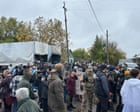
Getting civilians out of a besieged city isn't a neat logistical operation. It's messy. When news broke that the evacuation of civilians had begun in the besieged Ukrainian city of Oleshky, most international coverage treated it like a standard humanitarian corridor story. They missed the reality on the ground.
If you want to understand what's actually happening along the Dnipro River, you have to look at the geography, the active shelling, and the sheer desperation of the people stuck between two armies. Oleshky sits directly across the river from Kherson city, perched on the Russian-occupied left bank. That single geographic fact changes everything.
Unlike cities with open highway access to friendly territory, leaving Oleshky means crossing water under artillery fire or navigating heavily militarized checkpoints deep into occupied territory. You don't just pack a bag and drive away. Every step carries risk.
Why Oleshky Became a Humanitarian Flashpoint
Before Russia's full-scale invasion in February 2022, Oleshky was a quiet town of roughly 24,000 people in the Kherson region. It was known for the Oleshky Sands, Europe's largest desert-like expanse of sand dunes, and its proximity to the regional capital just across the Antonivskyi Bridge.
Everything shifted in November 2022 when Ukrainian forces liberated Kherson city on the right bank of the Dnipro. Suddenly, the river became the front line. Russian troops dug into Oleshky, turning residential neighborhoods into fortified firing positions.
For the civilians left behind, daily life turned into a survival exercise. Power grids failed. Running water disappeared for weeks at a time. When the Kakhovka hydroelectric dam collapsed in June 2023, floodwaters submerged massive sections of Oleshky, drowning neighborhoods and forcing survivors onto rooftops while shelling continued overhead.
That disaster set the stage for the ongoing evacuation crisis. Thousands of residents refused to leave their homes during the initial occupation, hoping the front line would move quickly. By the time the water rose and the artillery barrages became relentless, leaving had become nearly impossible.
The Reality of Leaving a Besieged City on the Dnipro
When officials and volunteer networks report that an evacuation has begun in Oleshky, people sitting safely in Western capitals picture big white buses with Red Cross flags rolling down paved roads. That's pure fiction.
In reality, getting out of Oleshky splits into two vastly different, equally complicated paths. Neither path looks like a textbook humanitarian corridor.
Moving East Through Occupied Territory
Because Ukrainian forces control the opposite bank of the Dnipro, there is no direct, officially sanctioned bridge or ferry route for civilians to cross straight into Ukrainian-held Kherson. The Antonivskyi Bridge is destroyed. Small boats attempting to cross the open water face immediate drone surveillance and mortar fire from both sides.
As a result, most residents evacuating Oleshky have to travel south and east first—deeper into Russian-controlled territory toward Crimea or the Zaporizhzhia region. From there, those trying to reach Ukrainian-controlled territory or the European Union must make a grueling multi-day detour. They often pass through filtration checkpoints, cross into Russia, travel north to the Baltic states or Belarus, and loop back around.
It costs money many pensioners simply don't have. It requires physical stamina that elderly or wounded residents lack.
The Role of Underground Volunteer Networks
Where official agreements fail, grassroots volunteers step in. Throughout the conflict in southern Ukraine, informal networks of drivers, local coordinators, and international aid workers have done the heavy lifting.
These volunteers use Telegram channels and encrypted messaging apps to coordinate pickups from basements and damaged apartment blocks. They track shelling patterns. They share real-time updates on which roads are mined and which checkpoints are turning people back.
Honestly, without these local drivers risking their vehicles and lives, the evacuation numbers would be close to zero. Major international organizations like the International Committee of the Red Cross and the United Nations have repeatedly stated that they lack guaranteed security access to the occupied left bank. When big institutions can't get clearance, local volunteers fill the void.
Misconceptions About Humanitarian Corridors in Ukraine
If you follow conflict news closely, you've probably noticed how often the phrase "humanitarian corridor" gets thrown around. Here's the truth—formal, mutually respected corridors have been the exception in this war, not the rule.
People assume that once an evacuation is announced, the shooting stops. It doesn't. Artillery duels across the Dnipro River continue daily. Reconnaissance drones buzz constantly over Oleshky's streets, tracking any movement that looks military. A civilian van moving too fast can easily draw fire.
Another massive misconception is that everyone wants to leave. During my years analyzing conflict displacement, one pattern shows up everywhere: deep attachment to home. Many of the people remaining in Oleshky are elderly. They've lived in the same house for fifty years. They have pets, gardens, and nowhere else to go. Leaving means becoming a displaced person reliant on meager state stipends in an unfamiliar city. For a 78-year-old with mobility issues, staying in a cold basement sometimes feels less terrifying than stepping into the unknown.
What Aid Organizations and Observers Are Saying
Data from occupied territories is always hard to verify independently, and anyone claiming exact casualty or evacuation figures from inside Oleshky is guessing. However, reports from exiled Ukrainian local officials, including Oleshky Mayor Yevhen Ryshchuk, alongside assessments from the Institute for the Study of War, paint a consistent picture.
The infrastructure in Oleshky is shattered. Medical care is almost nonexistent, as local hospitals have been looted, damaged, or repurposed for military casualties. Pharmacies are empty. Basic insulin, blood pressure medication, and antibiotics are treated like gold.
The United Nations Office for the Coordination of Humanitarian Affairs (OCHA) has consistently highlighted the left bank of the Kherson region as one of the hardest-to-reach areas in Ukraine. Unlike communities on the western side of the river, where international convoys regularly deliver generators, food kits, and building materials, Oleshky remains largely cut off from formal international relief.
How to Verify News and Support Legitimate Relief Efforts
When breaking news hits about evacuations in active war zones, misinformation spreads faster than verified facts. Fake donation links pop up within hours. Rumors about safe routes can get desperate families killed.
If you're tracking the situation in Oleshky or looking to support civilians fleeing the Kherson region, stick to verified channels and practical actions:
- Cross-check frontline reports. Compare statements from Ukrainian regional authorities with independent mapping and analysis from organizations like the Institute for the Study of War or the UN OCHA situation reports. Never trust single-source viral posts on social media claiming a route is suddenly "safe."
- Donate to vetted local responders. Large global charities do important work in stabilized areas, but smaller, vetted Ukrainian foundations and volunteer evacuation groups actually operate near the contact line. Look for transparent organizations with documented financial audits, such as Vostok SOS or Helping to Leave, which specialize in evacuating vulnerable people from occupied and frontline communities.
- Avoid sharing specific evacuation logistics. If you see relatives or local groups posting specific street names, vehicle descriptions, or pickup times for civilians leaving Oleshky, don't amplify them publicly. Open-source intelligence works both ways, and exposing pickup points puts evacuees directly in the crosshairs.
- Focus on medical and winterization aid. People making it out of besieged towns like Oleshky rarely arrive with more than a single backpack. Organizations providing immediate cash assistance, emergency medical care, and temporary housing in transit hubs like Zaporizhzhia, Kryvyi Rih, and Odesa need sustained funding long after the initial headlines fade.
Paying attention when a crisis breaks is easy, but sticking with the facts after the news cycle moves on is what actually helps the people caught in the middle.