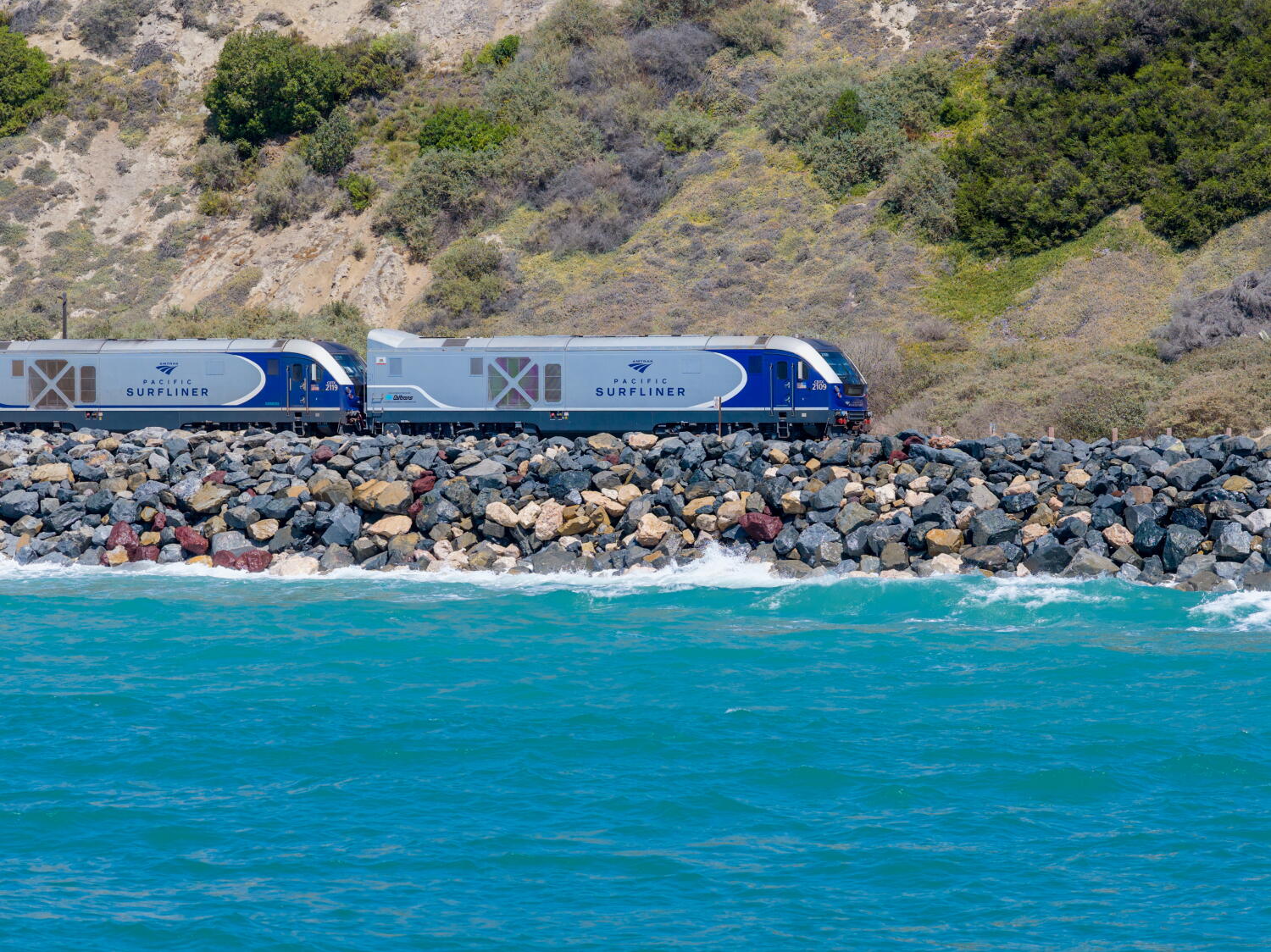
Two people died on the tracks recently after a Pacific Surfliner collision, and local officials admitted what rail workers have known for decades. It happens way more often than the public realizes.
Most folks assume train-versus-pedestrian fatalities are rare freak accidents or the result of someone ignoring blaring horns and flashing red gates. That assumption gets people killed. The reality along the 351-mile Los Angeles–San Diego–San Luis Obispo (LOSSAN) rail corridor is far more complicated, and honestly, much more preventable if people understood the physics and psychology of modern passenger rail.
When a Pacific Surfliner train strikes someone on the tracks, the news cycle usually treats it as a brief traffic disruption. Commuters groan about delays. Authorities issue a standard reminder to stay off the right-of-way. Then everyone moves on until the next tragedy hits the headlines a few weeks later.
Why Pacific Surfliner Collisions Happen So Frequently
California leads the nation in pedestrian rail fatalities, and the LOSSAN corridor is one of the busiest passenger rail routes in the United States. Stretching from San Luis Obispo through Santa Barbara, Ventura, Los Angeles, and Orange County down to San Diego, this corridor weaves directly through densely populated beach towns, urban centers, and popular surf spots.
People cross these tracks every single day to get to the beach. They walk along the gravel ballast as a shortcut to work. They take graduation photos on the rails because the vanishing-point aesthetic looks good on Instagram.
Here's the problem. Nearly every inch of that track is private property, yet miles of it run right through public spaces with minimal physical barriers. In beach communities like San Clemente, Encinitas, and Del Mar, the tracks literally sit between residential neighborhoods and the ocean. Residents treat crossing the rails like crossing a quiet neighborhood street.
It isn't a street.
According to data tracked by the Federal Railroad Administration (FRA) and Operation Lifesaver, trespassing along railroad rights-of-way is the leading cause of rail-related deaths in America. Every year, hundreds of people lose their lives walking on or near train tracks nationwide, and Southern California consistently accounts for a disproportionate share of those numbers.
The Silent Speed Illusion
If you've ever stood near a highway, you have a decent intuitive sense of how fast a car is moving. Your brain uses size cues and engine noise to judge distance and speed.
Trains break your brain's spatial wiring.
Because a Pacific Surfliner locomotive is massive—roughly 15 feet tall and 10 feet wide—an optical illusion called looming occurs. Large objects moving directly toward an observer appear to be traveling much slower than they actually are. When a Surfliner is barreling down the coast at 79 mph (or up to 90 mph on upgraded stretches of track), it looks like it's crawling. By the time a pedestrian realizes the train is closing in, it's already too late.
Then there's the noise factor. Old freight trains clatter and roar loudly enough to shake the fillings out of your teeth. Modern passenger equipment doesn't. Continuous welded rail eliminates the classic "clickety-clack" sound people expect from movies. If the wind is blowing off the Pacific Ocean, or if a pedestrian is wearing noise-canceling headphones, a multi-hundred-ton train can approach almost silently until it's right on top of them.
Stopping Distance Isn't a Suggestion
Drivers routinely miscalculate how fast a train can stop, and pedestrians make the exact same mistake. You can't swerve a train. You can't slam on the brakes and expect it to halt in a hundred feet.
A standard Pacific Surfliner trainset—typically consisting of a Charger locomotive and several bi-level Surfliner passenger cars—weighs hundreds of tons. Moving at 79 mph, that train requires more than a mile to come to a complete emergency stop.
Think about that distance.
If an engineer spots someone standing on the tracks ahead and immediately throws the train into emergency braking, the train will still travel the length of roughly 18 football fields before stopping. The engineer has zero ability to avoid the impact. All they can do is sound the horn, hit the emergency brake, and brace for the worst.
The Overhang Trap
Even people who think they're being "safe" by standing next to the tracks get caught by basic train geometry. A train isn't the width of the steel rails. Locomotives and passenger cars overhang the tracks by at least three feet on each side.
If you stand within three or four feet of the rail, you are in the strike zone. Grab irons, steps, and mirror assemblies jut out from the side of the cars. Furthermore, a train moving at high speed creates a powerful aerodynamic wake—a vacuum effect that can pull loose clothing, backpacks, or an unsteady person directly into the side of the moving cars.
The Human Toll Nobody Talks About
News reports focus on the victims on the tracks and the stranded commuters waiting for bus bridges. Almost nobody talks about the people sitting in the cab of the locomotive.
Train engineers and conductors carry a brutal psychological burden. Unlike a car crash where a driver might have a split second to steer away, a locomotive engineer is locked onto steel rails. They watch the entire incident unfold through the windshield in high definition, completely powerless to change the outcome.
Federal studies on rail crew trauma show high rates of post-traumatic stress disorder (PTSD) among locomotive engineers involved in grade-crossing or trespasser fatalities. Many veteran engineers experience multiple fatal strikes over the course of a 30-year career. Some never return to the cab after a severe incident.
First responders face similar trauma. Local fire departments, sheriff's deputies, and coroners along the Southern California coast spend hours walking stretches of ballast after a high-speed collision, dealing with scenes that most civilians couldn't stomach for five seconds.
Why Fences and Signs Aren't Enough
Whenever a double fatality or high-profile accident hits the news, community members immediately demand more fencing, louder horns, or pedestrian bridges. Those measures help, sure, but they don't solve the root problem.
In coastal cities like Del Mar and San Clemente, erecting tall chain-link or wrought-iron fences along the bluffs sparks fierce pushback from residents who don't want their ocean views blocked. Even where fences go up, people cut holes in them within weeks so they don't have to walk a quarter-mile to the nearest legal underpass.
Quiet zones complicate things further. Many coastal municipalities have petitioned the FRA to establish quiet zones, prohibiting engineers from routinely sounding their horns at public grade crossings unless they see an immediate hazard. While quiet zones make beachfront living more peaceful for homeowners, they remove a critical layer of auditory warning for distracted pedestrians scrolling on their phones.
Rail agencies like Metrolink, Amtrak, and the North County Transit District (NCTD) have poured millions into grade separations, pedestrian underpasses, and AI-assisted camera systems designed to detect trespassers early. Still, technology can't override human impatience. As long as people view a two-minute detour to a legal crosswalk as an inconvenience, fatalities will keep happening.
What You Need to Do Around Active Rail Corridors
Surviving around active passenger rail isn't complicated, yet people overthink it or ignore basic rules because they feel invincible in familiar neighborhoods.
- Only cross at designated legal crossings. Look for marked crosswalks, pedestrian bridges, or underpasses. If you have to step over gravel ballast or climb through a gap in a fence, you're trespassing and putting yourself in immediate danger.
- Kill the distractions before approaching tracks. Take one earbud out. Put your phone in your pocket. Look both ways twice, because double-track corridors like the LOSSAN line frequently have two trains passing in opposite directions at the exact same time. Waiting for one train to pass and immediately stepping onto the second track is a classic, fatal mistake.
- Give the tracks at least 15 feet of clearance. Never sit on the rails, walk along the ties, or pose for photos anywhere near the right-of-way. If a train approaches while you're near a corridor, step back far away from the ballast and wait until it clears completely.
- Respect flashing lights and lowered gates. Gates drop for a reason. Never duck under a lowered gate arm or try to beat an approaching Surfliner across an intersection, even if the train looks far away.
If you see someone lingering on the tracks, struggling near a crossing, or bypassing safety gates, call the emergency number posted on the blue and white Emergency Notification System (ENS) sign located on every railroad crossing post. That sign lists a direct dispatch number and the exact crossing ID, allowing railroad dispatchers to immediately alert approaching trains and halt traffic before another double fatality makes tomorrow's headlines.