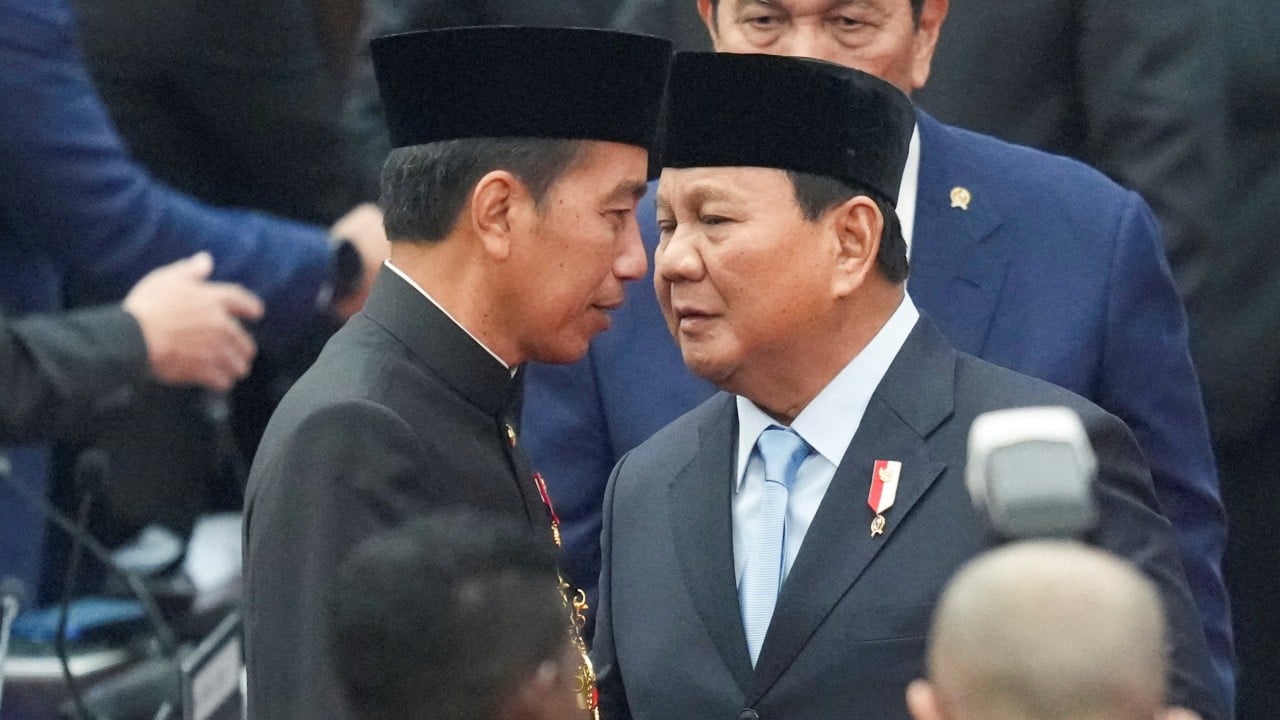
Everyone in Jakarta's political circles saw this coming. Yet most international observers are still misreading the exact mechanics of the Prabowo-Widodo rift.
When Indonesian lawmakers started scrutinizing Vice President Gibran Rakabuming Raka’s credentials, it looked like standard parliamentary noise. It isn't. It's a calculated, slow-motion pressure campaign that exposes the fragile marriage of convenience between President Prabowo Subianto and former president Joko Widodo.
If you're watching Southeast Asian politics, you need to understand why this matters right now. Prabowo won the presidency on the back of Jokowi’s immense popularity and political machinery. In exchange, Jokowi's eldest son, Gibran, got the vice presidency through a controversial Constitutional Court ruling that lowered the minimum age requirement for candidates. That deal got them into the Merdeka Palace. Keeping them aligned inside it is an entirely different story.
Why Lawmakers Are Targeting VP Gibran Now
Politics in Indonesia rarely moves through direct, public confrontation. Javanese political culture favors subtlety, proxy battles, and plausible deniability.
When members of the House of Representatives (DPR) begin questioning Gibran’s qualifications, educational background, or administrative readiness, they aren't acting in a vacuum. The DPR is overwhelmingly controlled by Prabowo’s massive ruling coalition, known as the Onward Indonesia Coalition (KIM Plus). Nothing of political consequence happens in that legislature without at least tacit approval from the top—or a deliberate decision by the top to look the other way.
Here's the real dynamic at play. Prabowo doesn't need to attack Jokowi directly. Doing so would alienate millions of loyal Jokowi voters and destabilize his own cabinet, which is still packed with Jokowi-era holdovers. Instead, letting lawmakers poke holes in Gibran’s credentials achieves two goals at once. It keeps the young vice president on the defensive, and it reminds Jokowi that his political leverage has an expiration date.
The Constitutional Court Shadow
You can't separate Gibran’s current vulnerability from how he got the job in the first place.
Back in late 2023, the Constitutional Court—then led by Chief Justice Anwar Usman, who happens to be Jokowi’s brother-in-law—issued a ruling that carved out an exception to the 40-year age minimum for presidential and vice-presidential candidates. Because Gibran had served as the elected mayor of Surakarta (Solo), he became eligible at just 36.
The backlash was immediate. An ethics panel later removed Anwar Usman as chief justice for severe conflicts of interest, though the ruling itself stood. For many lawmakers and civil society groups, Gibran’s legitimacy has been tainted since day one. Revisiting his credentials isn't just petty politics; it's exploiting an open wound that never actually healed.
Educational and Administrative Scrutiny
Beyond the age controversy, critics and certain parliamentary factions have repeatedly zeroed in on Gibran's academic records and thin executive resume.
Before becoming Vice President, Gibran spent less than three years as the mayor of a mid-sized city in Central Java. Before that, he ran a catering business and a chain of martabak pancake stalls. Compare that to Indonesia's historical vice presidents—seasoned bureaucrats, military generals, prominent economists, and veteran party bosses.
Lawmakers questioning his credentials are essentially asking a simple question out loud. If something happens to Prabowo, who is in his mid-70s, is Gibran actually equipped to run the world's fourth most populous nation? By framing the issue around competence and formal qualifications, legislators avoid sounding purely vindictive while still landing heavy political blows.
How the Prabowo-Widodo Alliance Started Cracking
To understand the current friction, look at the structural mismatch between the two men.
Jokowi spent ten years building a legacy centered on infrastructure, social welfare payouts, and maintaining influence after leaving office. He famously said he would "cawe-cawe" (meddle) in the 2024 election to ensure continuity. His end goal was clear—build a political dynasty that would protect his legacy and keep his family relevant long after his second term ended.
Prabowo had different plans. After losing twice to Jokowi in bitter elections in 2014 and 2019, Prabowo finally won the top job on his third try. He didn't spend decades chasing the presidency just to act as a caretaker for his predecessor's family.
The Cabinet Balancing Act
Look at the sheer size of Prabowo’s Red and White Cabinet. It's the largest in decades, bloated with over 100 ministers and deputy ministers.
Why did Prabowo build such a massive government? Because he needed to absorb almost every major political party into his tent. By bringing in former rivals and expanding the coalition, Prabowo systematically diluted his dependence on Jokowi’s loyalists.
Every new party boss brought into the fold reduces the relative weight of the Widodo camp. When Jokowi was still in office, he held the purse strings and the law enforcement apparatus. Today, Prabowo controls the budget, the military, the police, and the intelligence agencies. Power in Jakarta flows toward the sitting president, and it flows fast.
Policy Divergences Behind Closed Doors
Publicly, Prabowo still praises Jokowi. They shake hands at events, smile for the cameras, and use the word "continuity" like a mantra.
Behind closed doors, their priorities clash. Jokowi’s crown jewel is Nusantara (IKN), the multi-billion-dollar new capital city rising out of the jungles of East Kalimantan. It's an expensive, logistically brutal megaproject that relies heavily on state funds because private foreign investment has been sluggish.
Prabowo, meanwhile, has his own signature obsession—a massive free nutritious meal program for schoolchildren and pregnant women, alongside ambitious food and energy self-sufficiency targets. Indonesia's state budget isn't infinite. Fiscal rules cap the budget deficit at 3% of GDP. Funding Prabowo’s social programs means slowing down or deprioritizing Jokowi’s infrastructure dreams, especially Nusantara. When money gets tight, political alliances fracture.
What Most Analysts Miss About Indonesian Coalition Politics
Foreign commentators often treat Indonesian political parties like Western ideological blocs. That's a massive mistake.
In Indonesia, parties are pragmatic vehicles for power and patronage, not rigid ideological camps. The Indonesian Democratic Party of Struggle (PDI-P), which launched Jokowi’s career before he abandoned them to back Prabowo, is technically the only major party outside the government. Yet even PDI-P has complex, backchannel relationships with Prabowo’s inner circle.
PDI-P’s Role in the Gibran Pressure Campaign
When lawmakers target Gibran, watch closely which factions are making the loudest noise.
PDI-P lawmakers have every reason to go after the Widodo family. Megawati Sukarnoputri, the party’s matriarch, views Jokowi’s pivot toward Prabowo as an unforgivable betrayal. For PDI-P, undermining Gibran serves a clear strategic purpose—it weakens Jokowi while driving a wedge between the former president and the current one.
What's telling is how Prabowo’s own Gerindra party reacts—or fails to react. In a tightly disciplined coalition, Gerindra lawmakers would immediately shut down any parliamentary inquiry or harsh questioning aimed at their own Vice President. When they let the criticism linger in the media cycle for days before offering lukewarm defenses, that silence speaks volumes.
The Role of Golkar and Party Machinery
Another critical piece of the puzzle is Golkar, Indonesia’s oldest and most adaptable political machine.
Before leaving office, Jokowi allies engineered a leadership shakeup that put Bahlil Lahadalia, a fiercely loyal Jokowi lieutenant, at the helm of Golkar. The move was widely seen as Jokowi securing a permanent institutional base for himself and Gibran, since neither of them actually owns a political party.
Prabowo tolerated it at the time. Now, however, having a Jokowi proxy controlling the second-largest party in parliament creates natural friction. Golkar politicians are famous for reading the political wind and aligning with whoever holds real executive power. As Prabowo consolidates control over state institutions, Golkar’s internal loyalties will inevitably be tested. Lawmakers poking at Gibran’s credentials are testing the waters to see just how hard Jokowi and his allies will fight back.
The Real Stakes for Gibran’s Political Future
Gibran isn't a passive bystander in all of this, though his options are narrow.
As Vice President, he has a constitutional role, a staff, and a national platform. He's tried to carve out a niche by handling constituent complaints directly through a public hotline and visiting local markets—mimicking his father’s famous blusukan (impromptu visits) style.
The problem is that blusukan worked for Jokowi when he was an outsider challenging a stagnant political elite in 2014. In 2026, Gibran is the political elite, and his rise is widely viewed as the result of nepotism rather than grassroots grit.
If lawmakers succeed in making Gibran’s credentials a recurring scandal, his path to the 2029 presidential election becomes vastly steeper. Five years is a long time in politics, especially without a party of your own. Right now, Gibran doesn't have the institutional shield that Prabowo spent decades building with Gerindra. He relies entirely on his father's fading aura and Prabowo's continued goodwill.
Could Gibran Actually Be Impeached?
Let's be realistic about the legal mechanics. Removing a sitting vice president in Indonesia is extraordinarily difficult.
Under the 1945 Constitution, impeachment requires a long, multi-stage process. First, the DPR must pass a formal motion with a two-thirds majority vote in a plenary session attended by at least two-thirds of all members. Then, the Constitutional Court has to examine and validate the charges—which must involve treason, corruption, bribery, other high crimes, misdemeanors, or proving that the official no longer meets the constitutional requirements for office. Finally, the People's Consultative Assembly (MPR) has to vote again to remove the official.
Nobody in Jakarta realistically expects a full impeachment over Gibran’s credentials right now. That would trigger a constitutional crisis and tank investor confidence overnight.
The goal isn't removal. The goal is containment. By keeping the credential controversy alive, lawmakers strip Gibran of political capital. They ensure he stays a junior partner in every sense of the word, unable to build an independent power base inside the bureaucracy or challenge Prabowo’s authority on key appointments.
What to Watch Next in Jakarta
If you're tracking this power struggle for business, policy, or geopolitical reasons, ignore the daily press conferences where everyone smiles and claims the coalition is rock solid. Watch these concrete indicators instead.
- Cabinet Reshuffles and State-Owned Enterprises (BUMN): Look at who gets removed from top ministerial posts and lucrative state-owned enterprise boards. If Jokowi loyalists start losing key economic and legal portfolios to Gerindra cadres or military retirees, the rift has moved from parliamentary theater to active purging.
- Nusantara Budget Allocations: Check the revised state budget numbers for the new capital city. A sharp drop in direct state funding for IKN—coupled with delays in moving civil servants there—is the clearest financial proof that Prabowo is shelving Jokowi’s legacy.
- DPR Committee Assignments and Investigations: Watch whether the parliamentary questioning of Gibran’s credentials fizzles out after a few news cycles or escalates into formal committee hearings. Escalation means Prabowo’s camp has decided the political cost of protecting Gibran outweighs the benefit.
- Regional Political Maneuvering: Keep an eye on Central Java and East Java, the traditional heartlands of Jokowi’s support. If local politicians and regional leaders begin publicly distancing themselves from the Widodo family to curry favor with Prabowo’s inner circle, Jokowi’s post-presidency influence is officially unwinding.
Indonesia's political system rewards patience and punishes overreach. Jokowi played a brilliant long game to put his son a heartbeat away from the presidency, but he underestimated how quickly power centralizes once a new president takes the oath of office. Prabowo holds all the institutional cards now, and the sudden parliamentary interest in Gibran's credentials is just the first subtle reminder of who actually runs the country.