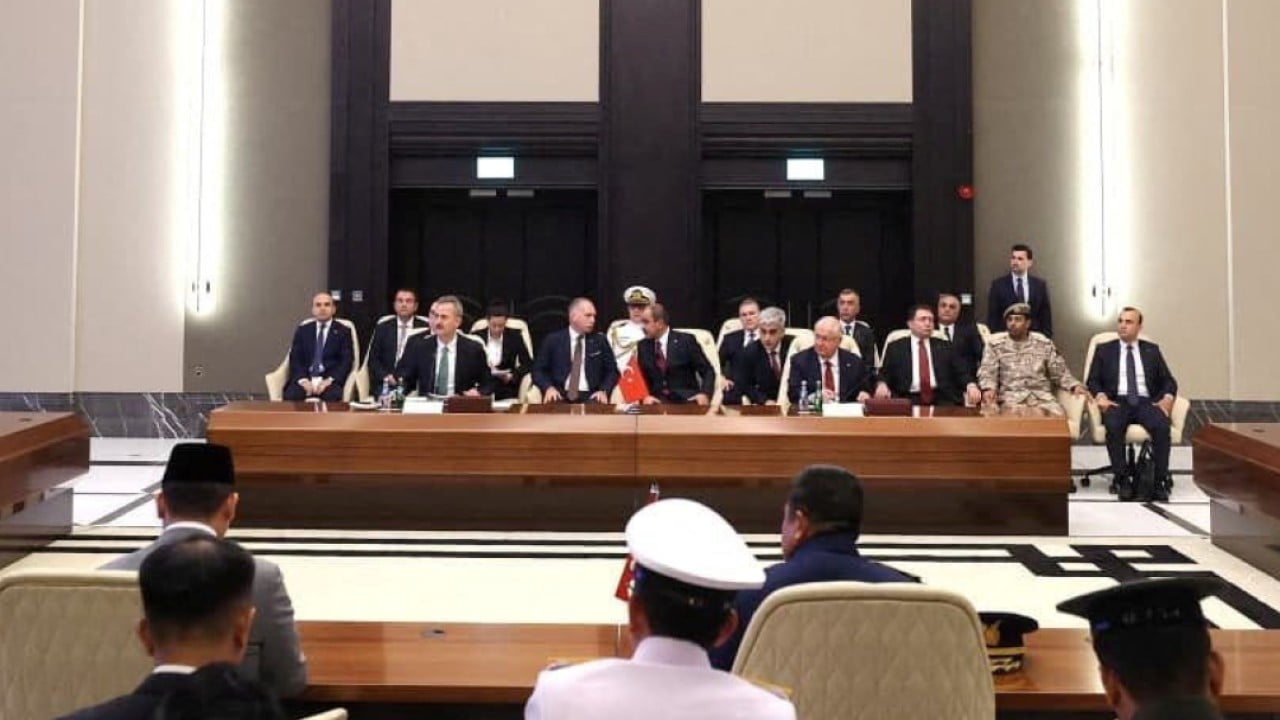
Western media loves a scary headline about an "Islamic NATO" forming behind closed doors. Honestly, that framing misses the actual story by a mile.
When Turkey, Pakistan, Qatar, and Indonesia ramp up joint defense pacts, trade deals, and diplomatic summits, they aren't trying to start a holy war or rebuild the Ottoman Empire. They're doing basic math in a multipolar world. Old security guarantees from Washington are looking shaky, traditional multilateral groups like the Organization of Islamic Cooperation (OIC) rarely get past strongly worded statements, and these four middle powers realized nobody is coming to save them. So they started pooling their exact strengths—Turkish drones, Pakistani nuclear deterrence and manpower, Qatari cash, and Indonesian demographics and critical minerals—to hedge their bets against both American unpredictability and Chinese dominance.
If you look at how these four countries interact, the logic jumps right off the page. Each brings something massive to the table that the others desperately lack.
Why These Four Specific Countries Need Each Other
You can't understand this alignment by looking at maps or religious demographics alone. You have to look at balance sheets, weapons factories, and supply chains.
Turkey has built a serious defense manufacturing base over the last fifteen years, led by companies like Baykar, Turkish Aerospace Industries (TAI), and Aselsan. They make combat-proven drones, corvettes, and armored vehicles at a fraction of Western prices, and they don't attach strict political strings to every sale. What Ankara lacks is deep capital reserves to fund next-generation projects like its KAAN fifth-generation fighter jet, plus guaranteed access to massive export markets to achieve economies of scale.
Enter Qatar. Doha sits on one of the largest natural gas reserves on Earth via the North Field, giving it a sovereign wealth fund—the Qatar Investment Authority—with hundreds of billions of dollars to deploy. What Qatar doesn't have is strategic depth or a large native population. Back during the 2017 Gulf blockade led by Saudi Arabia and the UAE, it was Turkish troops stationed in Doha and food airlifts from Ankara that kept Qatar from buckling. Since then, Qatari money has flowed steadily into Turkish defense firms, including a major stake in tank manufacturer BMC, and straight into Turkey's central bank reserves during currency crunches.
Pakistan brings something neither Ankara nor Doha possesses. Hard military mass and nuclear weapons. With a standing army exceeding 650,000 active personnel and battle-hardened experience, Islamabad acts as the security muscle in the equation. Pakistan's defense industry, particularly the Pakistan Aeronautical Complex (PAC), has co-produced the JF-17 Thunder fighter jet with China and already operates Turkish Bayraktar TB2 and Akinci drones alongside MILGEM-class corvettes built in partnership with Turkey. In return, Pakistan gets diplomatic backing on Kashmir from Ankara and crucial energy financing and LNG supplies from Qatar whenever Islamabad's foreign exchange reserves hit rock bottom.
Then there's Indonesia, the quiet giant that turns a regional trio into a global bloc. Home to over 280 million people and the largest economy in Southeast Asia, Jakarta controls vital maritime chokepoints like the Strait of Malacca and holds the world's largest reserves of nickel—the metal every EV battery maker needs. Under President Prabowo Subianto, a former defense minister who has aggressively pushed military modernization, Indonesia has signed major deals with Turkish defense firms like Roketsan for missiles and TAI for Anka drones, while courting Qatari investment for infrastructure and housing projects.
The Myth of the Unified Military Bloc
Let's clear up the biggest misconception floating around geopolitical forums. These four nations are not signing a mutual defense treaty where an attack on one automatically drags the other three into war.
Call it what it actually is. A flexible, transactional network.
Every single member of this group maintains deep, complicated relationships with rival superpowers that prevent them from forming a rigid ideological camp. Turkey is still a formal NATO member housing American nuclear weapons at Incirlik Air Base, even while buying Russian S-400 air defense systems and balancing ties with Moscow. Qatar hosts Al Udeid Air Base, the largest U.S. military installation in the Middle East, while simultaneously maintaining open channels with Hamas, the Taliban, and Iran.
Pakistan relies heavily on Beijing for the China-Pakistan Economic Corridor (CPEC) and over 80 percent of its major arms imports, according to data from the Stockholm International Peace Research Institute (SIPRI), yet still cooperates with Washington on counterterrorism. Indonesia guards its "bebas aktif" (free and active) non-aligned foreign policy like gospel, taking massive Chinese investment for nickel smelting while running joint military drills with the United States and Australia.
Because none of them want to be forced into choosing between Washington and Beijing, they're building a third lane. Working together gives them collective bargaining power when negotiating with larger powers.
Defense Co-Production Is the Real Glue
If you want to track where this partnership is actually going, stop reading diplomatic communiqués and start reading defense procurement contracts. Weapons co-production is where the rubber meets the road, because countries don't share sensitive military blueprints with partners they plan to betray next week.
Look at the Turkish-Pakistani-Indonesian triangle in aerospace and naval tech:
- The KAAN Fighter Program: Turkey's fifth-generation stealth fighter, developed by TAI, is wildly expensive. Ankara has openly invited Pakistan to participate in its development, leveraging Pakistani aerospace engineers who already have decades of experience integrating Western and Chinese avionics.
- Naval Modernization: Turkey's MILGEM warship program has become a shared platform. Pakistan ordered four Babur-class corvettes based on the Turkish Ada-class design, with two built in Istanbul and two in Karachi to transfer shipbuilding technology directly to Pakistani yards.
- Drone Ecosystems: Indonesia signed a $300 million deal for 12 Turkish Anka drones, complete with local assembly and technology transfer provisions via state-owned PT Dirgantara Indonesia. Qatar already operates Bayraktar TB2s and hosts joint naval and ground exercises with Turkish forces.
This isn't simple buyer-seller commerce. It's supply chain integration. When Pakistan builds hulls, Turkey supplies radar and electronic warfare suites, Qatar provides financing, and Indonesia buys and locally assembles the final product, they bypass Western arms export restrictions that have burned all of them in the past.
Ankara knows this pain firsthand after being kicked out of the U.S. F-35 fighter program in 2019 and facing quiet arms embargoes from European suppliers over its operations in Syria. Islamabad has lived under waves of American sanctions since the 1990s. Jakarta remembers the U.S. arms embargo over East Timor in the 1990s that grounded its F-16 fleet. Sharing intellectual property among themselves ensures no Western parliament can suddenly ground their air forces by blocking spare parts.
Money, Trade, and De-Dollarization Quietly Expanding
While defense grabs headlines, economic survival drives the day-to-day meetings. All four countries—with the obvious exception of cash-rich Qatar—have struggled with currency volatility, inflation, or debt pressures over the past few years.
Turkey and Pakistan have repeatedly tested bilateral trade mechanisms designed to bypass the U.S. dollar, using local currencies or barter-style arrangements for agricultural goods, textiles, and defense offsets. Meanwhile, the Preferential Trade Agreement (PTA) between Turkey and Pakistan aims to cut tariffs across hundreds of product lines, though bureaucratic red tape in Islamabad has slowed down the full rollout.
Indonesia and Turkey have been negotiating a Comprehensive Economic Partnership Agreement (CEPA) for years, pushing to lift bilateral trade toward the $10 billion mark. Indonesian palm oil, coal, and raw minerals flow toward Turkish factories, while Turkish machinery, construction firms, and defense hardware head east.
Qatar acts as the financial stabilizer across these bilateral tracks. When Turkey's lira crashed in 2018 and again in 2021, Doha expanded its currency swap line with Ankara's central bank to $15 billion, instantly easing pressure on Turkish reserves. Qatar has made similar multi-billion-dollar deposit and investment pledges to Pakistan's central bank to help Islamabad unlock stalled International Monetary Fund (IMF) bailout tranches.
In Indonesia, Qatari investors have stepped into flagship state priorities, including pledges toward President Prabowo's ambitious program to build three million affordable homes annually and investments in renewable energy and tourism infrastructure. Doha gets long-term sovereign returns and political goodwill across three major Muslim-majority nations; the recipients get capital without the harsh austerity conditions attached to Western loans.
Diplomatic Coordination Where Old Institutions Failed
Anyone who has watched the Organization of Islamic Cooperation (OIC) over the last two decades knows it moves at the speed of a glacier. Because the OIC requires consensus among 57 member states—many of whom are actively feuding with each other—it rarely produces concrete action during crises.
That frustration pushed Turkey, Malaysia, and Pakistan to launch the Kuala Lumpur Summit back in 2019, an effort to create a smaller, faster-moving diplomatic forum. Saudi Arabia pressured Pakistan into pulling out at the last minute back then, fearing a rival center of influence in the Muslim world.
Things look different now. Riyadh's own foreign policy has shifted toward pragmatic economic diversification under Vision 2030, cooling its hostility toward Ankara and Doha. That diplomatic thaw gave Turkey, Pakistan, Qatar, and Indonesia breathing room to coordinate openly on major global flashpoints without triggering an immediate Gulf crisis.
During the war in Gaza, this grouping functioned as a unified diplomatic bloc. Qatar led the high-stakes hostage and ceasefire mediation alongside Egypt and the U.S., while Turkey cut off trade with Israel and joined South Africa's genocide case at the International Court of Justice. Indonesia used its moral weight as the world's largest Muslim-majority nation to rally Global South support at the UN, while Pakistan pushed resolutions in Geneva and New York.
They also share an explicit agenda to reform global governance. Turkish President Recep Tayyip Erdoğan's famous slogan, "The world is bigger than five"—a direct shot at the five permanent members of the UN Security Council—resonates deeply in Jakarta, Islamabad, and Doha. None of these four countries sit permanently on the Security Council, yet together they represent roughly 550 million people and control critical trade corridors from the Bosporus to the Strait of Malacca.
Where This Partnership Hits Real Walls
It would be naive to pretend this alignment has no cracks. Serious friction points keep these four countries from ever merging into a seamless union.
First, economic overlap creates quiet competition. Turkey, Pakistan, and Indonesia all rely heavily on textile, garment, and low-to-mid-tier manufacturing exports. When Turkish and Pakistani textile exporters compete for the exact same European and American retail contracts, bilateral free trade talks suddenly stall because domestic lobbyists in Lahore and Bursa push back hard.
Second, their geopolitical priorities don't always line up. India is a massive trade partner and energy buyer for both Qatar and Indonesia. While Turkey and Pakistan frequently coordinate diplomatic messaging on Kashmir, neither Doha nor Jakarta has any interest in alienating New Delhi over South Asian territorial disputes. Qatar buys billions in Indian goods and relies on hundreds of thousands of Indian workers; Indonesia views India as a key maritime neighbor in the Indian Ocean.
Third, China's shadow looms differently over each capital. Pakistan's survival is tied directly to Beijing's wallet and arsenals. Turkey, by contrast, has long had tense friction with Beijing over the treatment of Uyghurs in Xinjiang—a Turkic, Muslim minority—even if Ankara has toned down its public criticism recently to attract Chinese EV factories. Indonesia welcomes Chinese capital for nickel processing but fiercely patrols its Exclusive Economic Zone around the Natuna Islands against Chinese coast guard incursions.
Finally, domestic politics can shift priorities overnight. Pakistan's chronic political instability and debt crises mean Islamabad often approaches partners looking for emergency bailouts rather than equal-footing investments, which breeds fatigue in both Ankara and Doha over time.
How to Read Signals From This Bloc Going Forward
If you're tracking geopolitical risk, emerging markets, or global defense trends, don't watch press conferences for clues about where this quartet is headed. Watch three concrete indicators instead:
- Technology Transfer Clauses in Defense Deals: Pay attention to whether future Indonesian and Qatari purchases from Turkey and Pakistan include local assembly lines and shared intellectual property. Standard off-the-shelf arms sales mean nothing; joint R&D facilities mean long-term strategic lock-in.
- Sovereign Wealth Fund Deployments: Track where the Qatar Investment Authority and Indonesia's sovereign wealth fund (INA) co-invest. When sovereign capital moves into joint infrastructure, telecoms, or defense manufacturing across these four borders, the political alignment has real financial teeth.
- Bilateral Currency Swap Renewals: Keep an eye on central bank agreements between Ankara, Doha, and Islamabad. Continued expansion of non-dollar trade settlement mechanisms shows how seriously they're insulating themselves from Western financial sanctions.
Ignore the sensationalist chatter about an emerging military superpower or a clash of civilizations. What you're actually watching is four pragmatic middle powers refusing to be pawns on someone else's chessboard, pooling their weapons, cash, and geography to buy themselves room to maneuver.

