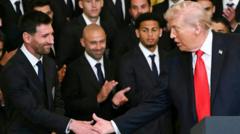
Lionel Messi and Inter Miami’s visit to the White House represents a collision of soft power, sports washing, and the relentless machinery of election-year optics. While the surface narrative centers on the club's 2023 Leagues Cup victory, the underlying reality is a calculated maneuver involving the most valuable sporting asset on the planet and a sitting president seeking a foothold with a specific demographic. This isn't just a trophy presentation. It is a high-stakes meeting of brands where the jersey and the ballot box are inextricably linked.
The tradition of championship teams visiting 1600 Pennsylvania Avenue typically follows a predictable script of handshakes and jersey swaps. However, adding Donald Trump to the equation transforms a routine photo op into a polarizing lightning rod. For Messi, a man who has spent two decades meticulously guarding his private life against the intrusion of partisan politics, this encounter is the most treacherous pitch he has ever played on. He is no longer just a footballer; he is a geopolitical tool.
The Strategy of the Photo Op
Modern political campaigns are won on optics, not just policy. By hosting the world’s most recognizable athlete, the Trump administration isn't just honoring a soccer team; it is attempting to capture the "Messi effect." This phenomenon transcends the sport. Messi carries a global approval rating that most world leaders would trade their legacies for. For a president, standing next to that level of unadulterated success offers a momentary, reflected glow of competence and universal appeal.
The timing is rarely accidental. Every movement of a presidential schedule during an election cycle is vetted for maximum impact. By bringing the "Herons" to Washington, the administration signals a direct appeal to the growing and politically significant Latino community. This is a group that has historically been the target of intense messaging from both sides of the aisle. Messi is the ultimate cultural bridge. He is the personification of the American Dream in its most extreme, globalized form: the outsider who arrives, conquers, and becomes the centerpiece of a multi-billion dollar domestic industry.
The Inherent Risk for Messi the Brand
The Messi brand is built on a foundation of silence and excellence. He is the anti-celebrity, a man who lets his feet do the talking while his management team carefully sanitizes his public image. Stepping into the West Wing alongside a figure as polarizing as Trump breaks that carefully curated neutrality. For every fan who sees this as a harmless tradition, another sees it as a tacit endorsement. This is the danger of the modern athlete. The days of "Republicans buy sneakers too" are long gone, replaced by an era where silence is often interpreted as a statement in itself.
In the corporate boardrooms of Adidas and Apple—two of the primary financial engines behind Messi’s move to Miami—there is undoubtedly a sense of trepidation. They didn't sign a $150 million deal to have their star become a footnote in a cable news cycle. The commercial calculus of Messi in Miami is built on universal appeal. The moment he becomes a partisan figure, that appeal narrows. This visit represents a high-wire act where the prize is a photo for the history books and the penalty is a fractured fanbase.
The Evolution of the Presidential Sports Visit
The White House championship visit used to be a dull affair. A few jokes, a team jersey with the president’s name on the back, and a quick tour of the grounds. It was a bipartisan ritual that survived through the Cold War and the 1990s without much friction. That changed during the Trump era. The refusal of teams like the Golden State Warriors and players like Megan Rapinoe turned the ceremony into a battleground for cultural values.
When a team finally does show up, it is no longer a given; it is a choice. For Inter Miami, a club co-owned by David Beckham and Jorge Mas, the decision to attend is a business move. Jorge Mas is a man who understands the intersection of politics and business in Florida as well as anyone. Miami is a city where politics is a contact sport. The Mas family has deep roots in the community and a history of political engagement. For them, a visit to the White House isn't just about a trophy—it’s about the long-term viability of their massive stadium projects and the political capital required to maintain a multi-billion dollar enterprise in the heart of South Florida.
The Shadow of 2024
We cannot ignore the calendar. We are in a year where every public appearance is scrutinized for its impact on the polls. By hosting Messi, Trump is making a play for the "center" of a sports-obsessed nation. It is a way to look "presidential" in a way that his opponents find difficult to replicate. There is a specific kind of gravity that comes with the White House that even the most successful campaign rallies lack.
On the other side of the coin, the Messi camp has likely negotiated the terms of this visit down to the last second of exposure. They will want the focus on the Leagues Cup trophy, not on the political climate. But as any veteran analyst knows, once you enter that building, you lose control of the narrative. The White House press corps isn't there to ask about Messi’s hamstring; they are there to capture the moment a global icon shakes hands with a man who has redefined American politics.
The Business of Soccer in a Divided Nation
Major League Soccer is in a precarious position. The league has bet its entire future on the Messi experiment. If the experiment becomes mired in the mud of political discourse, the growth trajectory could stall. The league needs every person in the country to care about the sport, regardless of who they vote for. By allowing this visit to proceed, the league is gambling that the tradition of the office will outweigh the divisiveness of the occupant.
There is also the international perspective to consider. The rest of the world looks at this visit through a different lens. In Europe and South America, the relationship between sports and politics is often more overt and more dangerous. Messi’s home country of Argentina is currently undergoing its own radical political shift. His global audience will see this through their own local filters. To a fan in Buenos Aires or Barcelona, this isn't just an American tradition; it's Messi interacting with the most powerful person in the world.
The Invisible Players in the Room
Behind the scenes, there are lawyers, publicists, and league officials who have spent months choreographing every step of this visit. They have vetted the guest list, the timing, and even the specific room where the ceremony takes place. They are trying to create a vacuum where only the sport exists. But reality always intrudes. The questions from the press will almost certainly veer into territory that the Miami PR team has spent weeks trying to avoid.
The true test of this visit’s success won't be the headlines tomorrow. It will be the sentiment of the fans in the stadium next week. If the supporters’ groups—who are often the most politically active and vocal segment of any fanbase—feel that the club has been used as a political prop, there could be a backlash. Miami’s fanbase is a mosaic of different cultures and political backgrounds. Maintaining the harmony of that mosaic while the team’s biggest stars are used for political points is a nearly impossible task.
The Reality of the Modern Athlete as a State Asset
We have entered an era where top-tier athletes are treated as state assets. Whether it is the LIV Golf tour, the massive investments in the Saudi Pro League, or the state-funded ownership of European giants like PSG and Manchester City, the wall between the pitch and the palace has crumbled. Messi is the most prominent example of this. His move to Miami was facilitated by a massive corporate alliance and sanctioned by a league that is essentially an arm of the American sports-industrial complex.
The White House visit is simply the logical conclusion of this trend. If you are the best at what you do, the state will eventually want to claim a piece of your success. This isn't unique to the current administration; it is a fundamental truth of power. Power gravitates toward popularity. Messi has more of the latter than anyone else on the planet, making him the ultimate prize for anyone who holds the former.
The true cost of this meeting isn't paid in money. It is paid in the erosion of the idea that sports can be a neutral ground. Once the jersey is presented and the photo is taken, that neutrality is gone forever. The image of Messi in the White House will be used in campaign ads, on social media feeds, and in historical documentaries for decades. It will be interpreted and reinterpreted long after Messi has played his final game and the current political cycle has faded into history.