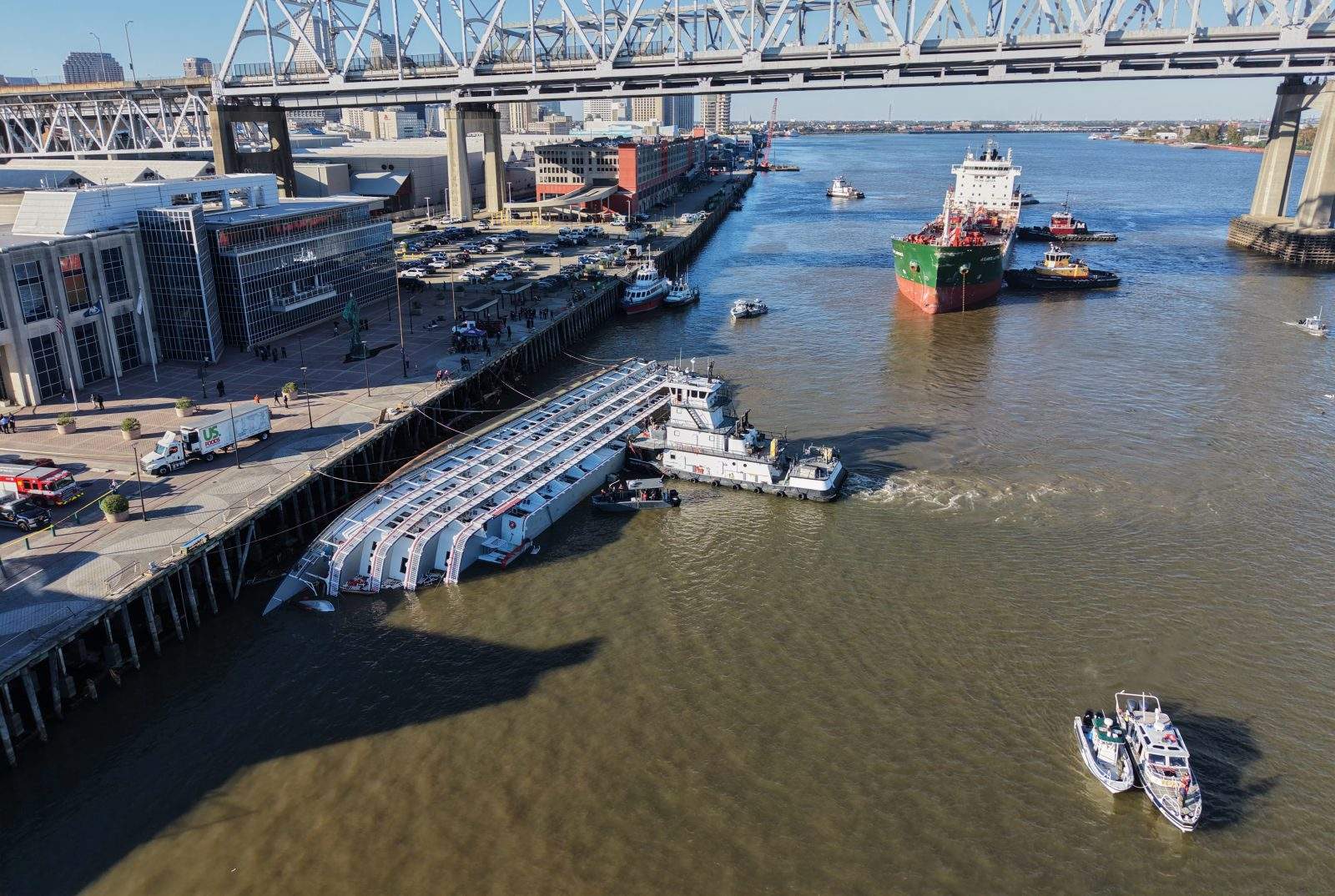
The Board of Commissioners of the Port of New Orleans has filed a federal admiralty lawsuit to arrest and take legal control of a commercial tanker following a collision with a passenger cruise ship on the Lower Mississippi River. By invoking maritime attachment and arrest procedures in the U.S. District Court for the Eastern District of Louisiana, port authorities are attempting to secure the vessel as physical collateral before its foreign owners can sail it out of American jurisdiction or shield assets behind offshore shell companies.
Most local news reports treat a port authority lawsuit like routine insurance paperwork. They miss the real story. When a massive commercial ship strikes a cruise liner in one of the busiest shipping corridors in North America, the immediate physical impact is only the opening act of a high-stakes legal war over maritime liens, infrastructure liability, and sovereign immunity. If a damaged ship slips downriver into the Gulf of Mexico before federal marshals nail a warrant to its wheelhouse, the port and every injured party risk spending years chasing empty holding companies from Panama to Liberia.
The Anatomy of a Maritime Arrest
In terrestrial law, if someone crashes a semi-truck into a municipal bridge, the city sues the driver and the trucking company. Maritime law operates on a completely different ancient logic. Under admiralty jurisdiction, the ship itself is treated as a legal person capable of committing a civil wrong.
When the Port of New Orleans moves to get control of a tanker, it is filing an in rem action directly against the vessel. The mechanism is blunt and effective. A federal judge issues a warrant of arrest, and U.S. Marshals physically board the ship, confiscate its navigation certificates, and appoint a court-approved substitute custodian. Without those papers, the captain cannot legally clear customs or move the hull an inch.
Why the rush? Because commercial shipping runs on corporate fragmentation. A single ocean-going tanker is frequently owned by a single-purpose corporation registered in a flag-of-convenience jurisdiction, managed by a firm in Europe, chartered by an energy trader in Singapore, and insured through a Protection and Indemnity (P&I) club in London. The vessel itself is often the only tangible asset within reach of U.S. courts. Once that hull crosses the three-mile territorial sea limit, enforcing an American judgment becomes an international nightmare.
To understand how fast things move in New Orleans maritime courts, look at the standard sequence of an emergency arrest:
- The Verified Complaint: Port attorneys file an emergency petition detailing physical damage to wharves, pilings, fender systems, or navigation channels, alongside economic losses from berth closures.
- Rule C Warrant Execution: Under Supplemental Rule C of the Federal Rules of Civil Procedure, a federal magistrate reviews the filing—often within hours—and authorizes U.S. Marshals to seize the ship.
- The Substitute Custodian Shift: Because the U.S. Marshals Service does not want to pay harbor fees or maintain skeleton crews on a volatile tanker, the port typically petitions to become the substitute custodian, giving the port authority direct operational control over where the ship is moored and how it is secured.
- Letter of Undertaking (LOU): The ship's P&I insurer eventually steps in, offering a legally binding financial guarantee up to the value of the vessel in exchange for the ship's release.
Why the Lower Mississippi Turns Minor Errors Into Disasters
Anyone who has spent time on the New Orleans riverfront knows the Mississippi is not a sleepy canal. It is a violent, fast-moving industrial artery. Between Baton Rouge and the Head of Passes, deep-draft ocean tankers share narrow, shifting bends with massive cruise ships, chemical barges, and towboats pushing thirty-barge flotillas.
The physics leave zero margin for error. A loaded commercial tanker can weigh upwards of 50,000 to 100,000 deadweight tons. When moving with a four-knot spring current pushing from behind, a tanker requires miles to come to a full stop. Its rudder only works effectively when water is flowing rapidly past the hull; if the main engine loses power—a dreaded "blackout"—the ship becomes an unguided battering ram drifting at the mercy of river eddies.
Cruise ships docked along the Julia Street or Erato Street terminals sit right along the outer curves of the river where current velocity peaks. Unlike cargo vessels built with thick double-hulled steel plating designed to absorb heavy contact with concrete pilings, modern cruise liners are floating hotels with expansive glass superstructures, delicate lifeboat davits, and complex shore-power connections. Even a glancing blow at three knots can rip through hull plating, sever gangways, and inflict millions of dollars in structural damage to both the liner and the port's terminal infrastructure.
The Pilotage Factor Nobody Mentions
Every foreign-flagged tanker and cruise ship navigating the Lower Mississippi is required by law to take aboard a state-commissioned river pilot. These pilots belong to specialized associations—such as the Crescent River Port Pilots' Association—and possess unmatched local knowledge of river stage, cross-currents, and shoaling.
Yet the presence of a compulsory pilot creates a bizarre legal gray zone. Under U.S. maritime law, when a vessel is under the direction of a compulsory pilot, the ship's owner is still liable in rem (meaning the ship itself can be seized and sold to pay damages), even if the owner is not personally liable in personam for the pilot's navigational mistake. This legal distinction is precisely why the Port of New Orleans sues the tanker directly rather than just sending an invoice to the shipping company's headquarters. If the port fails to arrest the vessel, the owner can argue in court that they are not personally responsible for a compulsory pilot's error, leaving the port with no viable defendant.
The Hidden Financial War Behind the Seizure
When a port authority demands control of a vessel, the battle is rarely just about bent steel. It is about demurrage, berth congestion, and the cascading economic shockwave that hits a port city when a terminal goes offline.
New Orleans is one of the top cruise homeports in the United States, handling over a million passenger movements annually. A single cruise ship turnaround brings thousands of tourists into local hotels, restaurants, and rideshares, while generating direct tariff revenue for the port through dockage and wharfage fees. If a tanker collision damages a cruise berth or leaves a crippled vessel blocking an active channel, the port loses revenue every single hour the berth remains unusable.
The Limitation of Liability Act of 1851
Standing directly in the path of the port's recovery is a 19th-century statute that maritime lawyers love to hate: the Limitation of Liability Act of 1851. Originally passed by Congress to encourage American shipbuilding by protecting vessel owners from catastrophic losses at sea, the law allows a shipowner to cap their total financial liability at the post-accident value of the vessel plus any pending freight charges—provided the owner can prove the accident occurred without their "privity or knowledge."
Consider what that means in practice. Suppose a hypothetical tanker causes $40 million in damage to a cruise ship and port wharves, while the battered tanker itself is only worth $18 million after the crash. The tanker's owners will immediately file a Limitation Action in federal court, attempting to force the Port of New Orleans, the cruise line, and every injured passenger into a single consolidated proceeding to fight over that $18 million pot.
By suing early and seizing the tanker, the port puts itself at the front of the line. Maritime liens do not get paid equally; they are ranked by a strict historical hierarchy:
- Expenses of Justice: Costs incurred by the U.S. Marshals and the substitute custodian to keep the arrested ship safe and moored.
- Seamen's Wages: Unpaid salaries owed to the crew aboard the vessel.
- Salvage and General Average: Claims by tugboats or emergency responders who prevented the ship from sinking or burning.
- Maritime Torts: Collision damage to other vessels (the cruise ship) and fixed shore structures (the port's docks and terminals).
- Contractual Liens: Unpaid fuel suppliers, repair yards, and cargo claims.
Notice where the Port of New Orleans sits on that list. As a tort claimant—and potentially as the substitute custodian—the port secures high-priority standing over ordinary commercial creditors.
Infrastructure Vulnerability and the Cost of Delay
Ports operate on tight capital budgets. Unlike private corporations that can raise prices overnight, public port authorities rely on bond issuances, federal infrastructure grants, and long-term terminal leases to fund repairs. When a tanker crushes a concrete fender system or destabilizes pilings supporting a cruise terminal, the port cannot wait three years for an insurance adjuster in London to sign off on a settlement.
Taking physical control of the tanker gives the port immense leverage at the negotiating table. Every day an arrested tanker sits idle at a New Orleans lay berth, its owner bleeds tens of thousands of dollars in lost charter revenue, crew wages, fuel costs, and port charges. Meanwhile, cargo buyers refuse to do business with a vessel tied up in federal litigation.
This economic pressure forces the tanker's P&I Club to act fast. In almost every major port collision, the seizure ends not with a public auction of the ship on the courthouse steps, but with a quiet, high-dollar wire transfer or a rock-solid Letter of Undertaking backed by billions in reinsurance reserves. Once the bank guarantee is lodged with the federal court, the U.S. Marshals lift the arrest warrant, hand back the ship's papers, and let the tanker sail downriver for dry-dock repairs.
What Comes Out of the Wreckage
Beyond the immediate courtroom maneuvering, every collision between a commercial tanker and a passenger vessel triggers parallel federal investigations by the U.S. Coast Guard and the National Transportation Safety Board (NTSB). These inquiries strip away the legal posturing and expose the operational reality on the bridge.
Investigators pull the Voyage Data Recorder—the maritime equivalent of an airplane's black box—to analyze bridge audio, radar tracks, rudder angles, and engine telegraph commands in the minutes before impact. They scrutinize whether fatigue played a role, whether communication broke down between the foreign bridge crew and the local river pilot, or whether the tanker entered the river with known propulsion defects that were concealed from Port State Control inspectors.
If the Coast Guard or NTSB uncovers evidence that the tanker's management company knew about faulty steering gear or neglected routine maintenance prior to the crash, the shipowner's defense under the 1851 Limitation of Liability Act collapses instantly. "Privity and knowledge" is established, stripping away the liability cap and exposing the parent company's global assets to full restitution.
For the Port of New Orleans, filing suit to seize the tanker is not an act of aggression; it is basic maritime survival. On a river where multi-million-dollar hulls pass within a few hundred feet of each other every hour, the authority that fails to lock down the ship before the tide turns is left holding the bill for someone else's mistake.