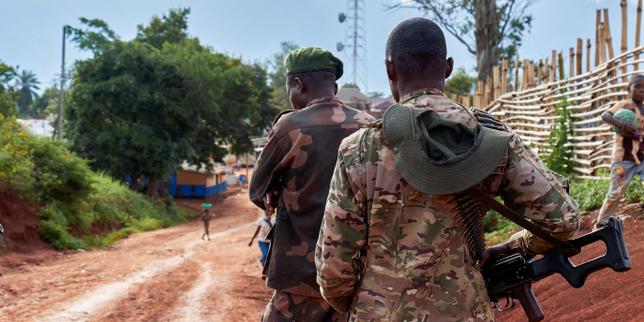
Mainstream media loves a tragedy that requires no intellectual heavy lifting. For decades, the international community has recycled the same tired narrative about the eastern Democratic Republic of Congo: it is an anarchic, chaotic zone of "impossible peace," an ancient tribal melting pot of inevitable violence where state failure is absolute.
This thesis is lazy. It is also entirely wrong.
The conflict in eastern DRC is not a product of chaos. It is a highly organized, predictable, and rational economic system. Peace is not "impossible" because of intractable ethnic hatreds or the insurmountable geography of the Kivu regions. Peace is absent because the current state of unstable equilibrium is incredibly lucrative for the regional elites, multinational supply chains, and the multi-billion-dollar humanitarian industry operating on the ground.
I have spent years analyzing regional security architectures and resource supply chains. I have watched Western analysts fly into Goma, spend three days in a heavily fortified compound, and return to write policy papers lamenting the "senseless violence." The moment you label violence as senseless, you admit you do not understand its utility.
The Misconception of the Weak State
The foundational error of the standard narrative is the belief that the Congolese state is simply too weak to govern its eastern territories. Foreign observers look at the proliferation of over a hundred armed groups—like the M23, the Democratic Forces for the Liberation of Rwanda (FDLR), and various Mai-Mai factions—and see a power vacuum.
There is no vacuum. Power in the eastern DRC has been deliberately decentralized into a hybrid network of military entrepreneurs, local strongmen, and provincial authorities.
Kinshasa does not lack the capacity to project power because of mere incompetence. The weakness of the official military apparatus (FARDC) is a structural feature, not a bug. A highly centralized, disciplined, and well-funded military in the east would pose a direct coup threat to the central government. Instead, the system operates on a franchise model.
Local commanders are given a license to extract wealth from artisanal gold, coltan, and tin mines. In exchange, they maintain a nominal allegiance to the capital. When a rebel group grows too powerful, the state briefly partners with rival armed groups to suppress them, creating a self-perpetuating cycle of managed instability.
Thought Experiment: Imagine a corporate entity that deliberately keeps its regional branches underfunded and disorganized so that headquarters can manipulate internal competition and prevent any single regional director from mounting a boardroom takeover. That is the governance model of the eastern DRC.
The Humanitarian Industrial Complex Needs the Crisis
Let us look at the data that the "impossible peace" crowd conveniently ignores. Billions of dollars in foreign aid pour into the eastern provinces annually. Goma has become a hub for international non-governmental organizations (INGOs) and United Nations agencies.
This influx of capital has created an artificial economy completely detached from reality. The presence of the UN peacekeeping mission (MONUSCO, and its shifting regional replacements) has spent tens of billions over two decades with zero permanent security outcomes to show for it.
Why? Because the stabilization industry suffers from a fundamental conflict of interest. If peace is achieved, the funding dries up. The SUVs vanish. The high-paying expatriate contracts terminate.
The industry addresses the symptoms of the conflict—displaced person camps, malnutrition, cholera outbreaks—while providing a buffer that protects the political elite from the consequences of their inaction. By absorbing the social cost of state failure, international aid subsidizes the very system that drives the violence.
Dismantling the "People Also Ask" False Premises
When looking into the regional dynamic, the public usually asks the wrong questions because they are fed flawed premises.
Why can't the UN stop the rebels in the DRC?
This question assumes the UN’s primary structural incentive is operational victory. It is not. The mandate of peacekeepers in the DRC is inherently risk-averse and defensive. Bureaucratic institutions prioritize self-preservation over decisive outcomes. Armed groups know exactly where the red lines lie; they operate right outside the perimeter of international intervention, using the UN presence as a predictable static variable in their operational calculations.
Is ethnic hatred the root cause of the Kivu conflict?
No. Ethnicity is the marketing department of the conflict; resource extraction is the finance department. Ground-level actors mobilize identity markers to recruit cheap labor and secure local loyalty, but the underlying drivers are land tenure rights, control over customs posts, and access to international mineral trade routes. Framing this as an ancient tribal feud is a cop-out that pardons the modern financial actors pulling the strings.
The Raw Materials Pipeline: The Laundering of Conflict Minerals
The conventional solution proposed by Western governments is "traceability." Initiatives like the Dodd-Frank Act (Section 1502) were designed to clean up supply chains by certifying minerals as conflict-free.
The reality? These regulations merely changed the logistics of smuggling.
Coltan and gold mined under the control of rebel factions or corrupt military units do not disappear. They are smuggled across the porous borders into neighboring countries—primarily Rwanda and Uganda—where they are laundered into the official global supply chain.
- Gold smuggling: Tons of artisanal Congolese gold leave through Kigali and Kampala every year, eventually landing in refining hubs like Dubai.
- The Certification Smokescreen: Bag-and-tag schemes are easily compromised. Armed groups simply pay off underpaid local officials to secure valid tags for illegally extracted minerals.
The international consumer electronics and green energy industries require these minerals. The global market does not actually want a complete shutdown of eastern DRC production; it wants cheap, uninterrupted access. The current shadow economy provides exactly that, without the regulatory burdens, minimum wage requirements, or environmental liabilities of a stabilized, legally transparent mining sector.
The Cost of the Contrarian Reality
Shifting the lens from "tragic chaos" to "rational system" requires admitting a grim truth: ending the conflict requires dismantling an economic network that feeds thousands of local actors, regional governments, and international corporations.
If you enforce absolute transparency tomorrow, you collapse the informal livelihoods of hundreds of thousands of artisanal miners who have no alternative economic options. These individuals would immediately become prime targets for rebel recruitment. This is the dark paradox of the Congolese war economy: the black market is the only functioning social safety net available.
Stop Funding the Symptoms
The strategy of sending more troops, renewing ineffective UN mandates, and hosting endless peace conferences in luxury European hotels is dead on arrival.
True stabilization requires a brutal pivot.
First, stop treating Kinshasa as a helpless victim of regional aggression. The central government must be forced to choose between international financial support and the continued enrichment of its military entrepreneurs in the east.
Second, the focus must shift entirely from military containment to infrastructure and formal formalization of land property rights. The armed groups thrive because land tenure in the east is a chaotic mess of customary law and corrupt state registries. Secure the land rights of the populations, and you cut the recruitment pipeline of the militias at the root.
Stop weeping for the DRC. Start tracking the balance sheets. Ensure the cost of managing the conflict exceeds the profit of maintaining it, or stop pretending you want peace.