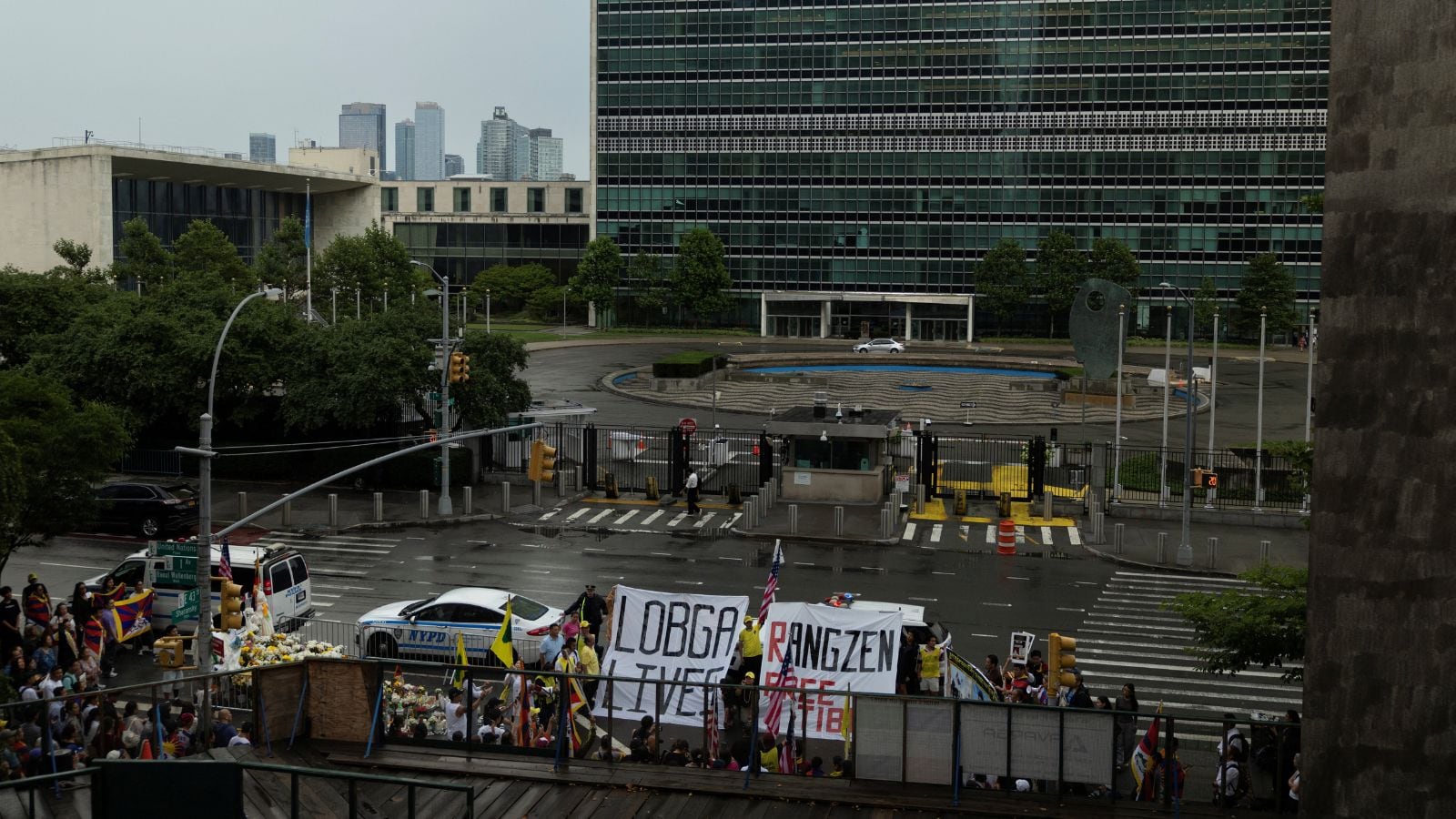
The traditional reporting surrounding acts of political self-immolation in restricted regions relies heavily on narrative-driven updates rather than structural analysis. When a community observes a milestone event, such as the forty-ninth day following a protest or a death—a duration carrying profound significance in Tibetan cultural and Buddhist frameworks—the resulting demonstrations are frequently framed merely as emotional outbursts. This approach obscures the underlying institutional mechanics, the transmission vectors of information, and the state-level response functions that dictate how such events ripple through closed networks.
To understand how localized dissent scales into sustained collective action under heavy surveillance, one must deconstruct the event not as an isolated tragedy, but as a high-cost signal within a constrained communication architecture.
The Information Bottleneck and High Cost Signaling
In environments where standard channels of free expression are blocked, the transmission of dissent requires high-cost signals. Self-immolation represents the absolute threshold of cost-imposing signaling. When standard channels of political feedback are eliminated by structural censorship, actors resort to extreme physical sacrifices to bypass information filters and capture external attention.
The forty-ninth-day marker functions as a coordination focal point. In Tibetan funerary and memorial traditions, the period following a death is marked by specific rituals that require communal gathering and synchronized mourning. State security apparatuses anticipate these temporal nodes, deploying preemptive saturation tactics, communication blackouts, and localized lockdowns.
The public demonstrations that occur despite these measures expose the failure threshold of preventive security models. When hundreds or thousands of individuals assemble in defiance of heavy securitization, it indicates that the perceived utility of collective solidarity has momentarily surpassed the immediate threat of state retribution. This dynamic invalidates the linear deterrence model often assumed by security planners, proving that compressed suppression can intensify coordination rather than dissolve it.
The State Response Function and Escalation Loops
The reaction of governing authorities to memorial protests follows a predictable operational matrix designed to minimize narrative contagion. This matrix relies on three distinct phases:
- Information Isolation: Immediate throttling of local telecommunications, cellular data, and regional internet access to prevent real-time documentation or broadcast from leaving the immediate geographic zone.
- Parametric Saturation: Deployment of security personnel to key transit nodes, monasteries, and market squares to disrupt the physical assembly of crowds before critical mass is achieved.
- Retrospective Attribution: Imposing collective administrative or legal penalties on monasteries, families, or local business owners associated with the dissenting individuals to raise the future cost of association.
This response function creates a recursive feedback loop. Each layer of suppression increases the informational value of the event for external observers while heightening the economic and personal friction for internal participants. The friction itself becomes a measurable variable in the cost function of dissent.
Network Resilience Under Structural Asymmetry
The persistence of collective action in heavily policed environments depends on decentralized cellular structures rather than formal leadership hierarchies. Traditional civil resistance models rely on explicit command-and-control chains. In regions subjected to deep technological surveillance, hierarchical organizations are rapidly neutralized through targeted detentions.
Protests that emerge around cultural or religious markers bypass the need for centralized coordination. Because the calendar date of significance is universally understood within the population, individual agents can independently converge on public spaces with synchronized intent without exchanging explicit directives that could be intercepted by monitoring systems.
This horizontal resilience renders conventional counter-protest strategies ineffective. Disabling a specific activist network yields diminishing returns because the coordination protocol is embedded within cultural practice rather than digital databases or organizational charters.
Strategic Trajectory and the Limits of Deterrence
The long-term equilibrium of dissent in highly monitored regions hinges on the efficiency of resource allocation between state surveillance and community adaptation. As security apparatuses incorporate advanced biometric tracking and automated communication analysis, the barrier to entry for effective protest rises exponentially.
Actors within these environments are forced to compress their operational footprints, shifting from visible public demonstrations to micro-tactics of non-cooperation and decentralized cultural preservation. Conversely, the escalating cost of maintaining total informational control places a permanent administrative burden on the state, requiring continuous capital allocation to suppress latent friction points that can never be entirely eliminated by force alone.
Resource allocation must shift toward targeted engagement models that address the root structural grievances driving high-cost signals, as reliance on pure deterrence mechanics yields diminishing returns over extended time horizons.