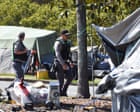
The festival was meant to celebrate the wind. Instead, it exposed the raw edges of how modern cities police poverty. In a resort precinct designed to project leisure and consumption, a homeless man found himself on the receiving end of a police Taser after refusing a move-on order. The instruction to leave the public park was issued not because of a crime, but to clear space for a community kite festival.
This incident is not an isolated flashpoint of overzealous enforcement. It represents the logical endpoint of sanitation policies that treat unhoused human beings as urban blight to be cleared before the tourists arrive. When public infrastructure becomes exclusively reserved for those who can pay for their presence, the social contract fractures.
The Mechanics of Exclusion
Urban management relies on invisible architecture and highly visible enforcement. Move-on powers, introduced across multiple jurisdictions under the guise of crime prevention and public safety, have quietly morphed into tools of social cleansing. Police officers are handed broad discretion to order individuals away from specific zones without proof of unlawful behavior.
In practice, these laws target visible poverty. A person sitting quietly on a park bench reading a book is part of the landscape. A person with all their worldly possessions packed into plastic bags sitting on that same bench disrupts the illusion of a clean, friction-free consumer environment.
When a major event lands in a public space, the state's tolerance for visible deprivation drops to zero. Organizers demand clear sightlines, unhindered foot traffic, and an aesthetic free from the reminders of structural inequality. The response is swift: municipal bylaws and police powers combine to sweep the unwanted away.
Manufacturing Order at Taser Point
The escalation in Queensland highlights a dangerous escalation in how municipal spaces are cleared. A move-on order is an administrative command backed by the threat of penal sanction. When an individual resists—whether due to exhaustion, mental distress, or a simple refusal to be rendered invisible—the state's apparatus responds with physical force.
Tasers were originally pitched as non-lethal alternatives to firearms, designed to neutralize immediate threats to life or limb. Their increasing deployment in compliance situations—enforcing administrative directions against vulnerable, non-violent citizens—betrays that original mandate. Deploying high-voltage weaponry over a dispute about park real estate during a festival reveals a profound disproportion in state power.
The man in question was not rioting. He was occupying space. The decision to draw a weapon and discharge it within a crowded public precinct underscores a systemic failure of de-escalation training and an over-reliance on pain compliance to solve social crises.
The Sanitized City Mirage
Cities are complex ecosystems of shared humanity, or at least they are supposed to be. Over the past two decades, urban planners and municipal authorities have embraced a philosophy of defensive design and aggressive gentrification. Benches are built with middle armrests to prevent lying down. Public toilets are locked or removed. Sprinklers run during dry nights.
These interventions send an unmistakable message: certain bodies are welcome, and others are criminalized simply for existing in public view.
When an event like a kite festival rolls into town, it acts as an accelerant for these underlying tensions. The festival brings economic activity, tourism dollars, and civic pride. It also brings an intense demand for aesthetic purity. The presence of homelessness shatters the carefully curated marketing image of a vibrant, thriving community. Rather than addressing the systemic failures that leave people sleeping rough, authorities deploy the ultimate band-aid: forced relocation backed by the barrel of a conducted energy weapon.
The Cost of Convenience
We have arrived at a cultural moment where the convenience of festival-goers supersedes the bodily integrity and basic dignity of marginalized citizens. Every time a move-on order is executed to clear a park for commerce or leisure, society draws a hard line around who counts as a member of the public.
The Taser discharge in Queensland is a symptom of a deeper rot. Until we recognize that public space belongs to the public in its entirety—including the broken, the unhoused, and the destitute—our community celebrations will remain hollow pageants built on the backs of the invisible and the abused. The real crisis is not that a man stood his ground in a park, but that we built a system where his mere presence required a weapon to remove it.