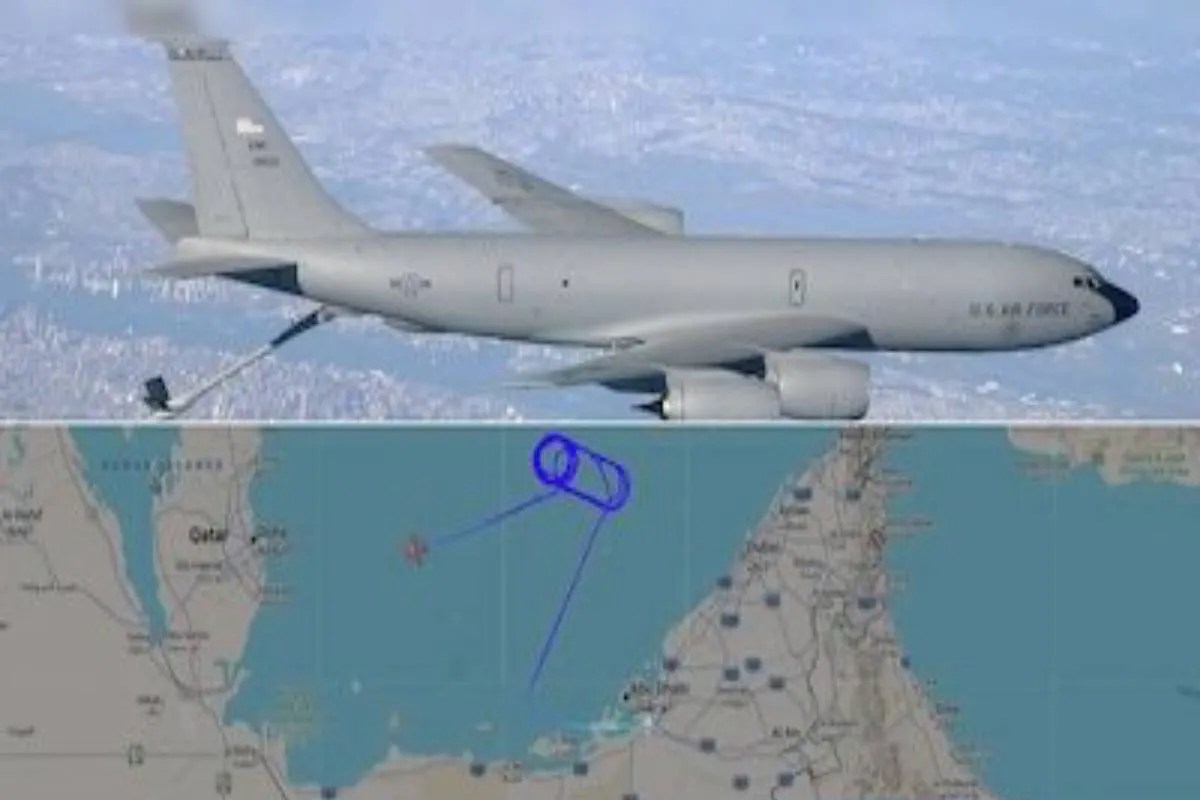
The mainstream media loves a "ghost in the machine" story. When news broke about a US military aircraft "vanishing" from flight tracking software over Qatar after circling aimlessly, the internet did what it always does: it panicked. Amateur sleuths pointed toward mechanical failure, secret abductions, or—the favorite of the tin-foil-hat brigade—supernatural anomalies.
They are all wrong. Building on this theme, you can find more in: The Algorithm and the Empty Desk.
The plane didn't disappear. It wasn't in trouble. And it wasn't a glitch. What the world witnessed was a deliberate, routine, and highly calculated display of signal management that the general public is too technologically illiterate to understand. We aren't looking at a mystery; we are looking at the fundamental friction between 1940s transponder logic and 21st-century electronic warfare.
The Transponder Trap
Most people think flight tracking websites like FlightRadar24 or ADS-B Exchange are the "truth." They aren't. They are a filtered, aggregated stream of unencrypted data. Experts at Mashable have also weighed in on this trend.
To understand why the Qatar "disappearance" is a non-story, you have to understand Automatic Dependent Surveillance-Broadcast (ADS-B). It is a system where an aircraft determines its position via satellite navigation and periodically broadcasts it. This is great for civilian air traffic controllers who want to make sure two Boeings don't occupy the same physical space at 30,000 feet.
It is a liability for the military.
When a US military asset—likely a platform like the RC-135V/W Rivet Joint or an E-11A BACN—circles an area like Qatar, it is doing its job. It is collecting data, acting as a communication relay, or testing localized jamming capabilities. The moment that mission shifts from "transit" to "operation," the pilot or the mission commander flips a switch.
The plane doesn't vanish from the sky. It vanishes from your screen.
The "ghosting" phenomenon is simply the toggling of the transponder into "Mode S" or turning off the ADS-B broadcast entirely. This isn't a malfunction. It’s operational security (OPSEC) 101. The fact that the plane circled first wasn't a sign of distress; it was likely a calibration orbit or wait-time for a specific mission window to open.
The Middle East is a Digital Laboratory
I have spent years watching how signal intelligence (SIGINT) assets move through the Central Command (CENTCOM) area of responsibility. If you think a plane "disappearing" over the Persian Gulf is rare, you haven't been paying attention.
Qatar’s Al Udeid Air Base is the nerve center of US air operations in the region. The airspace around it is the most surveyed, jammed, and electronically congested environment on the planet.
In this theater, we aren't just flying planes; we are testing the limits of Electronic Countermeasures (ECM).
Imagine a scenario where a military aircraft needs to mask its exact point of origin or its final destination from adversarial observers (who are also watching those same public flight trackers). The pilot will fly a predictable pattern to "bore" the observers, then go dark. By the time the signal drops, the aircraft could be doing one of three things:
- Entering a restricted corridor where civilian tracking is prohibited.
- Initiating a low-probability-of-intercept (LPI) radar test.
- Simply landing at a high-security facility while the public is busy looking at a "last seen" coordinate five miles away.
The competitor articles on this topic focus on the "mystery" because mystery sells clicks. But the real story—the uncomfortable truth—is that the US military treats public flight tracking data as a playground for misinformation.
Stop Trusting the Blue Icon
The "lazy consensus" among armchair analysts is that if the icon stops moving, the plane is down. This logic is dangerous and outdated.
We have to differentiate between Primary Radar and Secondary Radar.
- Primary Radar: Reflects radio waves off the skin of the aircraft. It doesn't care if the pilot wants to be seen or not.
- Secondary Radar (ADS-B/Transponders): Relies on the aircraft "talking" back to the ground.
When you see a plane vanish from a tracking app, you are only seeing the failure of the secondary signal. The military’s primary radar systems, and those of any sophisticated nation-state like Qatar or Iran, still see that aircraft perfectly clearly.
The "disappearance" is a digital curtain pulled over the eyes of the public, not the eyes of the professionals.
The Cost of the "Ghost Plane" Narrative
Every time a major news outlet runs a breathless piece about a "mysterious disappearance" of a military asset that clearly just went dark for OPSEC, they degrade the public's understanding of national security.
I’ve seen how this plays out in the private sector too. Defense contractors spend millions developing "stealthy" digital signatures, only for a $50 Raspberry Pi running an ADS-B receiver to "expose" them. The result? The military gets smarter. They learn to spoof. They learn to "teleport" icons across the map by manipulating GPS time-stamps.
The Qatar incident wasn't a failure of American technology. It was a successful demonstration of it.
If you want to know where the plane went, don't look at the map. Look at the geopolitical temperature. Qatar is a delicate hub of diplomacy and military might. If a high-value asset goes dark there, it’s because something is happening that isn't intended for a Twitter feed.
The Uncomfortable Reality of Modern Aviation
We are entering an era where "visibility" is a choice, not a requirement. For the military, the ability to disappear in plain sight is more valuable than any kinetic weapon.
The real danger isn't that a plane might vanish. The danger is that one day, a plane will appear on your tracking software that isn't actually there at all. Spooking the sensors is the next frontier of warfare, and the Qatar "ghost" was just a tiny, unintentional glimpse into that reality.
Next time you see a military tail number flicker and fade over a conflict zone or a strategic hub, don't look for a crash site. Look for the motive. The sky didn't swallow that plane. The pilot just decided you weren't cleared for the rest of the flight.
Log off the tracker and stop chasing ghosts. The real action is happening in the frequencies you can't see.