Diplomats love a shiny new press release. Give a room full of foreign ministers a microphone, a summit backdrop, and a few trendy buzzwords, and they will announce a historic strategic realignment before the coffee gets cold.
The lazy consensus sweeping Washington, Tokyo, Canberra, and New Delhi goes like this: the Quadrilateral Security Dialogue has matured. No longer just a loose maritime security talking shop, the Quad is supposedly transforming into an economic juggernaut built to counter Beijing’s stranglehold over artificial intelligence and critical minerals. Pundits nod sagely. Think tanks churn out white papers praising the "institutionalization" of supply chain resilience. Everyone claps. Read more on a similar issue: this related article.
They are celebrating a mirage.
The idea that four nations with wildly divergent industrial policies, incompatible trade priorities, and massive structural dependencies on Chinese manufacturing can casually decree an alternative critical mineral and AI ecosystem into existence is pure fantasy. I have watched multinational mining conglomerates and sovereign wealth funds burn hundreds of millions of dollars chasing government-backed "friend-shoring" initiatives that looked brilliant on a summit communiqué and died a quiet, expensive death in the permitting phase. Further analysis by MarketWatch explores comparable views on the subject.
The Quad’s grand pivot to economic security is not a masterstroke of statecraft. It is a distraction from the hard, unglamorous industrial realities these four governments refuse to confront at home.
The Myth of the Instant Supply Chain
Let us look at the actual mechanics of critical minerals, because foreign policy analysts rarely do. When officials talk about securing lithium, cobalt, rare earth elements, or graphite, they treat supply chains like Lego sets. Pull a piece out of Jiangxi province, snap a new piece into Western Australia or Nevada, and call it a day.
That is not how metallurgy works.
Australia digs up roughly half the world’s lithium. That sounds impressive until you follow the ore onto a cargo ship. The vast majority of that spodumene concentrate sails straight to China for chemical refining. Why? Because midstream processing—turning raw rock into battery-grade lithium hydroxide or separated rare earth oxides—is capital-intensive, energy-hungry, environmentally messy, and operates on razor-thin margins that Western equity markets despise.
China did not win this sector by accident, nor did it win merely through unfair subsidies. It won through decades of relentless vertical integration, state-backed patient capital, and a willingness to tolerate industrial pollution that would trigger immediate litigation and community blockades in California, New South Wales, or Karnataka.
Consider the numbers. According to data from the International Energy Agency, China controls roughly 60 percent of global critical mineral refining and upwards of 85 to 90 percent of rare earth element separation and magnet manufacturing. You do not overturn a thirty-year manufacturing monopoly with a Quad working group and a few hundred million dollars in joint development grants.
The Structural Friction Inside the Room
Even if money were no object, the Quad itself is the wrong vehicle for industrial coordination. The grouping works well when the mission is clear, kinetic, and defensive—like conducting joint naval exercises in the Indo-Pacific or sharing maritime domain awareness data to track dark vessels.
Economic security is the exact opposite. In naval exercises, four ships sailing together multiply their deterrence. In industrial policy, four nations trying to build domestic manufacturing bases are direct competitors fighting for the exact same pool of capital, engineers, and off-take agreements.
Look at the conflicting incentives sitting around the Quad table:
- The United States wants domestic manufacturing above all else. Washington’s industrial policy—anchored by massive subsidies and strict domestic-content rules—is explicitly designed to pull factories onto American soil, even at the expense of allies in Tokyo and Seoul.
- Japan is a resource-poor manufacturing powerhouse that survives on stable, low-cost global trade flows and high-precision component exports. Tokyo has spent over a decade quietly building its own bilateral mineral stockpiles through JOGMEC without waiting for Washington’s permission.
- Australia is an export-dependent quarry that relies on Chinese demand to balance its federal budget. Canberra wants to move up the value chain into processing, yet its high labor and energy costs make domestic refining brutally uncompetitive without permanent taxpayer life support.
- India protects its domestic market behind steep tariff walls, prioritizes local employment over global supply chain efficiency, and maintains deep, pragmatic trade ties with both Russia and China whenever it suits New Delhi’s development goals.
Pretending these four economies share a unified economic strategy requires ignoring every major trade dispute between them over the past decade. You cannot build a unified supply chain when your domestic politics demand protectionism against the very partners sitting across the table.
Why AI Governance Is the Ultimate Diplomatic Escape Hatch
Whenever policymakers hit a brick wall on hard infrastructure, they pivot to tech governance. Enter artificial intelligence.
The Quad’s newfound obsession with AI standards, semiconductor supply chains, and trusted digital infrastructure follows a predictable bureaucratic script. Semiconductors and frontier AI models are genuinely critical to modern military and economic power. Yet the Quad’s role in this space is largely decorative.
The real power in the global semiconductor ecosystem does not sit in Canberra or New Delhi. It sits in the boardrooms of TSMC in Hsinchu, ASML in Veldhoven, Nvidia in Santa Clara, and Tokyo Electron in Minato. Notice something about that list? Two of the most important players in the entire stack—Taiwan and the Netherlands—are not even in the Quad.
Furthermore, the US-led export control regime targeting advanced chips and lithography equipment was not negotiated through the Quad. Washington imposed those rules unilaterally using the Foreign Direct Product Rule, dragging Japan and the Netherlands along through intense bilateral pressure.
When the Quad issues joint statements on "safe, secure, and trustworthy AI" or launches small-scale agricultural AI pilot programs in the Indo-Pacific, it is engaging in low-cost diplomatic signaling. It gives ministers something positive to announce while avoiding the explosive disagreements over cross-border data flows, digital services taxes, and intellectual property enforcement that actually divide Washington and New Delhi.
Answering the Questions Nobody Wants to Ask
If you search for what the Quad is doing on tech and trade, you will run into the standard set of surface-level questions. Let us dismantle the flawed premises behind them.
Can the Quad break China's monopoly on critical minerals?
No. Not within this decade, and certainly not through diplomatic summits. Breaking a refining monopoly requires three things the Quad nations currently lack: streamlined permitting laws that allow mines and chemical plants to be built in three years instead of fifteen, massive state-backed price floors that protect Western refiners when Beijing floods the market to crash prices, and a massive expansion of cheap, baseload industrial electricity. Until a refinery can be permitted and powered in the United States or Australia as fast as it can in Inner Mongolia, the monopoly stays intact.
Is the Quad becoming an economic NATO?
Stop using this comparison. NATO is a binding mutual defense treaty backed by integrated military command structures and nuclear deterrence. The Quad is an informal diplomatic grouping with no secretariat, no binding treaty obligations, no unified trade bloc, and zero consensus on how to respond if Beijing blockades Taiwan. Calling it an economic NATO insults the intelligence of anyone who understands how treaties or markets actually function.
Does India benefit from the Quad's tech and mineral shift?
India benefits immensely—precisely because it takes the diplomatic prestige and technology transfer opportunities without sacrificing its strategic autonomy. New Delhi gets access to American defense tech, Japanese infrastructure financing, and Australian raw materials, all while continuing to import tens of billions of dollars in Chinese electronics, active pharmaceutical ingredients, and solar components. India is playing the room brilliantly. Western analysts mistaking India’s transactional pragmatism for ideological alignment are fooling themselves.
The Uncomfortable Trade-Offs of Real Decoupling
To be clear, I am not arguing that Western democracies and their Indo-Pacific partners should sit back and accept permanent dependency on Beijing for strategic materials and compute infrastructure. Supply chain concentration at this scale is a genuine national security vulnerability. If a crisis erupts in the South China Sea or the Taiwan Strait, Beijing will not hesitate to weaponize export controls on gallium, germanium, graphite, and rare earth magnets. We have already seen the opening salvos of those restrictions.
The mistake is believing we can solve a hard industrial problem with soft diplomatic architecture.
Real supply chain resilience comes with ugly, politically toxic price tags that almost no politician in Washington, Canberra, or Tokyo wants to explain to voters:
- Higher consumer prices. Non-Chinese refined minerals and domestically manufactured clean-tech components cost 20 to 50 percent more. Someone has to pay that green-and-security premium—either taxpayers through endless subsidies or consumers at the register.
- Environmental compromises. You cannot build a domestic lithium, nickel, or rare earth processing industry without digging massive open-pit mines, managing toxic tailings ponds, and burning enormous amounts of industrial power. Environmental groups and local NIMBY coalitions in democratic nations routinely sue these projects into oblivion.
- Market intervention. Free-market orthodoxy cannot beat state capitalism in commodity processing. Every time a Western rare earth miner gets close to profitability, Chinese state-backed producers can ramp up output, tank global spot prices, and bankrupt the Western competitor before its plant even reaches full capacity. Without guaranteed government off-take contracts and price floors, private capital will never fund midstream refining at scale.
What Actually Works Instead of Summit Theater
If policymakers and corporate strategists want actual resilience rather than press-release victories, they need to abandon multilateral wishcasting and focus on ruthless, targeted execution.
First, stop trying to build end-to-end supply chains inside every country. Reshoring everything is a recipe for bloat and failure. Instead, use bilateral defense-industrial agreements to lock in specific choke points. Let Australia and Canada focus on extraction and primary processing. Let Japan and South Korea handle specialized chemical refining and component manufacturing. Let the United States provide the venture capital, defense procurement contracts, and high-end chip design.
Second, weaponize sovereign procurement. Stop handing out small grants to dozens of speculative junior mining startups that will never reach commercial production. Follow the playbook Japan’s JOGMEC pioneered after the 2010 Senkaku rare earth crisis: take direct equity stakes in proven, late-stage projects, sign ten-year guaranteed off-take agreements at fixed floor prices, and build physical strategic stockpiles in underground salt caverns and warehouses.
Third, fix domestic permitting before signing another international MOU. An international agreement means nothing if an environmental review takes nine years and four rounds of federal court appeals. Give strategic mineral refining and high-voltage grid interconnects the exact same legal fast-track authority granted to wartime defense infrastructure.
Fourth, focus AI cooperation on compute infrastructure and energy, not ethics white papers. AI dominance is ultimately an energy and hardware bottleneck. Instead of hosting another symposium on algorithmic bias, use sovereign wealth funds and export credit agencies to co-finance nuclear power restarts, grid-scale battery storage, and subsea fiber-optic cables across the Indo-Pacific.
Imagine a scenario where the Quad cancels its next ten working-group meetings on AI ethics and redirects every dollar of administrative overhead into a single, joint sovereign fund that guarantees a floor price for non-Chinese separated dysprosium and terbium for the next fifteen years. Within thirty-six months, private institutional capital would flood into Western and Japanese refining plants, because the existential risk of Chinese price dumping would disappear overnight.
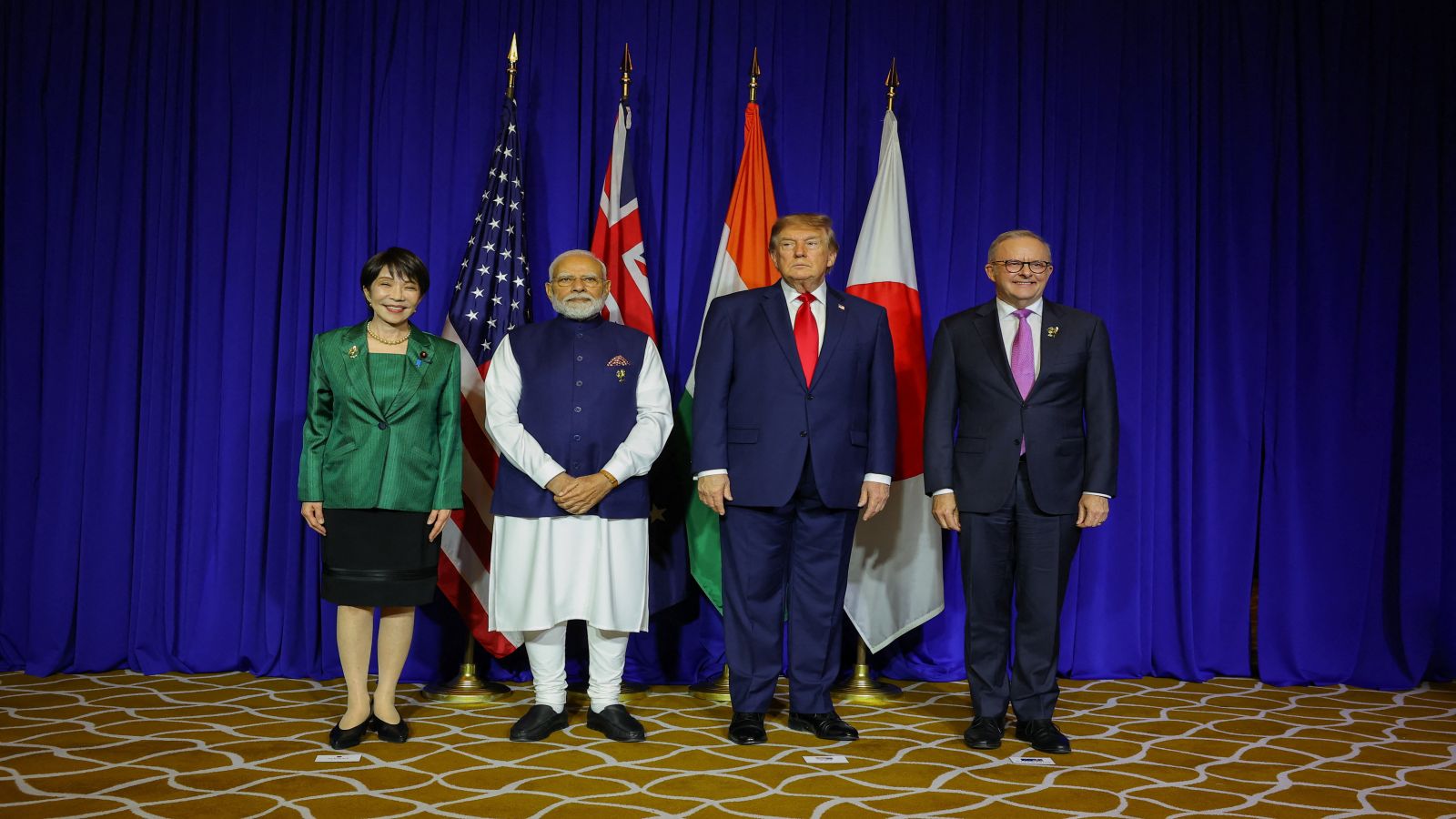
That is how markets move. Markets do not move because four foreign ministers posed for a photo op and promised to deepen cooperation.
Until Washington, Tokyo, Canberra, and New Delhi are willing to override their own domestic NIMBY lobbies, abandon protectionist squabbles with each other, and underwrite the brutal economics of midstream manufacturing, China’s grip on the physical foundation of the twenty-first century will remain unbroken.
Stop reading the summit communiqués and start watching the permitting dockets and commodity spot prices—because until those numbers move, the Quad’s economic pivot is nothing more than expensive noise.