The smell of cold machine oil and wet limestone hangs heavy over the Jura Mountains in late November. Inside a centuries-old workshop in Le Locle, a master horologist adjusts a brass loupe over his left eye, examining a balance spring thinner than a human hair. Four thousand miles away, in a humid industrial park on the outskirts of Shenzhen, a logistics coordinator refreshes a customs manifest on a glowing monitor, watching a pallet of precision medical sensors clear European airspace without a single punitive tariff attached.
Neither of these people works for a diplomatic corps. Neither sits in a Brussels committee room drafting retaliatory sanctions over electric vehicles or solar panels. Yet both are living inside the quiet triumph of an economic experiment that most Western policymakers insisted could never work.
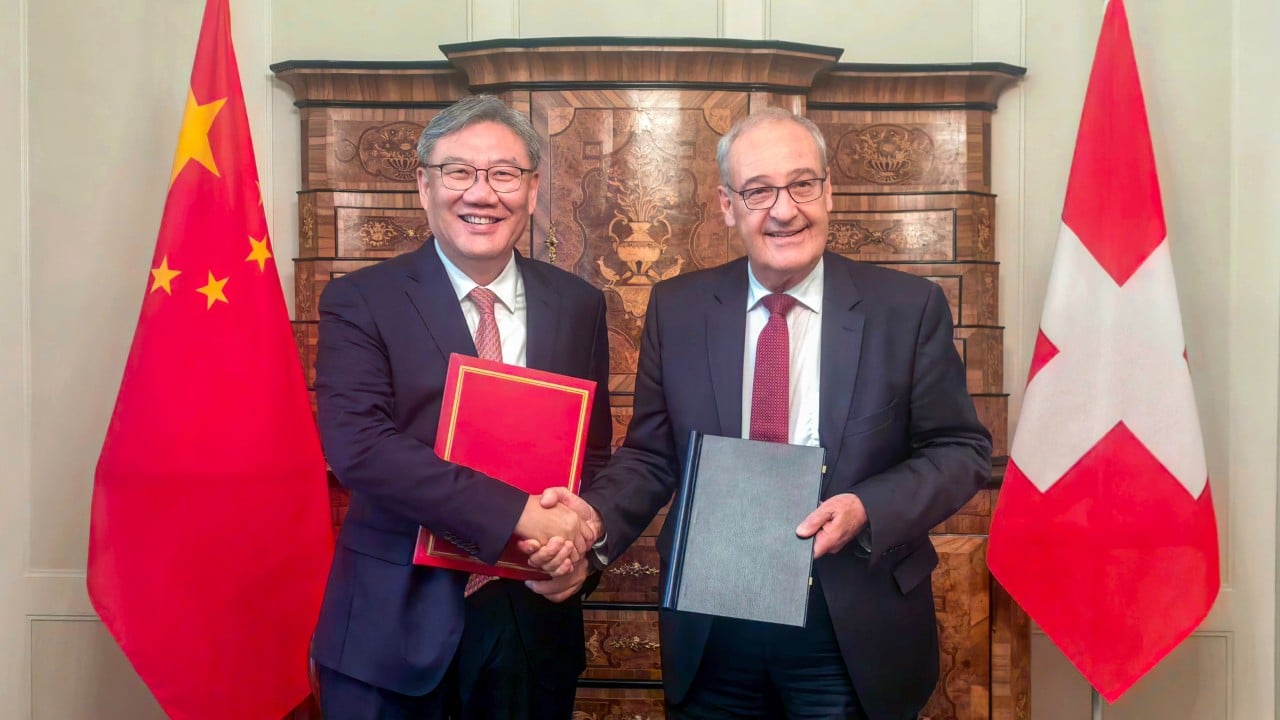
While the European Union and Beijing have spent the last several years locked in a bruising cycle of tariffs, anti-subsidy probes, and mutual suspicion, landlocked Switzerland has quietly operated a radically different playbook. Over a decade ago, Bern signed a bilateral Free Trade Agreement with China—becoming the first continental European nation to do so. Today, as Brussels erects higher walls to protect its industrial base, the China-Switzerland trade partnership stands as a living, breathing counterargument to the prevailing orthodoxy of economic decoupling.
It is an uncomfortable truth for political hardliners. We like our geopolitics tidy, divided cleanly into allies and adversaries, winners and losers. Trade policy, however, rarely obeys the neat boundaries drawn on strategic maps. When you strip away the ideological noise and look at what actually happens on factory floors in Basel and Shanghai, a far more complicated—and human—story emerges.
The Anatomy of an Unlikely Alliance
To understand why a wealthy, fiercely independent Alpine nation of nine million people would hitch its economic wagon to an Asian superpower of 1.4 billion, you have to understand vulnerability.
Switzerland has almost no natural resources. No oil fields, no rare earth mines, no sprawling agricultural plains. For centuries, Swiss survival depended on a simple, unforgiving formula: import raw materials, apply extraordinary human precision, and export high-value finished goods to the rest of the world. Export or perish.
Consider a hypothetical Swiss manufacturer—let us call her Clara—who runs a mid-sized precision tooling company outside Zurich. Ten years ago, her business relied almost entirely on German automotive suppliers. When electric vehicle transitions and energy shocks rattled the European industrial heartland, her order books shrank overnight. Had she been bound by the same tariff barriers and diplomatic freezes that increasingly govern EU-China commerce, Clara’s specialized milling machines would have sat idle. Instead, because of the 2014 Sino-Swiss Free Trade Agreement, her components entered the Chinese market with steadily declining duties, finding eager buyers among Chinese robotics and medical device firms desperate for Swiss tolerances.
Numbers tell the skeleton of this story, even if they miss its heartbeat. Since the agreement took effect in July 2014, bilateral trade between China and Switzerland has surged past $50 billion annually, with China cementing its status as Switzerland’s third-largest trading partner after the European Union and the United States. While many Western nations run massive, politically toxic trade deficits with Beijing, Switzerland has frequently posted a trade surplus—driven by pharmaceuticals, chemicals, luxury watches, and precision machinery.
Wait. Let that sink in.
A tiny European democracy, with some of the highest labor costs on planet Earth, regularly sells more physical goods to China than it buys back.
How? By refusing to compete on volume and instead trading on irreplaceability. You cannot easily replicate a century of Swiss pharmaceutical research or micro-mechanical mastery through state subsidies alone. Beijing knew it needed Swiss precision to upgrade its own manufacturing base; Bern knew it needed access to the world’s fastest-growing consumer and industrial market to keep its factories humming. Both sides set aside grand ideological lectures and negotiated a deal rooted in cold, mutual self-interest.
Meanwhile, in Brussels
Walk through the glass-and-steel corridors of the European Commission in Brussels, and the atmosphere feels worlds apart from the pragmatic quiet of Bern.
For the twenty-seven member states of the European Union, dealing with China is an exercise in herding cats through a minefield. Germany wants to protect its massive automotive investments in Shanghai; France wants aggressive tariffs to shield European green-tech manufacturers from subsidized Chinese imports; smaller Eastern European nations worry about security dependencies and infrastructure debt. By the time Brussels reaches a consensus, policy often arrives years late, blunted by compromise, and wrapped in combative rhetoric.
Think of the EU-China relationship like a massive cargo ship trying to turn in a narrow canal—every degree of rudder movement triggers alarms on the bridge, threatens to scrape the banks, and requires twenty-seven captains to agree on the speed. Switzerland, by contrast, is a nimble Alpine skiff. Without the obligation to harmonize its foreign trade policy with twenty-six other capitals, Swiss negotiators could tailor tariff reductions down to individual product lines, protecting sensitive domestic agriculture while throwing open the doors for industrial machinery and biotech.
The divergence became unmistakable during the recent wave of European tariffs on Chinese electric vehicles and green technology. As Brussels and Beijing traded threats of counter-tariffs on European pork, dairy, and luxury spirits, Swiss officials quietly worked on upgrading their existing free trade pact. In 2024 and 2025, both nations pushed forward negotiations to modernize the agreement, expanding market access for services, green technologies, and financial cooperation.
I have sat in trade policy conferences where European diplomats dismiss the Swiss model as an anomaly—a luxury afforded only to a small, neutral nation that doesn't have to shoulder the geopolitical burden of defending the continent. There is truth in that critique. Switzerland does not maintain a global military presence, nor does it bear the weight of setting regulatory standards for a 450-million-person single market.
Yet dismissing the Swiss experience entirely misses the deeper lesson. What happens when trade policy becomes purely a weapon of geopolitical signaling rather than an instrument of economic livelihood?
The Invisible Stakes on the Factory Floor
We talk about tariffs in percentages, as if a 25 percent duty were merely a clean line drawn across a spreadsheet. It never is. A tariff is a tax paid by real people—an engineer in Baden whose research budget gets frozen, a dockworker in Rotterdam watching container volumes drop, a family in Guangzhou paying more for imported Swiss diagnostic equipment that detects cancer earlier.
To grasp the human cost of fractured trade, imagine a retired schoolteacher in Chengdu named Mr. Lin—a hypothetical composite drawn from real healthcare trends across urban China. When Mr. Lin is diagnosed with a complex autoimmune condition, his doctors prescribe a targeted biologic therapy developed in Basel. Under a cooperative trade framework, tariff reductions and streamlined regulatory recognition mean that therapy reaches his hospital pharmacy faster and at a lower cost. Now imagine that same drug caught in the crossfire of retaliatory trade sanctions, delayed at customs for months while diplomats argue over intellectual property clauses.
That is the invisible stake. Trade wars are always fought by politicians in tailored suits, yet the casualties are always borne by patients, workers, and small business owners who never voted for an economic blockade.
Of course, the Swiss path is far from a frictionless utopia. Critics inside Switzerland—including human rights advocates, labor unions, and wary parliamentarians—have repeatedly warned that deep economic entanglement carries a silent price. When a huge portion of your watchmaking or pharmaceutical revenue depends on Beijing’s goodwill, speaking out on sensitive political issues becomes an agonizing calculation. Self-censorship does not require a government decree; sometimes it just requires a quarterly earnings report.
Even seasoned Swiss executives admit behind closed doors that operating in China has grown harder, not easier, over the past five years. Domestic Chinese competitors have moved rapidly up the value chain. A Chinese firm that bought Swiss CNC grinding machines in 2016 is now building its own rival machines in 2026—and selling them across Southeast Asia at half the price. Intellectual property protection remains a constant, exhausting vigilance, and local procurement rules increasingly favor domestic champions.
I won't pretend the Swiss model solves every dilemma of twenty-first-century globalization. It doesn't. Blindly trusting any superpower with critical supply chains is naive, and Europe’s push to "de-risk" from single-source dependencies emerged from genuine shocks—empty pharmacy shelves during the pandemic, severed gas pipelines, and sudden export controls on critical minerals.
What Pragmatism Actually Looks Like
So why does the China-Switzerland partnership still matter so intensely right now? Because it proves that "de-risking" does not have to mean burning down the bridge.
There is a vast, fertile middle ground between total economic surrender and total decoupling. Switzerland found it by insisting on three deceptively simple principles that larger powers routinely forget:
- Specificity over slogans: Instead of sweeping ideological bans, Swiss negotiators mapped trade line by line, identifying exactly where Swiss and Chinese economies complemented each other rather than collided.
- Institutional dialogue over megaphone diplomacy: When disputes arise over intellectual property or market access, Bern relies on standing technical committees that meet quietly away from television cameras, solving problems before politicians turn them into national pride contests.
- Relentless reinvestment in domestic excellence: Switzerland never used its trade deal as an excuse to get lazy. It pours over three percent of its GDP into research and development, ensuring that whatever it sells to China remains indispensable.
Look closely at those three habits. None of them require Alpine neutrality or a nine-million-person population. They require discipline, humility, and the courage to treat trade as a practical craft rather than a morality play.
Back in that quiet workshop in Le Locle, the watchmaker lifts his loupe and sets the tiny mechanical movement onto a velvet tray. Inside that casing, thirty-two microscopic gears interlock with tolerances measured in microns. If two gears clash, the entire timepiece grinds to a halt. They do not have to be made of the same metal, nor forged in the same furnace—they only have to mesh without destroying one another.
Outside, snow begins to fall over the Jura ridge, muffling the sound of the freight train winding down the valley toward Basel, carrying crates bound for Zurich, Frankfurt, and eventually, the cargo holds of Shanghai.