The fluorescent lights of a late-night logistics office in Rotterdam hum with a low, persistent vibration that you only notice at three in the morning. Elena, a composite character drawn from the thousands of European supply-chain directors navigating modern trade corridors, stares at three glowing monitors. On the left screen, a shipping manifest from Shenzhen sits frozen in customs clearance, stalled by shifting tariff schedules out of Washington. On the right screen, a freight rail timetable stretching across the Eurasian landmass shows delays caused by ongoing sanctions and regional conflict tied to Moscow. And in the center monitor, blinking steadily like a lighthouse in thick fog, sits a trade financing portal routed through Beijing.
Wait. You might also find this connected story useful: Inside the Shenzhen Summit Where Three Strongmen Traded Substance for Spectacle.
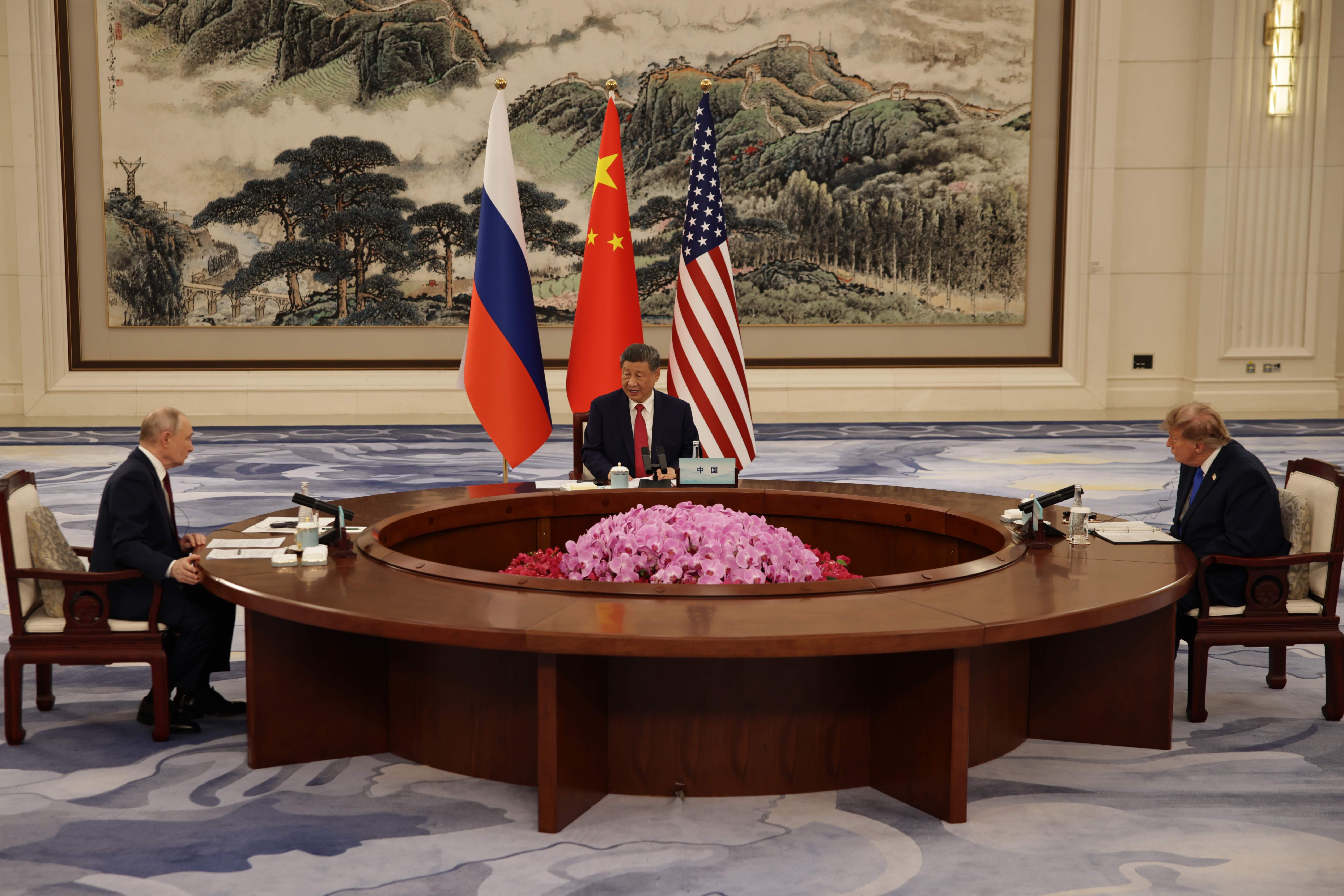
Look closer at that arrangement of screens. It is not merely the frantic setup of one exhausted manager trying to move microchips and solar panels across oceans before sunrise. It is the exact geopolitical geometry of our current era, compressed onto a single desk. When international observers and foreign policy analysts examine how Xi Jinping is demonstrating China's global status—specifically by occupying a central position in relation to Donald Trump and Vladimir Putin—they often describe it in the bloodless, clinical language of statecraft. They talk about bilateral frameworks, strategic triangles, and multipolarity.
From the ground floor of the global economy, however, it feels entirely different. It feels like standing inside a room where two loud, unpredictable giants are shouting across a table, while a third figure sits quietly at the head of that table, holding the keys to the doors, the ledger for the electricity bill, and the contracts everyone eventually has to sign. As discussed in detailed coverage by BBC News, the implications are notable.
To understand how we arrived at this peculiar arrangement, we have to step back from the breathless breaking-news chyrons and look at the mechanics of leverage without using the buzzwords pundits love so much. Consider a simple, everyday analogy: the neighborhood hardware store during a sudden winter freeze. When the pipes burst and tempers flare between neighbors arguing over whose fault the frozen main line is, the person who owns the only supply of copper tubing and pipe wrenches does not need to yell. They do not need to threaten anyone. They simply unlock the front door, turn on the open sign, and let the line form outside.
Beijing has spent the better part of two decades quietly stocking the shelves of that metaphorical hardware store.
The Architecture of the Middle Seat
When foreign policy scholars at institutions like the Carnegie Endowment for International Peace and Chatham House analyze the triangular dynamic between Washington, Moscow, and Beijing, they point to a structural shift that took years to assemble. In the late twentieth century, during the Cold War, Henry Kissinger famously executed a diplomatic maneuver that pulled Beijing closer to Washington to isolate Moscow. Back then, Washington occupied the pivot point. Both communist powers needed something from the United States—capital, technology, or security guarantees—more than they needed each other.
Today, the magnetic poles have flipped.
Watch how the interactions unfold in practice. On one flank, Moscow finds itself deeply dependent on Chinese markets and industrial output. Following the sweeping Western sanctions imposed after the invasion of Ukraine, Russia's economic survival increasingly relied on trade with its massive southern neighbor. According to customs data published by Beijing, bilateral trade between China and Russia surged past $240 billion annually, far ahead of earlier schedules. Russian crude oil, natural gas, and raw commodities flow south and east at discounted rates, while Chinese electronics, heavy machinery, and consumer vehicles flow north and west to fill the void left by departing European and American corporations.
Yet, as analysts at the Center for Strategic and International Studies frequently note, this partnership has clear boundaries. Beijing provides Moscow with an economic lifeline, diplomatic cover at the United Nations, and a shared rhetorical opposition to American dominance. At the same time, Chinese state banks have repeatedly tightened compliance checks on Russian transactions to avoid triggering secondary sanctions from the United States Treasury. Beijing keeps Moscow close enough to serve as a strategic counterweight to the West, yet holds enough distance to protect its own access to Western financial markets.
Now turn your gaze to the other flank of the triangle.
Across the Pacific, the relationship between Beijing and Washington—particularly under the volatile, transactional approach championed by Donald Trump—operates on a completely different frequency. Where Putin offers ideological alignment against the Western-led order, Trump brings tariff threats, trade renegotiations, and sudden shifts in alliance commitments. For many capitals in Europe and Asia, the unpredictability of American trade policy and security guarantees creates acute anxiety. Allies wonder whether longstanding defense treaties remain ironclad or whether every relationship is suddenly up for renegotiation on a transactional basis.
And right there, in the space opened up by Washington's unpredictability and Moscow's isolation, Xi Jinping steps forward.
The Choreography of Stability
I remember sitting in a cramped press briefing room in Geneva several years ago, watching diplomats from fifteen nations try to salvage a climate and trade communiqué after hours of deadlock. The air smelled like stale espresso and wet wool coats. Whenever the American delegation pushed aggressively for immediate structural concessions, the room tensed. Whenever the Russian delegates dug in their heels on procedural vetoes, the clock ticked down toward failure. Then, the Chinese delegation would calmly circulate a revised draft—one that preserved their core commercial interests while sounding reassuringly measured, patient, and committed to "win-win cooperation."
That memory comes rushing back whenever Beijing hosts high-level summits or dispatches envoys across the Global South.
Why does Beijing's positioning resonate so strongly outside Washington and Brussels? Because for a finance minister in Jakarta, a central banker in São Paulo, or an infrastructure planner in Nairobi, geopolitical grandstanding does not build bridges or stabilize currencies. Predictability does. When Washington threatens sweeping tariffs on allies and adversaries alike, and when Moscow wages a protracted land war that disrupts global grain and energy markets, Beijing presents itself as the adult in the room—the champion of open trade, multilateral institutions, and sovereign non-interference.
Of course, the reality beneath that polished diplomatic surface is far more complicated, and anyone who pretends otherwise is ignoring the ledger.
Let us be completely honest about the contradictions embedded in this posture. While Beijing champions free trade at forums like Davos and APEC, domestic industrial policies—subsidizing electric vehicles, batteries, and green technology on a massive scale—have flooded global markets with low-cost exports, threatening manufacturing jobs not only in Ohio and Bavaria, but also in Brazil, India, and Thailand. While Chinese diplomats speak passionately about territorial sovereignty and peace, Beijing refuses to condemn Russia's violation of Ukrainian borders and maintains relentless military pressure around Taiwan and in the South China Sea.
Even inside China, the economic engine powering this global stature faces serious headwinds. A prolonged real estate slump, sluggish domestic consumer confidence, high youth unemployment, and mounting local government debt mean that Beijing's leadership is not operating from a position of effortless invincibility. In fact, many economists argue that Xi's assertive outreach abroad is directly tied to pressures at home: when domestic consumption falters, exporting industrial capacity and securing stable external markets become matters of political survival.
What Happens When the Pivot Holds the Leverage
Consider what happens next when both Washington and Moscow must route their strategic calculations through Beijing.
Suppose a sudden crisis erupts on the Korean Peninsula, or a fresh escalation threatens energy shipping lanes in the Middle East. Who picks up the phone first, and whose phone rings twice? Washington recognizes that Beijing holds unmatched economic sway over Pyongyang and maintains deep commercial ties with Tehran. Moscow knows that without Chinese diplomatic backing and commercial trade, its leverage against NATO diminishes sharply. Meanwhile, leaders across Europe—caught between war on their eastern border and tariff friction across the Atlantic—find themselves traveling to Beijing to plead with Xi to use his influence over Putin while simultaneously trying to keep their own export markets open.
Notice the pattern. Every road leads through the center.
In diplomatic history, occupying the central position between two rivals does not require being stronger than both combined. It only requires being indispensable to each while ensuring that the two rivals remain unable to reconcile with each other. As long as Washington and Moscow remain locked in deep hostility, neither can afford to completely alienate Beijing. If Washington pushes China too hard without offering off-ramps, Beijing leans closer to Moscow. If Moscow asks for too much military assistance or drags China too deeply into its confrontation with Europe, Beijing quietly taps the brakes and reminds the Kremlin who controls the trade pipeline.
This dynamic carries profound consequences for ordinary people far removed from diplomatic palaces.
Think back to Elena in her Rotterdam office at three in the morning. Her company does not care about ideological debates over multipolarity or centuries-old grievances over spheres of influence. She cares about whether a container of lithium-ion batteries clears port inspection in time to keep an assembly line running in Stuttgart, and whether the insurance premium on a cargo vessel crossing the Red Sea doubles overnight. Every time Washington imposes a new export control, every time Moscow rattles a nuclear saber or disrupts an energy pipeline, and every time Beijing retaliates with restrictions on critical minerals like gallium, germanium, or rare earth elements, the shockwaves travel straight through her spreadsheets and land on household budgets around the world.
Higher borrowing costs. More expensive electronics. Slower clean-energy transitions. Fragmented supply chains that force companies to build duplicate factories in multiple countries just to hedge against political risk.
The Fragility Behind the Throne
There is a temptation, when watching carefully choreographed state visits in the Great Hall of the People, to assume that this central position is permanent—that history has settled into a neat, predictable orbit around Beijing.
History rarely cooperates with neat diagrams.
Sitting at the center of a geopolitical triangle looks commanding from the outside, yet it carries an exhausting, precarious burden. To stay in the middle, Beijing must constantly perform a high-wire balancing act without a safety net. Lean too far toward Putin's revisionist foreign policy, and Beijing risks triggering unified economic retaliation from North America and Europe—markets that still account for the overwhelming majority of China's high-value trade surplus. Lean too far toward accommodating Washington's demands on trade and technology, and Beijing risks appearing weak before a domestic audience conditioned for years to expect national rejuvenation and resistance to Western containment.
Furthermore, middle powers around the world are not passive spectators waiting to be arranged like chess pieces. Countries like India, Indonesia, Saudi Arabia, Turkey, and Brazil have watched this three-way contest closely and drawn their own conclusions. Rather than choosing one patron, they are practicing their own form of multi-alignment—buying discounted oil from Russia, welcoming infrastructure investment from China, seeking advanced defense technology from the United States, and playing all three powers off one another to extract better terms for their own citizens.
The world is not simply splitting into neat blocs, nor is it bowing quietly to a single new center of gravity. Instead, it is becoming noisier, more transactional, and far harder to steer.
Back in Rotterdam, the first gray light of dawn begins to bleed through the blinds, turning the glow of Elena's three monitors pale and watery. The Shenzhen manifest finally clears after an overnight regulatory exemption. The Eurasian rail shipment remains delayed by forty-eight hours, rerouted through a secondary corridor in Central Asia. She rubs her eyes, reaches for a cold cup of coffee, and begins drafting the morning briefing for her executive board—knowing full well that by noon, a single post from Washington, a troop movement ordered from Moscow, or a quiet regulatory directive issued from Beijing could force her to rewrite the entire plan before dinner.