The rain in Wan Chai does not fall so much as it hangs, heavy and warm, clinging to the glass facades of convention centers and the tailored wool of people who rarely take the subway. On a humid Sunday morning inside the Hong Kong Convention and Exhibition Centre, the air conditioning hums at a frequency designed to keep thousands of suited delegates from sweating through their collars. There are no megaphones here. No makeshift street stages. No tangled webs of bamboo scaffolding draped in competing banners.
Instead, there is the soft, rhythmic click of leather soles on polished marble.
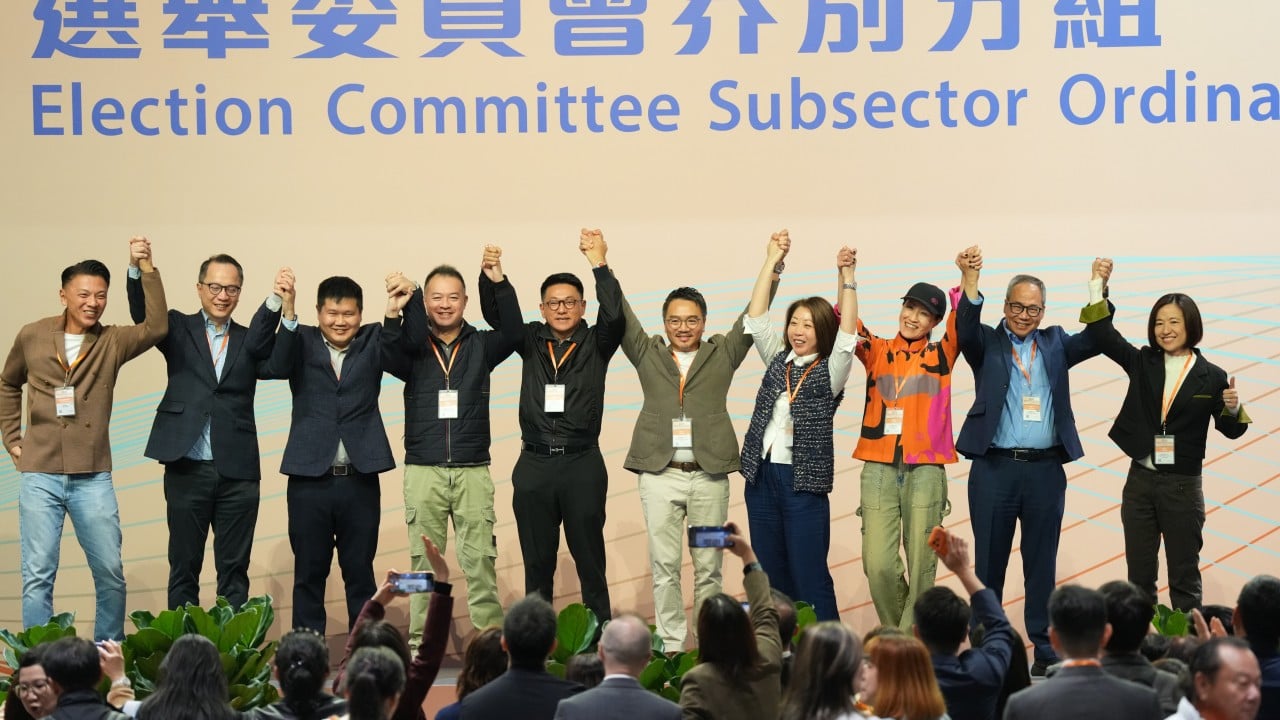
If you were standing in the corridor outside the ballot counting hall during the Hong Kong Election Committee subsector elections, you might mistake the atmosphere for an unusually tense annual shareholders' meeting. Men and women clutch laminated badges, speaking in hushed Cantonese punctuated by sudden, sharp bursts of polite laughter. To the casual observer scrolling past a headline—something dry and institutional about a "healthy contest" with "a few upsets"—this looks like bureaucratic routine. A procedural box checked on a Sunday afternoon before everyone goes home for dim sum.
Look closer at the faces leaving the counting room, though, and you see something entirely different. You see the quiet shock of an old-guard trade association boss whose family has held a seat in this room for two decades, suddenly realizing his name isn't on the winners' list. You see the tight, triumphant smile of a younger, mainland-educated tech entrepreneur who spent the last six months knocking on doors in industrial towers, building a coalition nobody saw coming.
Power.
It rarely announces itself with a trumpet when it shifts inside a closed room. Mostly, it sounds like a heavy door clicking shut while another opens just wide enough for a new silhouette to slip through.
The Invisible Room Where the Future Is Drafted
To understand why a handful of surprise losses in a subsector election sends tremors through boardrooms from Central to Kowloon, you first have to discard everything you think you know about mass democracy. This is not an election where millions of citizens line up at neighborhood schools to drop paper into clear plastic boxes. Since the sweeping electoral overhaul of 2021—a restructuring that reshaped Hong Kong’s political DNA under the principle of "patriots administering Hong Kong"—the Election Committee has become the single most consequential body in the city.
Think of the Hong Kong political system as a high-security vault. In the past, the public held one of the keys, able to influence a portion of the legislature and exert pressure on the executive branch through noisy, unpredictable street-level politics. The 2021 reforms changed the locks. Today, the 1,500-member Election Committee is the master key. Not only does this body choose the city’s Chief Executive, the top leader who steers a financial hub of seven and a half million people, it also directly elects 40 of the 90 seats in the Legislative Council—and holds the power to nominate every single candidate who wants to run for the remaining 50.
Nothing moves in Hong Kong's formal governance without passing through this room first.
Consider a hypothetical character to ground what this actually feels like on the ground. Let us call him Arthur, a composite of the dozens of mid-tier logistics executives who make up the commercial backbone of Kwai Chung. Arthur isn't a politician. He worries about container throughput, warehouse rents, and whether his children will find decent jobs in a city reinventing its economy. Under the old system, Arthur voted in a broad functional constituency where his single ballot felt like a drop of water in Victoria Harbour. Under the restructured rules, the voter base for many subsectors narrowed dramatically, shifting from individual professionals to corporate bodies and designated associations.
Suddenly, Arthur’s company holds a corporate vote. His phone starts ringing. Not with automated campaign robocalls, but with personal invitations to private lunches in Sheung Wan. Candidates aren't pitching vague ideological slogans anymore; they are asking him about cross-border customs clearance times and cold-chain subsidies.
When analysts describe this race as a "healthy contest," they are pointing to a deliberate recalibration by Beijing and the local establishment. After the 2021 overhaul, the inaugural cycle was widely criticized by international observers as a coronation—a rubber-stamp exercise with so little competition that most seats were won unopposed. A rubber stamp, however, has a fatal flaw: it gathers dust, breeds complacency, and fails to warn leadership when the ground beneath them is shifting. You cannot govern a complex, hyper-capitalist metropolis if your inner circle is too comfortable to notice the roof is leaking.
So, for this cycle, the message from the top was unmistakable. Competition wasn't just permitted; it was required.
The Anatomy of an Upset in a Vetted Pool
When every candidate has already passed through a rigorous national security vetting committee—a filter designed to ensure absolute loyalty to the constitutional order—you might assume the outcome is predetermined. If everyone plays for the same overarching team, how can there be an upset?
Ask the veterans of the accounting, engineering, and traditional clan associations who walked away empty-handed when the final tallies flashed onto the screens.
In a pre-vetted field, ideology disappears from the ballot, leaving raw execution, generational friction, and network density as the sole deciding factors. When you strip away party labels, an election transforms into a brutal audit of who has actually been doing the work. For years, certain seats in the Election Committee were treated like hereditary titles. An elder statesman of a chambers-of-commerce guild would put his name forward, collect nominations from his peers over tea, and coast to victory on seniority alone.
This time, seniority wasn't enough.
Take the contested races in the commercial, professional, and grassroots subsectors, where more than a thousand candidates vied for hundreds of contested seats—a stark contrast to the quiet uncontested sweeps of the recent past. In several high-profile subsectors, established figures who relied on name recognition and decades-old Rolodexes were unseated by younger, technically fluent challengers who treated the corporate electorate like a startup market.
I remember speaking with a campaign strategist in Admiralty a week before the polls opened, watching him map out voter outreach on a whiteboard covered in red and blue dry-erase markers. He looked exhausted, rubbing the bridge of his nose as he explained the new math. In the old days, he told me, you needed a few charismatic soundbites for the evening news to move thousands of individual voters. Now, your entire electorate in a given subsector might consist of fewer than three hundred corporate entities and association directors.
"If you miss twenty phone calls," he said, tapping the board with his marker, "you lose. You can't hide behind a party banner when every single voter knows your mobile number and remembers whether you showed up to their industry roundtable last November."
That intimacy creates a strange, high-stakes pressure cooker. When a prominent incumbent loses in a system like this, the humiliation is deeply personal. You cannot blame a sudden swing in public mood or an external political wave. You lost because the people sitting across the table from you—your peers, your suppliers, your fellow directors—quietly decided someone else would represent their interests better.
The Myth of the Monolith
From the outside, particularly through the lens of Western commentary, Hong Kong’s post-2021 political establishment is often portrayed as a uniform gray monolith—a single bloc moving in lockstep. That view misses the fierce, subterranean tug-of-war happening beneath the surface of the city's elite.
Spend an evening in the members' dining rooms of Central, and you quickly realize that the "patriotic camp" is not a single interest group; it is an arena where rival visions of Hong Kong’s survival are colliding.
On one side sit the traditional local tycoons and legacy land developers—families whose fortunes were built on real estate monopolies, retail empires, and historical proximity to power. Their instinct is preservation: protect asset values, maintain low taxes, keep regulatory friction to a minimum, and preserve the old ways of doing business.
On the other side stands a rising cohort of mainland-linked executives, state-backed enterprise managers, and younger technocrats educated in Shenzhen, Beijing, or overseas. Their mandate is transformation. They look at Hong Kong’s sky-high commercial rents and sluggish digital adoption not as sacred traditions, but as structural liabilities holding the city back from integrating into the Greater Bay Area.
And wedged between them are the grassroots and labor representatives—union leaders and district organizers who know that if housing affordability and stagnant wages aren't addressed, no amount of high-finance wizardry will keep the social fabric intact.
The Election Committee race is where these three tectonic plates grind against each other.
When an upset occurs—say, a candidate backed by traditional business networks losing out to a challenger aligned with innovation hubs or grassroots welfare coalitions—it is a visible tremor from that subterranean collision. It signals which faction is gaining institutional muscle ahead of the next Legislative Council and Chief Executive cycles.
Consider what happens next when a Chief Executive hopeful begins gathering nominations from this newly minted committee. Every seat that flipped from an old-guard developer ally to a tech-sector newcomer changes the bargaining table. The next leader of Hong Kong won't just be nodding to the same ten families who have dominated the skyline since the 1980s; they will have to answer to a broader, hungrier, and far more fragmented coalition of specialists who expect tangible policy returns.
The Quiet Stakes for the People Outside the Hall
It is easy, standing in the rain outside the Convention Centre, to feel a profound sense of distance between the drama inside and the daily reality of a nurse in Tuen Mun or a cafe owner in Sham Shui Po. Turnout percentages among the designated electorate were high—often crossing eighty or ninety percent in fiercely contested subsectors—yet for the vast majority of Hong Kong residents who no longer cast a direct ballot for this committee, the entire exercise can feel like watching a chess match behind thick bulletproof glass.
You can see the pieces moving. You know the outcome dictates the rules of the building you live in. Yet your hands never touch the board.
That disconnect is the central tension of modern Hong Kong governance, and pretending it doesn't exist would be dishonest. When an electoral system trades broad popular participation for curated institutional representation, it gains administrative predictability, yes—the gridlock that once paralyzed the legislature and delayed infrastructure budgets for years has vanished. Bills pass in hours rather than months. Policy alignment with Beijing is frictionless.
Yet efficiency carries its own quiet risk: the danger of an echo chamber.
If the 1,500 people inside that hall only talk to one another, if they mistake high turnout among corporate directors for genuine public consensus, the city loses its early warning system. A vibrant society needs friction—not the destructive kind that burns down train stations, but the constructive heat of competing ideas, uncomfortable questions, and genuine accountability.
This is precisely why those unexpected upsets in the subsector races matter far more than the raw numbers suggest. They prove that even within a tightly defined perimeter, real contestation is alive. They demonstrate that incumbency is no longer a lifetime guarantee, and that even vetted insiders can be held to account by their peers when they grow complacent or out of touch.
Think back to Arthur, our hypothetical logistics executive in Kwai Chung. On Monday morning after the election, he walks back into his warehouse office. Nothing on the harbor looks different. The cranes still swing over the container terminals; the ferries still churn across the gray water toward Kowloon. Yet the candidate Arthur backed—a younger supply-chain specialist who promised to push for automated cross-border customs corridors—pulled off a narrow victory over a three-term association veteran.
For the first time in years, Arthur feels like his phone call might actually be returned. Not because the system suddenly became a Western-style street democracy, but because the rules of survival inside the establishment now reward the people who solve real problems rather than those who merely occupy chairs.
The Long Shadow of a Sunday Count
By Sunday night, the giant digital tally boards inside the exhibition hall had dimmed. Staffers rolled away the blue ballot boxes, peeling off security seals and packing away the folding tables. Outside, the city’s neon lights reflected off wet asphalt as black sedans pulled up to the VIP entrance, whisking newly minted committee members away to celebratory dinners in private rooms high above Victoria Harbour.
There were no victory parades through Causeway Bay. No tearful concession speeches delivered to roaring crowds in public squares. Just a quiet transfer of institutional leverage, recorded in neat columns of numbers and certified by judicial observers.
Yet as the sedans merged into the late-night traffic along Gloucester Road, the real work—and the real risk—had only just begun. Those 1,500 seats are not trophies to be displayed in glass cases; they are levers attached to the future of a city standing at the most delicate crossroads in its modern history. Hong Kong is trying to prove it can remain an indispensable global financial bridge while knitting itself tightly into the economic and political fabric of mainland China.
The upsets on that rainy Sunday proved that new voices can still break through the old hierarchy. Whether those new voices have the courage to tell hard truths once they are inside the room remains the only question that truly matters.