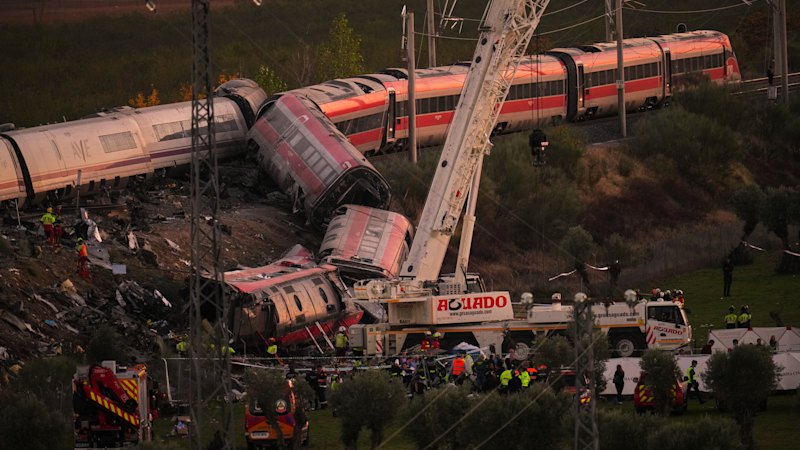
Ten thousand miles is a strange unit of measurement until you try to carry grief across it.
To understand what happened on a stretch of Spanish railway track, you first have to understand the peculiar optimism of the long-haul traveler. You pack a bag in Sydney or Melbourne or Perth. You zip it shut against the hum of a ceiling fan, step onto a jet that smells faintly of recycled air and roasted almonds, and surrender twenty-four hours of your life to the sky. You do this because Europe promises a kind of effortless motion. Once you land, the map shrinks. You buy a paper ticket or tap a phone screen, step onto a sleek carriage, watch olive groves blur into terracotta rooftops, and trust that steel rails will carry you safely toward whatever version of wonder you came to find. Recently making waves in this space: The Quiet Escalation of Los Angeles County Sales Taxes and the Math Behind the Cap.
Then, in the span of three violent seconds, the physics of that trust collapse.
When confirmation arrived from Canberra and Madrid that two Australians had been killed in the devastating train crash in Spain, the news arrived in the blunt, compressed shorthand of modern breaking alerts. Two names withheld pending family notification. Consular assistance deployed. An investigation launched into how a routine rail journey turned into twisted metal and emergency flares. Further insights regarding the matter are detailed by Associated Press.
Stop. Read those words again, slowly, without the armor of a scrolling newsfeed.
A headline turns a catastrophe into an inventory. It counts the carriages off the tracks, tallies the ambulances dispatched to the embankment, and reduces two entire human histories—decades of inside jokes, half-finished books on bedside tables, mortgage payments, dog walks, favorite coffee orders—into a single digit beside a nationality. Two Australians. Confirmed dead.
I have stood on the platform of a European train station with a heavy backpack cutting into my shoulders, watching the departure board flip its mechanical slats, feeling that exact, intoxicating weightlessness that comes from being far from home. When you travel from Australia, distance is not an abstract concept; it is the defining architecture of your life. Every trip abroad requires a deliberate crossing of oceans. Because the journey takes so much effort, you treat the destination with a heightened, almost fragile reverence. You notice the slant of afternoon light through a carriage window. You take photos of mundane things—a crusty roll, a faded station sign, the blurred green of a foreign hillside—to send back to a family WhatsApp group where everyone is currently asleep.
Consider what happens next in a crash like this, not in the official press briefings, but in the quiet kitchens twelve time zones away.
Imagine a hypothetical family in Brisbane—let us call them the Millers, a composite drawn from the very real, agonizing protocol every Australian consular officer knows by heart. In Brisbane, it is two in the morning. The house is silent except for the low thrum of the refrigerator. On a nightstand, a phone lights up with an international prefix, or perhaps a knock sounds at the front door—a sound nobody ever associates with good news at that hour. Meanwhile, half a planet away in Spain, investigators are walking along a torn ballast bed with clipboards and high-visibility vests, trying to reconstruct the final telemetry of a locomotive.
That gap—between the cold mechanics of a European rail investigation and the warm, breathing domesticity of an Australian home—is the invisible terrain of every overseas tragedy.
The Architecture of Modern Rail Trust
To grasp why a train derailment or collision in Spain shocks the nervous system so deeply, you have to look at what rail travel represents in the European imagination. Unlike highways, which we subconsciously accept as chaotic arenas of human error, trains feel deterministic. They run on fixed tracks. They are governed by automated signaling systems, centralized control rooms, and decades of engineering refinement.
Think of a modern rail network like a vast, synchronized watch. Every gear—from the steel alloy of the rails expanding in the Spanish heat to the millisecond-precise block signals telling a driver when to brake—is designed to eliminate surprise. When you board a train in Spain, whether it is a high-speed Alta Velocidad service slicing across the Castilian plateau or a regional commuter line winding through coastal valleys, you are stepping inside that watch. You assume the gears cannot possibly collide.
History, however, reminds us that precision systems fail in the narrow seams where technology meets human vulnerability.
Spain knows this sorrow intimately. In July 2013, near Santiago de Compostela, a train entered a curved section of track at nearly double the posted speed limit, killing seventy-nine people in one of Europe’s worst rail disasters in decades. That tragedy forced sweeping audits of braking systems, track sensors, and cab signaling across the country. Over the following years, Spain poured billions of euros into expanding and modernizing its rail infrastructure, turning it into one of the most admired networks in the world. Millions of tourists—Australians prominent among them—rode those lines every single year without a second thought.
And that is precisely why a fatal crash lands like a betrayal. Safety, over time, breeds invisibility. We stop noticing the engineering miracles beneath our feet until the exact moment they give way.
What Consular Silence Actually Means
In the immediate aftermath of the crash in Spain, the Australian Department of Foreign Affairs and Trade—DFAT—issued the measured, careful statements that always accompany overseas fatalities. Officials confirmed they were providing consular assistance to the families of the two Australians killed, while declining to release identities or granular details out of respect for privacy.
To an impatient public hungry for specifics, diplomatic language can feel frustratingly opaque. Why not name them immediately? Why not explain precisely where they were sitting, where they were headed, what went wrong?
Having watched how crisis response teams operate behind closed doors, I can tell you that this silence is not bureaucracy for its own sake. It is a fragile protective wall built around people whose lives have just detonated.
Before a name can ever appear in a newspaper, a chain of agonizing verification must occur across languages, time zones, and legal jurisdictions. Spanish emergency responders and forensic teams must positively identify the victims amid the wreckage—a process complicated by damaged luggage, scattered passports, and the sheer violence of a rail impact. Those findings must be transmitted through diplomatic channels to Canberra. Only then can Australian officials locate next of kin, ensure a parent or partner is not alone when they hear the words, and coordinate the grim logistics of repatriation.
Repatriation. It is a clinical word for an unbearable task: bringing someone home in a cargo hold who left through a departure gate.
The Invisible Stakes of Being Far From Home
There is a specific vulnerability to dying abroad that rarely makes it into official reports. When tragedy strikes at home, the community gathers physically. Neighbors bring casseroles; friends sit on the edge of the sofa; familiar streets hold your grief in place.
When someone dies on a railway line in Spain, the grieving are stranded on the wrong side of the world.
Families suddenly find themselves navigating Spanish judicial inquiries, translation hurdles, airline bereavement fares, and insurance clauses while in a state of acute shock. At the same time, survivors from the same carriages—other travelers who walked away with bruises, concussions, or survivor’s guilt—are left standing on dusty rural roadsides in small Spanish towns, clutching dead phones and trying to explain to local paramedics what happened.
Let us look honestly at what remains uncertain in the hours and days following such a crash. Early reports from the scene of a major rail accident are almost always fragmentary. Emergency crews focus first on extricating the trapped and triaging the injured, not answering reporters' questions. Whether the primary cause lies in track infrastructure, signaling failure, mechanical fault, or human operation takes weeks or months of black-box data analysis to establish with certainty. Anyone claiming total clarity in the first forty-eight hours is guessing.
What is not uncertain is the human cost already paid.
Every year, hundreds of thousands of Australians board planes bound for Europe. For young Australians, a European rail pass is practically a rite of passage—a summer spent chasing late sunsets, hostel friendships, and the thrill of waking up in a new city every few days. For older Australians, it is often the culmination of decades of saving: a long-planned autumn trip through Andalusia or Catalonia, timed for cooler weather and quieter plazas.
They buy travel insurance. They check their passport expiry dates. They download offline maps. None of them ever look at a train timetable and calculate the odds that the steel beneath them might buckle.
The Weight of an Empty Seat
Think back to that carriage in Spain just before the impact.
The ordinary rhythm of a train journey is hypnotic. The gentle lateral sway. The rhythmic clack-clack over rail joints. Someone is scrolling through photos from the morning's walking tour. Someone else has leaned their forehead against the cool glass of the window, half-asleep, watching the Spanish countryside unspool in shades of ochre and green. Two Australians are somewhere in that moving tube of aluminum and glass, bound to home by text messages sent hours earlier and return flights booked weeks ahead.
In a world conditioned to consume tragedy at high speed, the hardest discipline is refusing to move on too quickly. It is easy to read that two Australians have died in Spain, feel a brief, sharp pang of sympathy, and swipe upward to the next distraction.
Yet somewhere in Australia right now, a suitcase is still sitting in a spare bedroom waiting to be unpacked. A calendar still has a return flight circled in pen. And a family is learning, hour by excruciating hour, that ten thousand miles is not a distance you measure on a map—it is the space between the last message sent from a sunny platform in Spain and the silence that followed.