The plates hit the ceramic tile at 8:14 PM on a Friday night in a packed bistrot in Lyon. Nobody gasped. Nobody even looked up from their steak frites.
Just ten seconds earlier, a four-foot-tall machine with oversized digital cat eyes and four open-backed plastic trays had glided effortlessly between a stroller, a distracted toddler, and a server carrying three scalding bowls of French onion soup. The machine paused, let a patron pull their chair in by two inches, chimed a soft, melodic ding, and rolled toward table twelve.
It did not ask for a tip. It did not complain about a double shift. And almost certainly, it was built in Shenzhen by a company you have probably never heard of.
For years, the global imagination has been held hostage by a very specific kind of sci-fi theater. When we picture the robotic revolution, we picture Elon Musk on a dimly lit stage in California, unveiling Tesla’s Optimus—a sleek, metallic mirror of the human form, walking slowly across polished concrete while engineers hold their breath in the wings. We expect the future to arrive with fanfare, billions of dollars in Silicon Valley venture capital, and an uncanny valley stare.
We got the story completely backward.
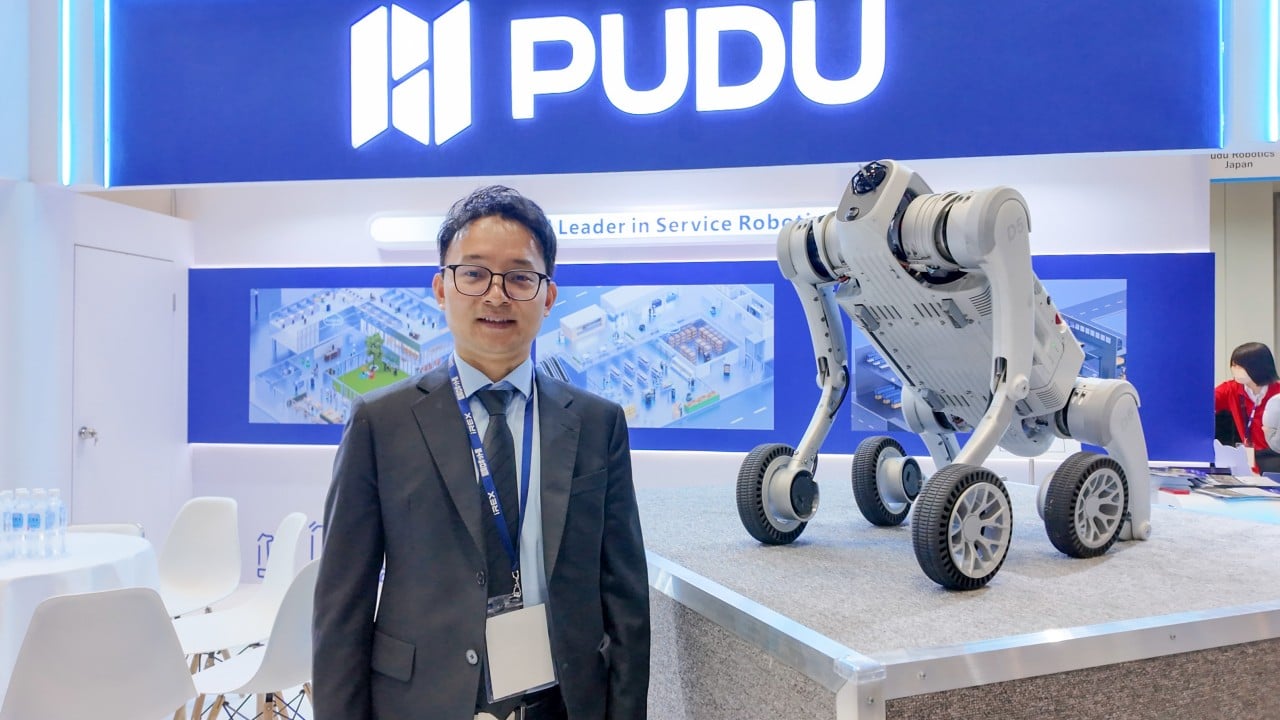
While the West has been obsessed with building machines that look like us, a quiet juggernaut out of southern China has been busy building machines that actually work with us. Pudu Robotics—a firm founded in 2016 in the bustling hardware capital of Shenzhen—has spent the last decade doing something remarkably unglamorous. They built busboys. They built floor scrubbers. They built delivery carts on wheels. And in the process, they conquered the world.
Today, roughly 80 percent of Pudu Robotics’ revenue comes from outside mainland China. Walk into a Pizza Hut in Poland, a Marriott in Tokyo, a family diner in Texas, or a hospital corridor in Seoul, and there is a staggering chance you will cross paths with a Pudu machine. With over 80,000 units shipped across more than 60 countries, this isn't an experiment anymore. It is infrastructure.
And now, armed with the kind of brutal, real-world street smarts that no laboratory simulation can ever replicate, Pudu is stepping onto Tesla’s turf. They are building humanoids.
The Myth of the Laboratory Genius
To understand why Pudu’s entry into the humanoid race should make executives in Austin and Silicon Valley sweat, you have to understand the fundamental difference between a robot raised in a cleanroom and a robot raised in a greasy spoon.
Let’s look at a hypothetical scenario—call it the Tuesday Lunch Rush.
Imagine an engineer in California programming a bipedal humanoid to pick up a coffee mug from a sterile white table. The lighting is consistent. The floor is flat. Nobody is throwing french fries at the robot's sensors, and nobody is drunkenly leaning against its chassis while trying to take a selfie. The humanoid executes the task beautifully. The stock price ticks up.
Now, drop that same billion-dollar prototype into a bustling dim sum restaurant in Hong Kong or a cramped pub in London at peak capacity.
Suddenly, the floor is slick with spilled lager and grease. Wi-Fi signals drop out behind thick brick walls. A child darts out from behind a tablecloth at three miles an hour. A chair is pushed out at an angle that defies standard geometric mapping. In this environment, a purely theoretical robot—no matter how advanced its neural network—experiences a crisis. It freezes. It stumbles. It becomes an expensive, two-hundred-pound obstacle.
Pudu Robotics spent ten years living in that Tuesday Lunch Rush.
When founder Zhang Tao started the company, he didn't set out to replicate human anatomy. He looked at the severe, structural labor shortages choking the global service industry—a crisis that accelerated violently after 2020—and asked a pragmatic question. What is the fastest way to take the heaviest, most repetitive physical burdens off a human worker's back?
The answer was wheels, LIDAR sensors, and obsessive spatial awareness.
I remember the first time I stood beside a BellaBot—Pudu’s flagship delivery robot—in a cramped, noisy ramen shop in Osaka. I intentionally stepped into its path just to see what would happen. There was no jerky, mechanical braking. No whirring panic. The machine simply decelerated with the smooth, liquid grace of a seasoned chauffeur, recalculated a micro-route around my left shoe, and continued on its way, all while keeping four bowls of steaming broth from spilling a single drop.
That kind of spatial intelligence cannot be faked. It is forged through millions of hours of edge-case failures in the messy, unpredictable real world. By the time Pudu decided to enter the humanoid market, they didn't have to guess how machines interact with chaotic human spaces. They already owned the map.
The Anatomy of a Pragmatic Giant
For a long time, the robotics industry operated under an unspoken caste system. At the top sat the prestige projects: Boston Dynamics doing backflips, Tesla promising an army of general-purpose humanoids, Figure AI raising hundreds of millions from tech titans. At the bottom sat commercial service robots—seen by tech elitists as little more than glorified Roombas with trays attached.
That hierarchy is collapsing.
In late 2024, Pudu unveiled the PUDU D7, a semi-humanoid robot, quickly followed by the D9, a full-sized bipedal humanoid standing roughly five-foot-seven and capable of navigating stairs, slopes, and complex industrial environments. Looking at the specs, it is easy to compare them to Tesla’s Optimus or Unitree’s G1. They have multi-fingered dexterous hands. They use end-to-end artificial intelligence models to learn tasks rather than relying on rigid, hardcoded scripts. They walk on two legs.
But look closer at why Pudu is building them, and the strategic divergence becomes blindingly obvious.
Tesla’s vision for Optimus is built on vertical integration and massive, speculative scale. Musk wants to deploy thousands of Optimus units inside Tesla’s own Gigafactories first, using them to sort battery cells and move parts, before eventually selling them to consumers as domestic helpers. It is a top-down, moonshot approach.
Pudu is doing the exact opposite. They are taking a bottom-up, ecosystem approach.
Think of Pudu’s strategy like the evolution of the smartphone. Before the iPhone changed everything, telecom companies spent years building the cellular towers, the supply chains for miniature glass screens, and the battery logistics. When the leap finally happened, the infrastructure was already waiting.
Pudu already has the sales channels. They already have the maintenance technicians stationed in Frankfurt, Tokyo, Chicago, and Dubai. They already have the trust of thousands of enterprise clients—hotel chains, hospital networks, logistics warehouses, and retail giants—who have been signing checks to Pudu for years.
When a hospital administrator in Germany decides they need a machine that can not only roll down a hallway delivering medicine, but also reach out, press an elevator button, open a heavy fire door, and hand a chart to a nurse, who are they going to call? The unproven automotive company promising deliveries next year, or the vendor whose machines are already patrolling their hallways right now?
Why Eighty Percent Matters
There is a statistic buried in Pudu’s corporate profile that deserves far more scrutiny than it usually gets: 80 percent of their sales happen overseas.
In the current geopolitical climate, that number is nothing short of extraordinary. Western markets have grown increasingly skeptical of Chinese hardware, erecting tariffs, security reviews, and regulatory walls against everything from electric vehicles to telecommunications gear. Yet Pudu slipped right through the net.
Why? Because nobody feels threatened by a machine that delivers dumplings.
By starting with low-stakes, high-utility service bots, Pudu bypassed the geopolitical panic that has stalled so many other Chinese tech champions. They quietly embedded themselves into the daily operations of Western capitalism. A restaurant owner in Ohio doesn't care about supply chain geopolitics when they cannot find a single human being willing to work the closing shift for fifteen dollars an hour. They just want their doors to stay open.
This global footprint gives Pudu two massive advantages in the humanoid wars.
First, it gives them pricing power and supply chain dominance. Operating out of Shenzhen—the undisputed nervous system of global hardware manufacturing—Pudu can iterate, prototype, and source actuators, sensors, and custom chips at a speed and cost structure that Western competitors simply cannot match. While American robotics startups burn through cash just to build a dozen prototypes, Shenzhen’s supply chain allows companies like Pudu to drive down unit costs toward mass-market viability.
Second, it gives them data diversity. A robot trained exclusively in American factories learns American environments. Pudu’s fleet operates in the narrow, cobblestone-adjacent interiors of European cafes, the hyper-dense vertical malls of East Asia, and the sprawling suburban big-box stores of North America. Every environment feeds back into their AI models, creating a generalized spatial intelligence that is uniquely cosmopolitan.
The Invisible Stakes of the Two-Legged Future
It is easy to get swept up in the corporate horse race—Shenzhen versus Austin, scrappy specialist versus trillion-dollar titan—and lose sight of what this actually means for the people living inside these spaces.
Let’s be honest about the tension here. Watching a humanoid robot fold laundry or carry a crate is fascinating on a screen, yet deeply unsettling when you imagine it standing next to you at work.
I felt that exact unease last year while touring an automated logistics facility. Watching robotic arms pack boxes with hypnotic, relentless precision, a wave of cold clarity hits you: human hands are wildly inefficient. We get tired. Our lower backs ache. Our minds wander after four hours of repetitive motion.
For decades, blue-collar and service workers were shielded from full automation by a simple biological fact: the human body is an astonishingly versatile machine. Wheels cannot climb stairs. Mechanical claws crush delicate fruit. As long as the physical world remained designed for two legs and ten fingers, human labor remained indispensable.
Humanoids erase that final moat.
If Pudu, Tesla, and their competitors succeed in bringing down the cost of a dexterous, bipedal robot to the price of an economy car—say, $20,000 to $30,000—the economics of human labor shift overnight. A machine that works twenty-four hours a day, seven days a week, amortizes its cost in less than a year. After that, it works for the price of electricity.
Pudu’s executives are acutely aware of the optics. They consistently frame their technology not as a replacement for human workers, but as a lifeline for aging societies. And to be fair, look at the demographic cliff facing countries like Japan, South Korea, Germany, and China itself. Populations are shrinking. Birth rates are plummeting. There simply are not enough young bodies to care for the elderly, clean the hospitals, stock the shelves, and serve the food.
In a nursing home in rural Japan, where one exhausted caregiver might be responsible for twenty residents through the night, a humanoid robot that can lift a patient safely out of bed or fetch water at 3:00 AM isn't a job-stealer. It is the only thing keeping the facility from shutting down.
The catch, as always, lies in who controls the transition. History shows us that technological leaps rarely distribute their rewards evenly without a fight. The Industrial Revolution brought unimaginable wealth and modern comfort, yet it chewed up generations of weavers, farmers, and factory hands before labor laws and social safety nets caught up.
We are standing at the edge of a similar precipice, except this time, the machines don't just have stronger muscles. They have eyes, spatial memory, and the ability to learn by watching us.
The Illusion of the Finish Line
So, who wins? Does Pudu’s pragmatic, commercial-first army outmaneuver Tesla’s vertically integrated juggernaut?
The truth—and it is a truth few tech pundits like to admit—is that nobody knows, because the humanoid industry hasn't even survived its first real winter yet.
Right now, the entire sector is fueled by breathtaking optimism and staggering capital. Yet the engineering hurdles remain brutal. Battery life for untethered bipedal robots is still measured in a few hours, not full shifts. Dexterous hands, packed with dozens of tiny motors and tactile sensors, break easily when exposed to dust, moisture, or sudden impacts. Software that looks miraculous in a curated demo video can still fail catastrophically when faced with an unfamiliar lighting glare or a slightly deformed cardboard box.
Tesla has the war chest, the AI compute clusters, and the gravitational pull of Elon Musk’s brand to brute-force its way through years of expensive trial and error. If anyone can build a massive, self-sustaining manufacturing loop for humanoids, it is the company that broke the auto industry's orthodoxy.
Yet Pudu possesses something money cannot easily buy: institutional humility.
They know what it takes to keep a machine running when nobody with a PhD is in the building. They know how to design hardware that can be wiped down with bleach by a minimum-wage worker at midnight without short-circuiting. They understand that in the real world, reliability beats brilliance every single time.
They didn't start by trying to build a god in a machine. They started by trying to carry dirty dishes without dropping them.
The Shift You Won't Notice
Think back to that bistrot in Lyon.
When the four-wheeled robot rolled past those diners on a busy Friday night, the most remarkable thing wasn't the technology inside its chassis. It was the total lack of wonder in the room. Within three years, a machine that would have looked like high-budget cinema in 1995 had become as unremarkable as a toaster or a revolving door.
That is how the humanoid revolution will actually arrive.
It will not come as a sudden, dramatic takeover. There will be no single day when the robots march down Main Street. Instead, one morning you will walk into a hotel lobby, a warehouse, or a hospital wing. You will see a figure standing near the corner, quietly sorting boxes or wiping down a counter. Its movements will be fluid, unhurried, and eerily familiar.
You will glance at it for half a second, check your phone, and keep walking—never realizing that the future didn't announce itself with a roar, it simply clocked in for its shift.