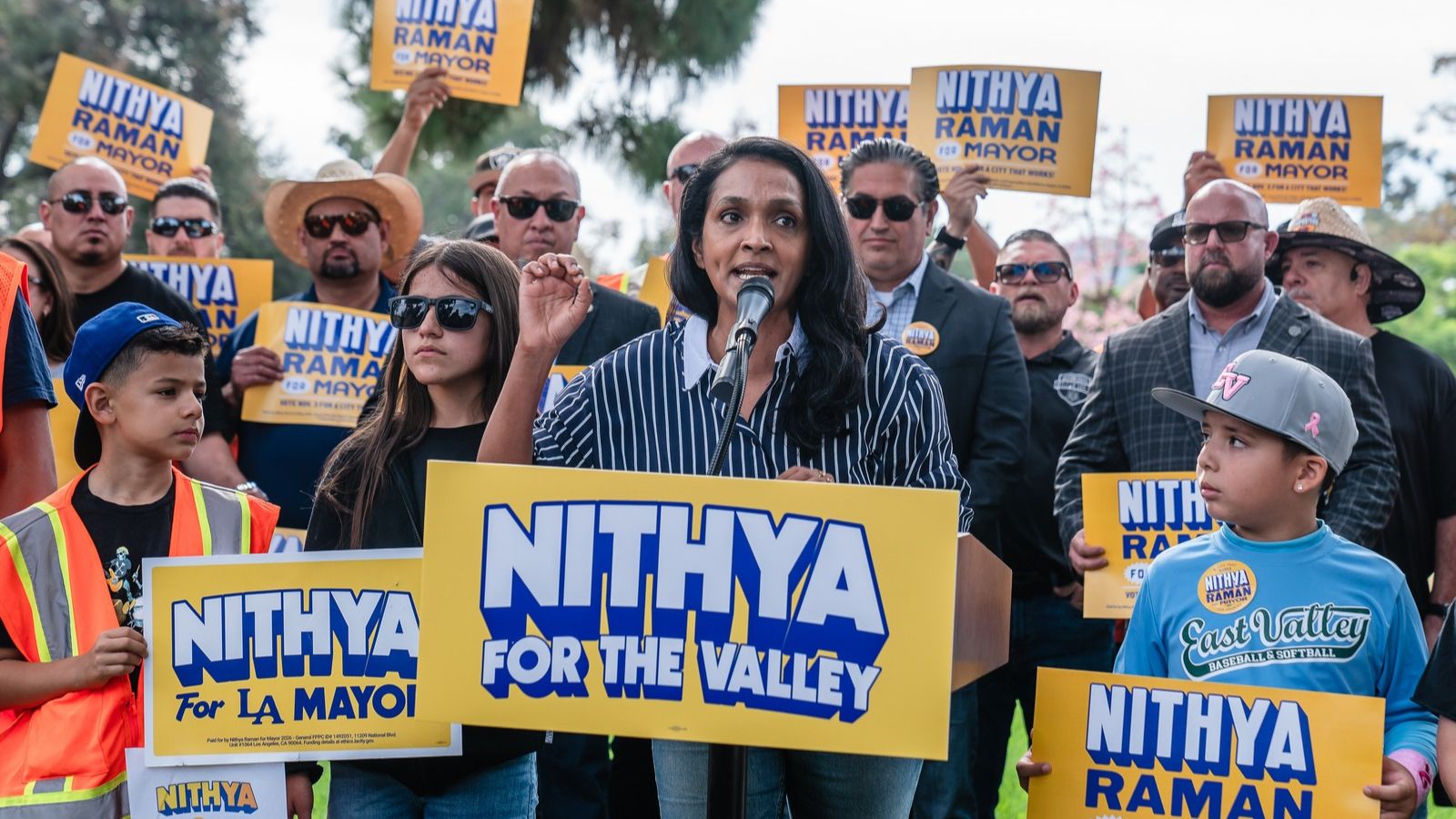
The fluorescent lights of a community room in East Hollywood hum at a frequency that makes your teeth ache. Outside, the traffic on Sunset Boulevard crawls like a wounded animal, brake lights bleeding red into the smoggy dusk. Inside, forty people sit on folding metal chairs, clutching paper cups of lukewarm coffee and waiting for someone to explain why their rent went up four hundred dollars while the hallway outside their apartment still smells like wet drywall and mildew.
This is where American municipal politics actually happens. Not on cable news panels, and not in viral TikTok clips edited to pulsing hip-hop beats. It happens in rooms that smell faintly of floor wax, where exhausted people try to figure out if the person standing at the front of the room is selling them a fantasy or offering them a wrench.
For the past year, political observers across the country have tried to force a neat, symmetrical narrative onto the 2026 Los Angeles mayoral race. Looking eastward toward New York City, pundits saw the explosive, media-savvy insurgency of Zohran Mamdani—a democratic socialist assemblymember whose sharp digital presence and unapologetic ideological branding turned a local race into a national sensation—and immediately went hunting for a West Coast equivalent. When Nithya Raman, the urban planner turned Los Angeles City Councilmember, entered the fray to challenge incumbent Mayor Karen Bass, the headline practically wrote itself.
Except the headline is wrong.
To understand what is actually unfolding in the sprawling, sun-bleached basin of Los Angeles, you have to abandon the comforting shorthand of coastal comparisons. You have to look at the mechanics of power in a city that functions less like a cohesive metropolis and more like eighty-eight suburbs locked in a trench coat, fighting over water rights and bus lanes.
The Anatomy of a False Equivalence
Politics loves a mirror. It is much easier for commentators to say this candidate is just like that candidate than it is to untangle the dense, localized web of zoning laws, union endorsements, and neighborhood council politics that dictate who runs a city of nearly four million people.
Zohran Mamdani’s political rise in New York was built on high-voltage ideological clarity. Operating within the hyper-dense, transit-connected ecosystem of Queens and the broader five boroughs, his campaign thrived on sharp contrasts, viral street interviews, and a unified democratic socialist infrastructure that treated every block like a battlefield of ideas. It was loud, confrontational, and designed for an algorithm that rewards moral certainty.
Nithya Raman, by contrast, is an urban planner by training, and she campaigns like one.
Watch her in a room—say, a cramped bakery in Silver Lake or a senior center in the San Fernando Valley—and you will not see a firebrand whipping a crowd into a frenzy. You will see someone leaning forward, elbows on her knees, asking granular questions about municipal sanitation contracts, trash pickup delays, and the specific bureaucratic bottlenecks preventing a three-story apartment building from breaking ground. She speaks in the cadence of someone who has actually read the municipal code and found where the commas were placed to keep poor people out.
Critics on the moderate wing of the Democratic Party, along with allies of Mayor Karen Bass, often point to Raman’s early backing from the Democratic Socialists of America (DSA) as proof that she represents a radical, disruptive break from practical governance. Meanwhile, some of the furthest-left activists in Los Angeles have occasionally expressed frustration with her willingness to work inside the grinding machinery of City Hall, arguing that compromise dulls the edge of systemic change.
Both critiques miss the point. Raman is not running as an ideological twin to New York’s progressive insurgent because Los Angeles does not respond to New York’s political physics.
The Invisible Weight of Four Million Lives
Consider a hypothetical character—let’s call her Elena—who lives in a rent-stabilized fourplex in Koreatown. Elena is a medical assistant who commutes forty-five minutes each way to a clinic in Culver City. She does not follow municipal politics on X. She does not know the difference between a progressive caucus and a moderate coalition. What she knows is that every morning she steps over a man sleeping in a tattered tent next to her building's dumpster, and every evening she spends twenty minutes circling her block looking for parking because the Metro line near her apartment feels unsafe after dark.
When politicians talk about "transformative vision," Elena hears static. When they talk about "preserving neighborhood character," she hears an excuse for why nothing ever gets built and her cousin had to move to Palmdale just to afford a two-bedroom apartment.
Elena is the invisible center of gravity in this election. And she is the reason why the race between Karen Bass and Nithya Raman is far closer—and far more consequential—than a simple comparison to New York politics suggests.
When Karen Bass won the mayor’s office in 2022, she did so on the promise of competence, warmth, and coalition-building. After decades in the California State Assembly and the U.S. House of Representatives, Bass arrived at City Hall as the ultimate insider who knew how to make the phones ring in Sacramento and Washington. Her signature initiative, Inside Safe, was designed to cut through red tape and move unhoused Angelenos out of street encampments and into motel rooms quickly.
For a city traumatized by visible suffering on its sidewalks, Bass offered the soothing balm of institutional authority.
Yet four years later, the structural math of Los Angeles remains stubbornly undefeated. According to data from the Los Angeles Homeless Services Authority and independent housing researchers, while thousands of people were moved indoors temporarily, the inflow of newly unhoused residents—driven by skyrocketing rents, expiring tenant protections, and stagnant wages—continued to outpace the city’s ability to build permanent supportive housing. The motels were expensive. The leases were temporary. And for residents like Elena, the tents seemed to vanish from one corner only to reappear two blocks away.
The Urban Planner’s Gamble
This is the precise fault line where Nithya Raman has planted her flag.
Think of a major city’s housing and homelessness crisis like a flooded basement. One approach to governance—the traditional, crisis-management approach—is to buy the biggest, most expensive buckets available and hire crews to bail water around the clock. It looks heroic. It creates immediate visual progress. People see the water level drop on the main floor and feel a sense of relief.
The other approach is to put on boots, wade into the dark, and look for the burst pipe behind the drywall.
Raman’s entire political identity is built around the burst pipe. Having earned a master’s degree in urban planning from MIT and having spent years researching sanitation, infrastructure, and poverty in both India and Los Angeles, she views the city not as a collection of political constituencies to be placated, but as a broken physical system that needs to be redesigned.
During her tenure representing Council District 4—a sprawling, horseshoe-shaped district that stretches from the working-class apartments of Koreatown up through the wealthy hillside estates of the Hollywood Hills and into the San Fernando Valley—Raman built a reputation as a policy technician who refused to play by City Hall’s unwritten rules. She pushed aggressively for tenant protections, fought to streamline the permitting process for affordable housing, and challenged the long-standing practice of criminalizing homelessness without providing permanent shelter.
To her supporters, this is the exact kind of structural courage Los Angeles needs before the spotlight of the 2028 Olympic Games arrives to expose every crack in the city’s foundation.
To her detractors, it is a dangerous experiment. Business leaders, homeowners' associations, and several powerful municipal labor unions argue that Raman’s skepticism of traditional policing and her push for aggressive tenant regulations will chill real estate development and make the city harder to manage. In a city where homeowners vote at dramatically higher rates than renters, challenging the suburban status quo is a perilous tightrope walk.
Why Geography Destroys Easy Labels
If you want to understand why Nithya Raman is not "LA’s Mamdani," look at a map of Los Angeles.
New York City is vertical. Its density forces strangers into daily, unavoidable proximity on subway platforms and crowded sidewalks. Politics there moves at the speed of friction; a single viral moment can sweep through five boroughs before lunch.
Los Angeles is horizontal. It is a vast, sun-drenched archipelago of distinct micro-climates and fiercely guarded neighborhoods separated by freeways that act like concrete moats. A message that resonates in the dense, renter-heavy corridors of Hollywood can die completely by the time it crosses the Santa Monica Mountains into Sherman Oaks or reaches the harbor communities of San Pedro.
You cannot win Los Angeles solely on the strength of a charismatic social media presence or an ideological crusade. To win citywide, a candidate has to assemble an unlikely, fragile alliance across geography, race, and class.
Raman learned this the hard way during her first run for City Council in 2020, when she shocked the political establishment by defeating an incumbent, and again during her grueling 2024 re-election campaign after redistricting dramatically altered the boundaries of her district. Those campaigns forced her team to build one of the most sophisticated, hyper-local field operations in Southern California—an army of canvassers trained not to recite ideological slogans, but to have fifteen-minute conversations on front porches about sidewalk repairs, bus shelters, and property taxes.
It is unglamorous work. It does not generate national cable news segments. But in a low-turnout municipal election, door-to-door persuasion is the closest thing to political alchemy.
The Vulnerability of Power
There is a quiet anxiety humming beneath the surface of Los Angeles politics right now, a sense that the old tools are no longer working.
I remember sitting on a concrete stoop in Echo Park a few summers ago, watching a city crew clear an encampment under a highway overpass while a local mutual-aid volunteer stood ten feet away, frantically trying to write down the phone numbers of people whose belongings were being tossed into a compactor truck. Nobody in that scene looked like a villain. The sanitation workers looked exhausted. The police officers looked bored and uncomfortable. The unhoused residents looked terrified. Everyone was following a script written decades ago for a city that no longer existed.
That moment stays with you because it exposes the core delusion of modern urban politics: the belief that we can solve a structural crisis with optics.
Mayor Karen Bass enters this race with enormous institutional advantages. She commands deep loyalty among Black voters in South Los Angeles, strong backing from major labor unions like SEIU, and the quiet support of the city’s business establishment, which values predictability above all else. Her defenders point out, rightly, that governing a city of four million people during a period of post-pandemic budget deficits and soaring labor costs is infinitely harder than critiquing it from a council seat. They argue that Bass has brought calm, dignity, and federal resources to a City Hall that had been rocked by corruption scandals and racial tensions just a few years earlier.
Yet incumbency in the 2020s is a heavy crown. When you hold the top job, every delayed bus, every shuttered storefront, and every encampment that returns to a cleared boulevard becomes your personal responsibility in the mind of the voter.
Raman’s path to victory does not require her to become a viral sensation. It requires her to convince enough frustrated renters, disillusioned progressives, and pragmatic suburbanites that the quiet, meticulous work of rebuilding the city’s plumbing is worth the risk of changing leadership mid-stream.
The Reckoning at the Ballot Box
Ultimately, the obsession with comparing Nithya Raman to Zohran Mamdani tells us far more about the laziness of national political commentary than it does about the reality of Los Angeles.
Mamdani’s rise in New York was a story about ideological insurgency—about testing how far an unapologetic democratic socialist message could travel in the financial capital of the world. Raman’s campaign in Los Angeles is a story about institutional survival—about whether a sprawling, car-dependent metropolis can summon the political will to transform itself into a place where working people can actually afford to live.
One is a megaphone. The other is a blueprint.
As the campaign grinds toward election day, the noise will inevitably grow louder. Attack ads will flood local television stations, painting Raman as an out-of-touch radical who will bring chaos to quiet neighborhoods, while counter-ads will portray Bass as an entrenched insider presiding over stagnation. Consultants will spend millions of dollars trying to turn complex questions of land use and municipal finance into thirty-second emotional triggers.
None of that will change the quiet truth waiting at the bottom of the ballot.
Somewhere in Koreatown tonight, a woman like Elena is unlocking her front door after a ten-hour shift, setting her keys on a kitchen counter, and opening an envelope from her landlord. The numbers on the page don't care about national political trends, viral videos, or who gets compared to whom on television. They only measure the widening gap between what this city costs and what the people who keep it running can bear.


