Silence. That is the strangest part of standing near the Demilitarized Zone when the wind shifts south.
You expect sirens. You expect the heavy thud of boots or the distant cough of artillery. Instead, on a crisp autumn morning along the western frontier between North and South Korea, you hear a farm tractor sputtering two kilometers away, a magpie calling from a scrub pine, and the dry rustle of reed beds bent by a cold gust off the Imjin River. For stretches of time, the most heavily fortified frontier on Earth feels almost pastoral. Almost ordinary.
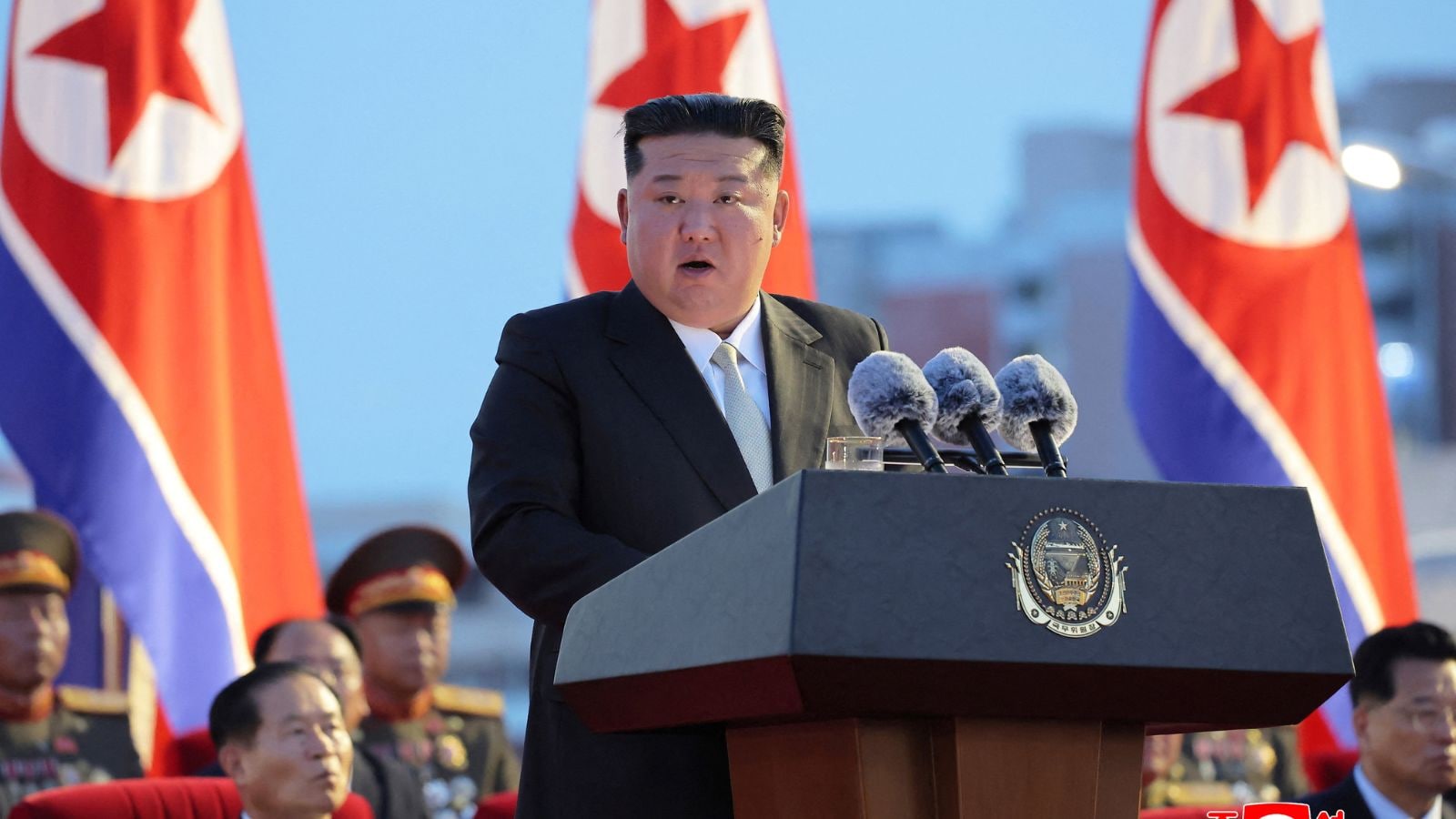
Then a threat arrives on the wire, carried in the terse, brittle cadence of Pyongyang’s state media: warnings that loudspeaker broadcasts could roar back to life, that more weapons could be moved closer to the line, that hard-won quiet is once again provisional.
Read a standard wire report and you get the skeleton of the story. Troop movements. Deterrence postures. Psychological operations. Tit-for-tat escalation along the Military Demarcation Line. It reads like a ledger of cold metal and diplomatic friction. Useful, sure. Clean, organized, easy to skim over coffee.
Yet a ledger tells you nothing about what happens to a person lying awake at two in the morning when the air turns sharp and sound carries farther than it has any right to carry.
To understand why threats of renewed propaganda broadcasts and forward-deployed weaponry carry such weight on the Korean Peninsula, we have to step out of the briefing room and listen to how fear actually travels. A missile flies along a ballistic arc you can plot on a radar screen. A loudspeaker wave rides the atmosphere. It slips past concrete barriers, threads through valleys, and lands inside someone’s kitchen whether they invited it or not.
When Words Become Ordnance
Let’s introduce a hypothetical character to ground this in daily life—a fictional South Korean dairy farmer we will call Min-ho, working a patch of alluvial land in Paju County, south of the border. Min-ho is not real, though thousands of farmers in northern Gyeonggi Province live with realities remarkably close to his.
In Min-ho’s world, the border is not an abstraction on a cable news map. It is a set of agricultural rules, curfews, checkpoints, and weather patterns. When the wind blows from the north at dusk, sound travels differently over flat fields and low ridges. Acoustic waves refract in cooler air near the ground, stretching outward across paddies and greenhouses.
Imagine what it feels like when those waves carry not pop songs or weather forecasts, but harsh, rhythmic voice-overs—accusations, taunts, political slogans, and warnings—amplified through high-power speaker arrays aimed across the divide. Even when South Korea’s own military operates loudspeakers aimed northward during periods of heightened tension, the noise spills sideways into border communities. Dogs bark. Sleep fractures. Neighbors check their phones to see if a routine provocation has crossed into something sharper.
Why do governments reach for loudspeakers when they also threaten to deploy more weapons?
Because propaganda and forward weaponry operate on different registers of pressure. Deploying artillery, rocket launchers, or fortified positions near the line signals physical capability and readiness to strike. It says: Look at the steel we can bring within range. Restarting propaganda broadcasts signals psychological intent and an appetite for friction. It says: We are willing to break the quiet, test nerve, and turn everyday life into an arena of contestation.
Think of it like turning up the thermostat in a room where everyone is already wearing heavy coats. Adding another coat changes your weight; turning up the heat changes the air everyone has to breathe.
I have spent enough time reading accounts from people who grew up near contested borders—and following decades of inter-Korean standoffs—to know that tension rarely arrives as a single cinematic explosion. More often, it seeps in through small disruptions. A delayed commute. A canceled community event. A mother telling her teenager not to stay out late near the river road because nerves along the line are raw.
Admittedly, from thousands of miles away, another round of threats out of Pyongyang can start to blur together. One statement sounds like the last. Another deployment of weaponry near the frontier feels like reheated history. Even people who follow East Asian security closely sometimes catch themselves wondering whether every warning is a genuine inflection point or another turn of a familiar, exhausting wheel.
That fatigue is real. And it is dangerous.
The Architecture of a Hair-Trigger Frontier
History on the Korean Peninsula has long been shaped by cycles of engagement and relapse. Since the 1953 Armistice Agreement halted active combat in the Korean War without producing a formal peace treaty, the two Koreas have existed in a state of suspended conflict. For more than seventy years, the Demilitarized Zone—a buffer strip roughly four kilometers wide and stretching about 250 kilometers across the peninsula—has functioned as both a scar and a strange sanctuary.
Within that narrow band and the fortified zones flanking it sit tripwires that have snapped before and could snap again.
Over the past decade and a half, the relationship between Seoul and Pyongyang has swung hard between brief diplomatic openings—summits, cultural exchanges, agreements to halt hostile acts along the border—and sharp reversals marked by missile tests, abandoned accords, and renewed military posturing. Whenever confidence collapses, the border is one of the first places the fracture shows.
Consider what happens next when trust evaporates:
- Buffer zones erode. Measures meant to keep troops and heavy weapons separated give way to fortification, patrol adjustments, and forward positioning.
- Communication channels go dark. Hotlines go unanswered, reducing the margin for misunderstanding when an accidental shot or misread movement occurs.
- Psychological pressure intensifies. Broadcasts, leaflets, or drone incidents test political resolve in Seoul while projecting toughness domestically in Pyongyang.
Weapons deployed closer to the border shorten reaction times. That is the cold military logic behind forward deployments. When systems sit nearer the line, commanders on both sides have less time to verify whether a movement is posturing, routine maintenance, or the opening move of an attack. Seconds compress. Mistakes become costlier.
Yet there is an irony here that gets missed when coverage focuses strictly on hardware. A howitzer or multiple-launch rocket system is terrifying because of what it can destroy. A propaganda array is unsettling because of what it erodes: the fragile, hard-won sense that normal life can proceed uninterrupted a few miles from the front line.
Let’s use a metaphor—explicitly a metaphor—to make sense of the dynamic. Imagine two neighbors living on either side of a high fence with a history of bitter feuds. For a while, they agree not to shout over the top and not to stack lumber against the posts. Then one neighbor starts stacking timber again and muttering loudly through a megaphone. Even if no bricks are thrown today, the other neighbor starts sleeping lightly, checking the locks twice, and wondering whether the shouting is meant to intimidate, provoke a slip, or mask a bigger shift behind the wall.
Neither side wants to look weak. Both sides watch for signs of hesitation.
What Cold Headlines Leave Out
When a headline says North Korea threatens to restart propaganda broadcasts and deploy more weapons at the border with South Korea, it compresses complex human and strategic pressures into a single line.
Behind that line are several layers that matter deeply if you want to understand what is actually at stake:
First, domestic signaling. Authoritarian states frequently pair external threats with internal mobilization. Hardline rhetoric and visible military readiness along the frontier can project strength at home, rally security forces, and frame economic hardship or diplomatic isolation as the product of hostile encirclement.
Second, leverage and bargaining. Pyongyang has a long track record of manufacturing tension to extract concessions, test a new South Korean or U.S. posture, or reset the terms of engagement on its own timetable. Raising the cost of calm is one way to force attention back onto the peninsula.
Third, the risk of miscalculation. High-tension environments leave very little room for error. A stray round, a misidentified vessel or aircraft, or an overreaction to a border maneuver can spiral faster than political leaders intend. Even when neither side seeks full-scale war, crises often begin with something neither side planned.
Fourth, everyday resilience. Life in South Korea does not grind to a halt every time Pyongyang issues a warning. Markets open, subways run, students study, and families carry on. That resilience is not naivety; it is adaptation born of decades of living alongside an unpredictable neighbor. Still, adaptation has a price. Living under persistent low-grade threat wears on people in quiet ways—through stress, vigilance, and the lingering knowledge that peace on the peninsula remains conditional rather than guaranteed.
Beyond the Noise
If you look closely at border standoffs, one truth stands out above the bluster: threats are rarely just about the present moment. They are bids to shape what people expect tomorrow.
A threat to restart broadcasts is a bid to occupy the airwaves and rattle nerves without firing a shot. A threat to deploy more weapons near the border is a bid to remind everyone of raw force and shorten the distance between warning and impact. Together, they test whether calm is sturdy or brittle.
Nobody outside the decision-making rooms in Pyongyang and Seoul can claim total certainty about what comes next. Anyone who pretends otherwise is selling certainty where only probabilities exist. What we can see clearly is that when loudspeakers hum and more hardware moves toward the line, the stakes are never confined to generals and diplomats. They reach down into farms, towns, and households where people simply want the wind to carry nothing heavier than leaves.
Out near the Imjin River, the reeds keep bending when the northern breeze picks up, whispering dryly against the bank as the sun drops low behind the hills.


