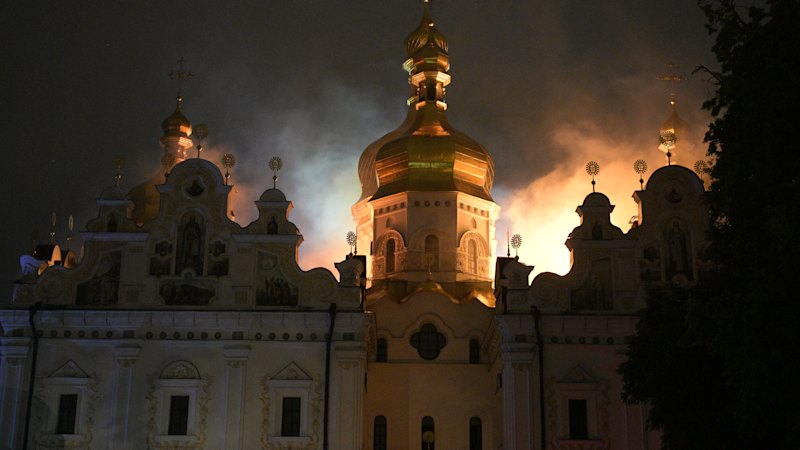
Mainstream war reporting has a predictability problem. When the wooden All Saints Skete of the Svyatohirsk Lavra went up in flames during the heavy shelling of eastern Ukraine, the media narrative immediately locked into a familiar groove. The headlines practically wrote themselves: an irreplaceable cultural tragedy, a senseless act of heritage destruction, a spiritual wound that can never heal.
This analysis is lazy. It misses the brutal, pragmatic reality of modern warfare.
Losing a 17th-century wooden monastery looks terrible on a broadcast. It evokes immediate emotional outrage. But viewing the destruction of cultural sites in a conflict zone purely through the lens of tragic vandalism completely misunderstands how modern military strategy operates. In a high-intensity artillery war, a monastery is rarely targeted simply because someone hates history. It is targeted because a massive stone or elevated complex sitting on a hill overlooking a river is the most valuable piece of military real estate for miles around.
The High-Ground Fallacy: Why Holy Sites Become Fortresses
For centuries, monastic orders built their sanctuaries to be isolated, easily defensible, and elevated. They chose high cliffs, deep forests, and strategic river bends to find peace. The irony is that the exact geographic features making a monastery a perfect spiritual retreat also make it a flawless military strongpoint.
The Svyatohirsk Lavra sits on the steep right bank of the Siverskyi Donets River. Look at any military map of the Donbas. A commanding height overlooking a major water obstacle is not just a holy site; it is an artillery spotter’s dream and a natural defensive fortification.
When war arrives, armies do not see symbols of faith. They see lines of sight, structural thickness, and tactical cover.
- Logistical Reality: Thick stone walls built to withstand medieval sieges offer better protection against modern shrapnel than almost any civilian infrastructure.
- Observation Advantages: Church towers and elevated monastic buildings provide 360-degree views for drone operators and forward artillery observers.
- Choke Point Dominance: Sanctuaries built near river crossings naturally command the very transit routes advancing forces must secure.
I have tracked urban and asymmetric conflicts for over a decade. The pattern never changes. From the historic alleys of Aleppo to the ancient monasteries of Kosovo, cultural architecture is dragged into the meat grinder of war because of its geography, not its geometry. To pretend that the destruction of these buildings is purely an ideological tantrum ignores the cold math of kinetic warfare. When a structure commands the battlespace, it becomes a target. Period.
The Propaganda Value of Ash
There is a secondary, colder calculation at play. Both sides of a conflict know that a burning monastery is worth more in the international media landscape than ten destroyed ammunition depots.
The Western press covers the destruction of a historic site with a specific type of moral outrage. It feeds a neat narrative of civilization versus barbarism. Military commanders are acutely aware of this. Leaving a force exposed to fire from an elevated monastery because you want to preserve the architecture is a luxury no commander on the ground can afford. Yet, the moment a shell hits that roof, the adversary wins a massive psychological warfare victory.
Consider the hypocrisy baked into the global outrage. The international community wrings its hands over charred timbers while completely ignoring the structural reality of the war. Heritage protection treaties like the 1954 Hague Convention are paper shields. They include massive loopholes for "imperative military necessity." If an adversary utilizes a cultural site—or if a commander reasonably believes they are using it—to direct fire, the legal protection vanishes instantly.
The lazy consensus screams about war crimes every time a historic facade chips. The brutal truth is that under the laws of armed conflict, the moment a holy site takes on a tactical function, its holiness is irrelevant to a targeting officer.
Dismantling the Premise: Can We Actually Protect Heritage in Total War?
People often ask how international bodies can better enforce the protection of historic landmarks during active operations. The question itself is fundamentally flawed. It assumes that war can be choreographed cleanly, that we can somehow keep the violence confined to empty fields.
Modern warfare is urban. It is industrial. It consumes everything in its path. Expecting an army fighting an existential battle to bypass a strategic height because of an ancient iconostasis is naive.
If you want to save historic infrastructure, the only unconventional strategy that actually works is complete demilitarization of the zone long before the front line arrives. That means stripping the site of any potential military utility. No troops, no communication relays, no logistics storage within a multi-kilometer radius.
But here is the downside nobody wants to admit: in a total war where every inch of territory matters, declaring a massive, defensible ridge line a "safe zone" is a tactical impossibility. It hands a massive piece of the chessboard to the enemy for free. No serious military force will ever agree to that.
The destruction at Svyatohirsk is not an anomaly, nor is it a sign of a new paradigm in warfare. It is the predictable outcome of ancient geography colliding with modern firepower. Stop judging the theater of war through the lens of an art museum curator. The flames are tragic, but in the logic of the trenches, they are entirely rational.