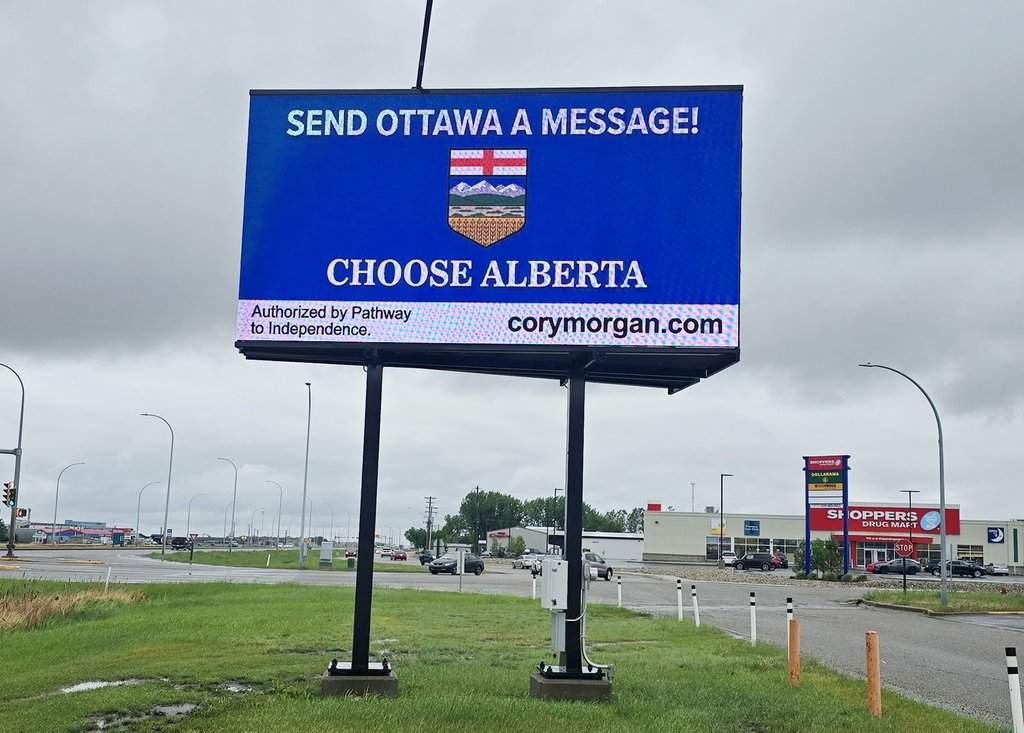
A standard municipal enforcement order usually ends with compliance or a fine. In the southern Alberta town of Taber, it triggered a multi-front political standoff. A controversial electronic billboard advocating for Alberta to leave Canada remains fully active along Highway 3 despite a firm June 13 deadline set by local authorities for its removal. The dispute is no longer just about municipal land-use bylaws or complaints from local residents. It has exposed a messy, high-stakes battle over free speech, property rights, and regulatory overreach just four months before Albertans head to the polls for a historic referendum on October 19.
The conflict began when Cory Morgan, an organizer for the pro-independence group Pathway to Independence, paid for a large digital advertisement displaying the Alberta shield alongside the words, "Send Ottawa a Message! Choose Alberta." Because the electronic sign sits on land leased from the Town of Taber, municipal officials quickly found themselves caught in a political crossfire. Citing a flood of public complaints, Taber Chief Administrative Officer Derrin Thibault issued a formal letter to the private billboard operator on June 3. The town declared the political messaging a "nuisance" that violated the terms of the commercial lease, giving the company 10 days to pull the ad or risk losing its license entirely.
That deadline came and went. The sign is still glowing. Instead of backing down, Morgan doubled down, purchasing space on two additional signs in the area, the third of which went live on Sunday.
By attempting to quiet a controversial political message, local bureaucrats inadvertently handed a fringe independence movement its most potent weapon: a platform to fight perceived censorship.
The High Stakes of the October Referendum
To understand why a single highway sign has caused such a massive administrative headache, one must look at the calendar. On October 19, Albertans will vote on a critical plebiscite. The ballot will ask voters whether the province should remain part of Canada or initiate the formal process toward a second, binding referendum on total secession.
The political atmosphere in the province is incredibly tense. Recent polling indicates that while outright separation remains a minority position, deep economic frustration with the federal government has made the upcoming vote highly volatile. Third-party advertising groups are spending heavily to sway undecided voters. Pathway to Independence is registered with Elections Alberta, meaning its campaign materials are fully compliant with provincial election laws.
When a municipality steps in to regulate the content of a registered third-party advertiser, it crosses an invisible line from basic property management into the territory of election interference. Morgan has seized on this distinction, publicly accusing the Town of Taber of taking a partisan side in an active democratic campaign.
The Nuisance Clause and Property Law
The legal mechanism Taber utilized to demand the billboard’s removal is a standard "nuisance" clause found in most municipal commercial lease agreements. These clauses are designed to protect towns from liabilities like graphic imagery, hate speech, or structural hazards.
Using a nuisance clause to suppress a mainstream, non-offensive political slogan is a precarious legal strategy. The phrase "Send Ottawa a Message" contains no profanity, incitement, or discriminatory language. The sign operator, who requested anonymity to protect his business relations, noted that his company routinely accepts all legitimate third-party advertisements that do not cross into illegal territory or hate speech.
By defining a peaceful political opinion as a municipal nuisance simply because it generated complaints, Taber has established an uncomfortable precedent. If public discomfort is the new benchmark for removing advertisements on town-leased land, any campaign regarding abortion, resource extraction, or tax policy could theoretically be banned under the exact same logic.
The Illusion of Corporate Neutrality
Municipalities frequently try to project absolute neutrality during sensitive election cycles. On June 3, the Town of Taber posted a public statement clarifying that it did not create, fund, or endorse the pro-separation advertisement, stating the message does not speak for the local government or the broader community.
That disclaimer should have been the end of the town's involvement. In a free society, the public understands that a billboard on a highway does not represent the official views of the municipality hosting it. However, by issuing the removal order immediately after issuing the disclaimer, the town abandoned its neutral stance.
Local residents are noticing the contradiction. Even those who oppose the separation movement have expressed discomfort with the town’s heavy-handed response.
| Resident | Stance on Separation | View on Billboard Removal |
|---|---|---|
| Barb Haynes | Opposed | Believes the sign should stay up as a legitimate message to Ottawa. |
| Anna Friesen | In Favor | Strongly opposes the town's removal order. |
| Kandis Howells | Undecided | Questions the removal, stating people can judge the message for themselves. |
The consensus among locals points to a broader cultural reality in rural Alberta: a deep-seated dislike for bureaucratic overreach often outweighs personal opinions on the actual policy being debated.
A Failed Attempt at Suppression
The ultimate irony of the Taber billboard controversy is its counterproductivity. Had town officials ignored the initial complaints, the digital slide would have cycled through its rotation, largely unnoticed by anyone living outside the immediate region.
Instead, the threat of censorship has acted as a massive fundraising accelerator for Pathway to Independence. Morgan acknowledged that the sudden surge of media attention brought a wave of new donors and provincial support. The capital generated by this single dispute has already funded more ad placements across southern Alberta, including a new installation planned for Dunmore, east of Medicine Hat.
Elections Alberta has steered completely clear of the mess, stating it has no jurisdiction over disputes between third-party advertisers and public or private land providers. This leaves the town council isolated, facing a potential breach-of-contract lawsuit from the billboard company and a prolonged public relations battle with passionate constitutional activists.
The sign continues to flash its message to passing motorists on Highway 3. The Town of Taber wanted to avoid controversy, but its hasty attempt to bury a divisive political topic has guaranteed that the debate will remain front and center all summer long.
Municipalities cannot police the boundaries of political speech without triggering a severe backlash, especially when the voters are already holding the matches.