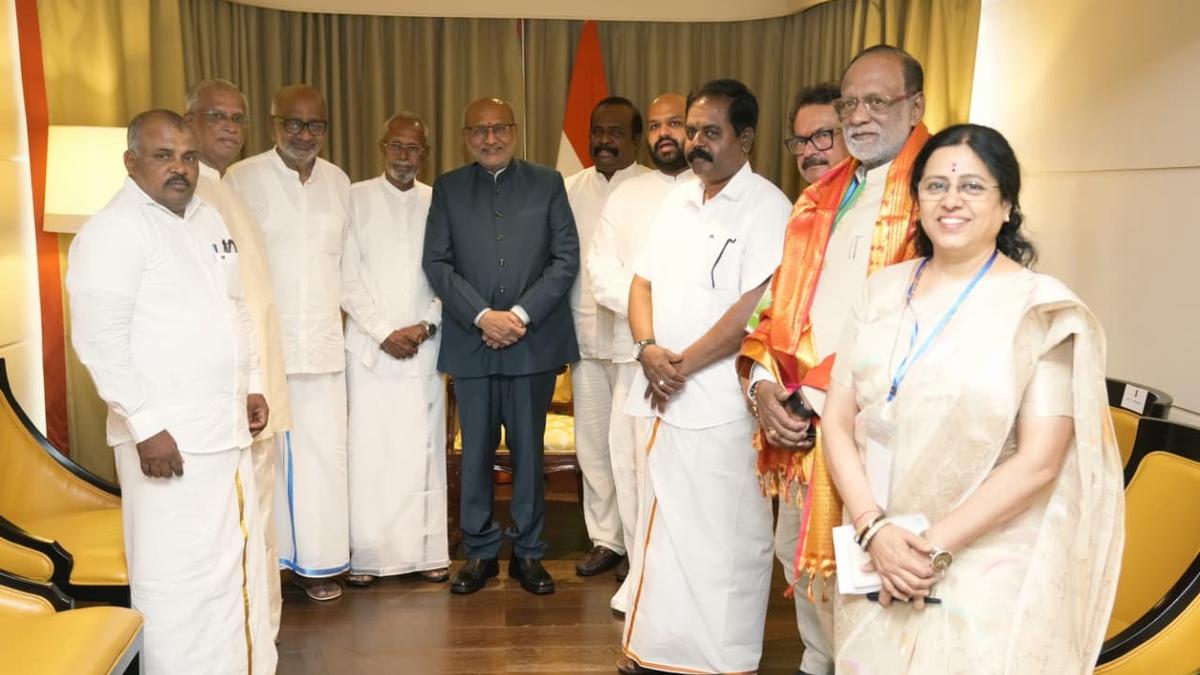
Forty years of diplomatic theater have brought Sri Lanka’s ethnic question no closer to a resolution than it was when the first shots of the civil war were fired. On April 19, 2026, a delegation of Tamil political leaders sat across from Indian Vice-President C.P. Radhakrishnan in Colombo, delivering a message that was less an appeal and more a post-mortem of a dying treaty. They demanded a "sustained Indian push" to revive the 1987 Indo-Lanka Accord, a document that has become a ghost in the halls of both New Delhi and Colombo.
The core of the frustration lies in the 13th Amendment, the legislative byproduct of that 1987 agreement. It was designed to devolve power to the provinces, granting the Tamil-majority North and East a semblance of self-governance. Instead, it has been systematically hollowed out. While the Vice-President offered the standard diplomatic assurances that India’s position remains "constant," the reality on the ground suggests a different story. India is caught in a strategic squeeze, balancing its historical role as a protector of Tamil rights against its modern necessity to keep Sri Lanka out of Beijing’s orbit.
The Strategy of Managed Paralysis
Colombo has mastered the art of "implementation without empowerment." While the 13th Amendment exists on paper, the executive branch has consistently withheld the two pillars that would make it functional: land and police powers. By keeping these under central control, the Sri Lankan state ensures that any provincial council remains a glorified municipal office rather than a legislative body.
The situation has worsened with time. Provincial Councils have been defunct for over seven years, their elections stalled by successive administrations citing technicalities or economic constraints. This legislative vacuum allows the central government to govern the North and East by proxy, bypassing the very democratic structures the Accord was meant to establish.
The current administration, led by the National People’s Power (NPP) coalition, presents a unique challenge. Historically, the Janatha Vimukthi Peramuna (JVP)—the backbone of the NPP—was the most violent opponent of the Accord, viewing it as an imperialist imposition by India. Today, President Anura Kumara Dissanayake speaks a language of reconciliation and a "new Constitution," but the timeline is non-existent. For Tamil leaders like M.A. Sumanthiran of the ITAK, this "new Constitution" feels like a convenient excuse to bury the 13th Amendment once and for all under the guise of reform.
India’s Strategic Dilemma
New Delhi’s "duty" toward Sri Lankan Tamils is no longer the primary driver of its foreign policy. In the 1980s, the Tamil issue was a domestic political necessity for any Indian Prime Minister eyeing the vote bank in Tamil Nadu. In 2026, the priority has shifted to the Indian Ocean Region (IOR) security architecture.
India’s engagement with Sri Lanka is now viewed through the lens of:
- Connectivity: Physical, digital, and energy links intended to integrate the two economies.
- Counter-balancing China: Preventing the further expansion of Chinese naval or economic footprints in ports like Hambantota or Colombo.
- Stability: Ensuring the 2022 economic collapse does not repeat, which would lead to a refugee crisis on Indian shores.
This shift has created a credibility gap. When Indian officials meet with Tamil parties, they reiterate support for the 13th Amendment, but when they meet with the Sri Lankan leadership, the conversation is dominated by grid connectivity and debt restructuring. The Tamil parties are aware that they are being used as a lever of influence—a card India plays when it needs to pressure Colombo, and one it tucks away when bilateral business is booming.
The Myth of the Unitary State
The fundamental deadlock is philosophical. The Sri Lankan state is built on a unitary structure that views any meaningful devolution as the first step toward secession. Even after the military defeat of the LTTE in 2009, the "security state" mindset persists. The central government fears that granting police powers to a Tamil-led province would create a parallel power structure that could eventually challenge Colombo’s sovereignty.
Conversely, Tamil parties have moved beyond merely asking for the 13th Amendment. There is a growing consensus among leaders like Selvarajah Kajendren that the current unitary framework is a cage. They are pushing for a federal model—irrevocable power sharing that cannot be snatched back by a simple majority in the Colombo parliament.
This is where the Indo-Lanka Accord fails. It was a compromise intended to stop a war, not a final blueprint for a multi-ethnic state. By clinging to a 40-year-old document that Colombo has no intention of honoring and New Delhi has no appetite to enforce, all parties are engaging in a stalemate that ignores the evolving grievances of the people.
The Demographic Erasure
While politicians argue over constitutional clauses, the "why" behind the Tamil urgency is found in the changing geography of the North and East. Reports of state-sponsored "Sinhalization"—the settling of majority Sinhalese populations in traditionally Tamil areas and the building of Buddhist shrines in Hindu-majority districts—are frequent.
Tamil leaders pointed out to Vice-President Radhakrishnan that the Tamil population in Sri Lanka is steadily decreasing. Economic migration, combined with a lack of political agency, is hollowing out the Tamil heartlands. If the 13th Amendment is not implemented soon, there may be no distinct Tamil political identity left to protect.
The issue of the fisheries conflict also remains a jagged edge in the relationship. Indian trawlers frequently enter Sri Lankan waters, depleting the resources that Northern Tamil fishermen rely on for survival. This creates a bizarre scenario where the very people India claims to protect are the ones most hurt by the activities of Indian nationals, further complicating the "special relationship" between the two.
Beyond the Diplomatic Script
If the Indo-Lanka Accord is to be more than a historical footnote, the "sustained push" requested by Tamil parties must involve more than periodic meetings in Colombo. It requires India to link its massive economic investments and debt relief packages to specific milestones in power devolution.
However, Colombo knows that India cannot afford to push too hard. If New Delhi becomes too demanding on the Tamil issue, the Dissanayake government could pivot back toward Beijing, which offers infrastructure with no strings attached regarding human rights or minority representation.
The "spirit" of the Accord is effectively on life support. The Tamil parties are asking for a miracle from a neighbor that is increasingly preoccupied with its own global ambitions. Without a fundamental shift in how Colombo views its own minorities—or a radical change in how New Delhi prioritizes its regional goals—the 13th Amendment will remain a relic of a failed peace, and the Indo-Lanka Accord will continue to be a treaty that exists everywhere except in practice.
The abrupt reality is that for the youth in Jaffna or Batticaloa, these high-level meetings are background noise. They are looking for jobs and stability, not a 1980s treaty. If the political class cannot deliver a functional governance model, the next crisis won't be settled by a signature in a Colombo hotel, but by the same desperation that fueled the past four decades of tragedy.