Geopolitics is a brutal theater. What looks like a petty personal grudge broadcasted over social media networks is almost always the visible symptom of a deep, structural fracture happening entirely behind closed doors.
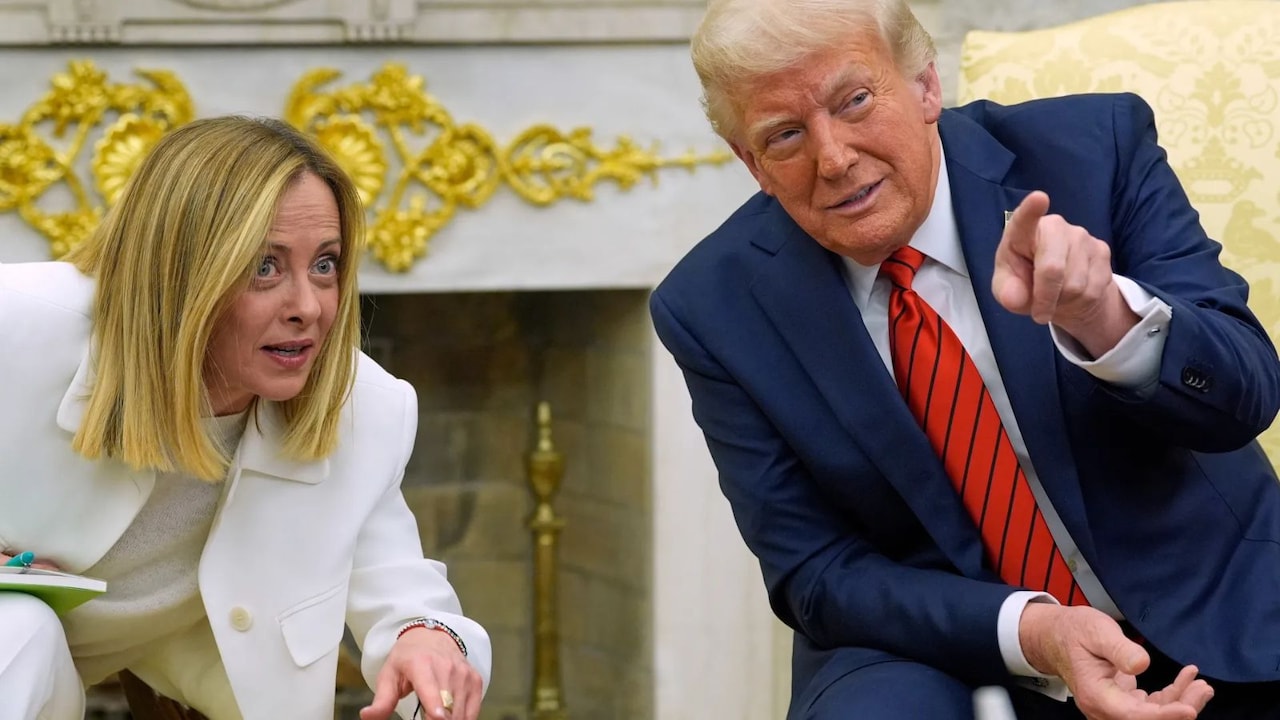
The public breakdown between United States President Donald Trump and Italian Prime Minister Giorgia Meloni over a disputed photograph at the Group of Seven summit in France has been widely framed as a comical clash of massive political egos. It is nothing of the sort. This sudden, venomous falling out represents a fundamental shift in how European leaders calculate the cost of aligning themselves with Washington, particularly when American military actions conflict directly with European economic survival. The trivial squabble over who requested a photo-op hides an immense, high-stakes battle regarding national sovereignty, international law, and the unauthorized usage of European airspace during the recent American war against Iran.
The initial blow landed when Trump claimed during an interview with the Italian television network La7 that Meloni had effectively groveled for a photo with him during the gathering in Evian-les-Bains. He insisted that he only agreed to stand for the picture because he felt sorry for her, adding that she was desperate to bolster her sagging domestic approval ratings. Within twenty-four hours, the carefully manufactured facade of conservative unity between Washington and Rome disintegrated. Meloni fired back on Instagram with an uncharacteristically fierce public rebuttal, declaring that neither she nor Italy would ever beg, and openly mocking Trump’s preoccupation with public approval.
Her message was blunt. She stated clearly that her domestic standing had not been helped by his friendship, and closed with a sharp warning that her popularity was none of his concern.
The response from the Italian diplomatic corps was immediate and severe. Foreign Minister Antonio Tajani abandoned a long-planned, high-profile diplomatic visit to the United States, issuing an official statement declaring that Trump’s remarks were a direct insult to the entire Italian nation. This was not a minor diplomatic adjustment. It was an explicit, deliberate freeze in bilateral relations, executed by an administration that had previously prided itself on being the most pro-Washington government in modern Italian history.
To understand how a relationship once celebrated as an ideological marriage could collapse so completely, one must look past the petty theater of social media. The true origin of this dispute lies not in a camera lens, but in the tarmac of airbases scattered across the Italian peninsula.
The Secret Battle Over Italian Airspace
The relationship began to fray long before the G7 leaders arrived in France. The actual point of fracture occurred when the United States entered a direct military conflict with Iran, a campaign that sent shockwaves through global energy markets and caused immediate, severe economic damage across the European continent.
Washington expected immediate, uncritical compliance from its Mediterranean allies. Trump demanded that Italy permit American bomber squadrons and transport aircraft to utilize crucial strategic assets, specifically Sigonella Naval Air Station in Sicily and Aviano Air Base in northeastern Italy, to launch offensive operations and logistical sorties toward the Persian Gulf.
Meloni flatly refused.
Her decision was rooted in basic constitutional survival. Under Italian law, any deployment of national territory or foreign military installations for offensive actions that are not explicitly authorized by a United Nations mandate or a direct NATO defensive declaration requires formal, comprehensive parliamentary debate and a majority vote. Meloni knew that the Italian public, already reeling from skyrocketing energy costs and inflation driven by the destabilized Middle East, would never tolerate direct involvement in a unilateral American war. She insisted that American operations from Italian soil be strictly limited to defensive tracking and pre-existing logistical rotations.
The American administration viewed this adherence to domestic legal protocol as a betrayal. Trump used his subsequent Truth Social broadsides to air this specific grievance, complaining bitterly that Meloni would not allow the United States to utilize Italian landing strips or runways despite the massive financial contributions Washington makes toward European defense.
The tactical inconvenience for the pentagon was immense. Without the ability to freely stage heavy logistical operations out of Sicily, American forces were forced to rely on more distant, logistically complicated routes, stretching supply lines during the height of the military campaign. Trump’s public anger revealed a fundamental misunderstanding of European coalition politics. He viewed military alliances as transactional protection frameworks where financial expenditure grants total operational authority over foreign territory, whereas Meloni viewed the partnership as an alliance of sovereign equals bound by explicit, immutable legal treaties.
The conflict exposed a harsh reality for Rome. Aligning too closely with an unpredictable American executive carries a devastating domestic price tag when foreign policy decisions threaten local economic stability.
The Myth of the Trump Whisperer
For nearly two years, political analysts across Europe labeled Meloni as the ultimate bridge between the radical populist right in the United States and the traditional European establishment. She was the sole major European leader to attend Trump’s second inauguration in 2025, a calculated political gamble designed to position Italy as the primary interlocutor for American interests on the continent.
The strategy worked brilliantly for a time. It yielded glowing photo-opportunities, mutual public praise, and an aura of unique diplomatic leverage that Meloni used to elevate Italy’s standing within the European Union.
That leverage has evaporated. The breakdown demonstrates that the concept of a European whisperer who can masterfully manage unilateral American populism through personal rapport is an illusion. When national interests diverge on core issues of war and economic survival, personal chemistry is the first thing that gets discarded. Meloni’s attempt to play the role of the pragmatic, loyal ally while simultaneously protecting her nation's legal and economic boundaries was always an unsustainable balancing act.
The immediate casualty of this illusion is Italy’s broader foreign policy architecture. By investing so heavily in a personal relationship with Trump, Meloni’s administration alienated traditional European partners in Paris and Berlin, who viewed her early sycophancy with deep suspicion.
Now, she finds herself isolated on both fronts. She is facing a hostile Washington that views her as ungrateful, while simultaneously dealing with European neighbors who are hesitant to welcome her back into the mainstream continental fold. The strategy of using a personal relationship with an American president to bypass traditional multilateral diplomacy has failed completely, leaving Rome to rebuild its international credibility from scratch.
This isolation is compounded by a shifting political landscape within Italy itself. The domestic costs of Meloni's foreign policy calculations are beginning to catch up with her administration.
The Domestic Trap and Diminishing Returns
The timing of this international blowup could not be worse for the Italian Prime Minister. Her government is currently navigating a treacherous domestic political minefield, following the high-profile defeat of a critical judicial referendum in March that her party had championed as a cornerstone of its legislative agenda.
The loss shattered her aura of domestic invincibility. It signaled to her political opponents that the electorate was growing weary of ideological culture wars and structural overhauls at a time when ordinary citizens are struggling to pay their electricity bills.
As her poll numbers began to fluctuate, her previously close alignment with Washington transformed from a valuable political asset into a massive electoral liability. The Italian public’s view of the American military campaign in the Middle East has been overwhelmingly hostile, with widespread condemnation coming from across the political spectrum, including explicit, severe rebukes from the Vatican. When Trump launched public attacks against the Pope over the pontiff’s criticism of the Iran conflict, Meloni was forced to make a choice between her American ally and her domestic base.
She chose her base. She publicly distanced herself from the White House's rhetoric, a move that Trump interpreted as a personal insult and a sign of political weakness.
+-----------------------------------+-----------------------------------+
| Trump's Strategic View            | Meloni's Sovereign Position       |
|-----------------------------------|-----------------------------------|
| Treaties imply operational access | Treaties dictate strict limits    |
| Financial aid buys leverage       | Sovereignty is non-negotiable     |
| Alliances require blind loyalty   | Alliances require legal consensus |
+-----------------------------------+-----------------------------------+
The true nature of the current conflict is laid bare when looking at these opposing viewpoints. Trump’s subsequent claims that she begged for a photograph were a deliberate attempt to exploit this domestic vulnerability, trying to paint her as a struggling leader who needed his star power to survive politically.
Meloni’s counterattack was calculated to neutralize this exact narrative. By stating that being his friend had actively harmed her popularity, she signaled to the Italian electorate that she was prepared to discard her relationship with Washington entirely if it meant protecting Italian sovereignty and national pride. It was a desperate but necessary pivot, an attempt to transform a humiliating public insult into a display of patriotic resistance against foreign bullying.
Whether this maneuver will succeed in stabilizing her domestic coalition remains highly uncertain. The economic fallout from the broader global instability continues to mount, and her government can no longer point to its unique influence in Washington as a justification for its foreign policy choices.
The Broader Fracture Inside NATO
The public warfare between Trump and Meloni is not an isolated incident. It is the most visible manifestation of a much larger, systemic crisis threatening the cohesion of the North Atlantic Treaty Organization.
The unilateral nature of recent American military actions has pushed the alliance to its absolute breaking point. European capitals are increasingly unwilling to serve as passive logistical hubs for military campaigns that they have no role in planning, yet bear the immediate economic and security consequences of. The spat over landing strips in Italy highlights a fundamental structural flaw in the modern transatlantic alliance that cannot be papered over with vague declarations of shared values.
For decades, the United States has operated under the assumption that its European allies would automatically provide logistical support, overflight rights, and base access whenever Washington decided to project military power globally.
That assumption is dead. The resistance from Rome proves that European leaders are no longer willing to write blank checks for American military adventures that directly destabilize their own economic backyards. If the United States continues to demand absolute obedience while ignoring the legal, constitutional, and economic constraints of its partners, the alliance will continue to fracture along these exact lines.
The era of easy transatlantic compliance is over. Meloni’s blunt dismissal of Trump’s public posturing should serve as a stark warning to Washington that even the most ideologically sympathetic leaders in Europe will choose domestic political survival and national sovereignty over the hollow prestige of a White House friendship.
The photograph that sparked this entire diplomatic war was ultimately taken, but it stands as a monument to a defunct alliance. The image shows two leaders smiling mechanically for the cameras, a fragile papering over of a deep, structural divide that can no longer be hidden from the world. The real story is not that a friendship ended, but that the illusion of easy American hegemony over its closest allies has finally been shattered beyond repair.
Donald Trump and Giorgia Meloni discuss relations at G7 This broadcast breaks down the immediate fallout of the G7 confrontation and the subsequent geopolitical reactions from Rome.