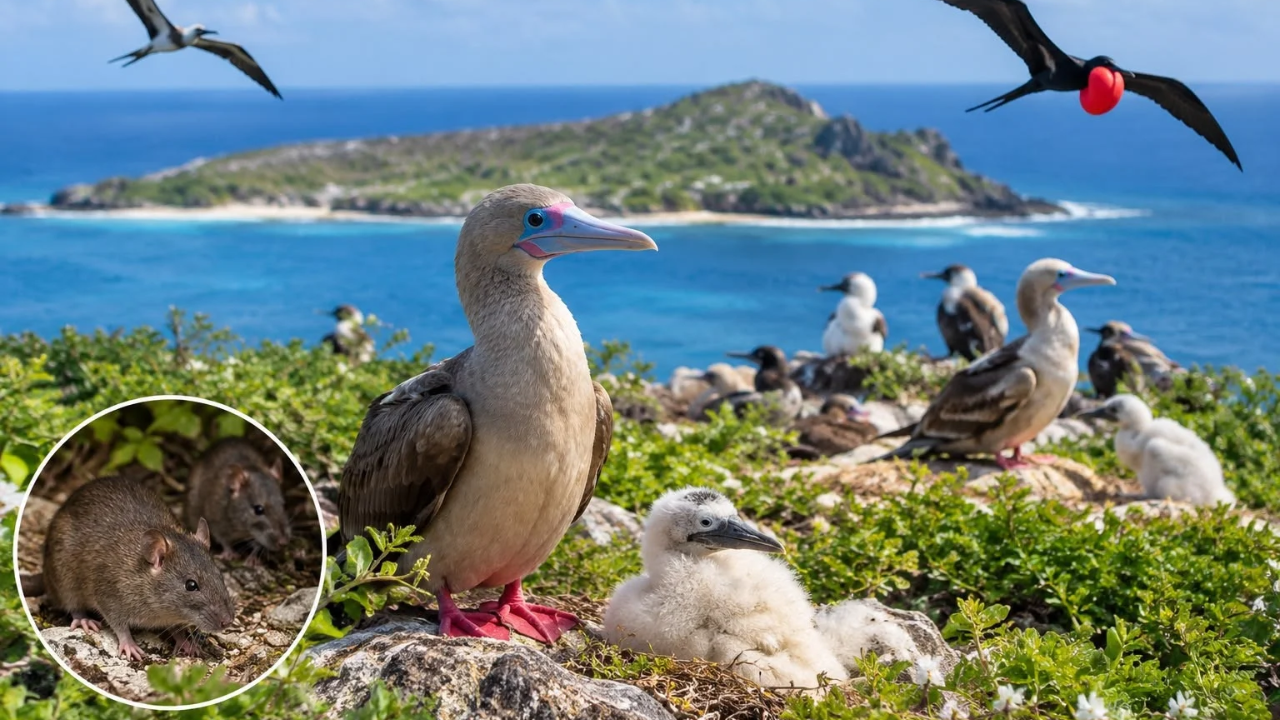
Removing invasive rats from a Pacific island can allow surviving seabird species to multiply up to tenfold over subsequent decades, provided the island remains isolated enough to prevent reintroduction and free of secondary predators that simply shift their diets when rodents disappear. That sounds like a straightforward triumph of conservation biology. On paper, it reads like a clean ledger entry: subtract the pest, add the birds, watch the colonies bounce back.
In the field, nothing is ever that tidy.
I have spent decades covering ecological policy, remote field stations, and the budgets that keep conservation programs afloat. I have seen plenty of press releases crowing about "island restoration" within twenty-four months of an aerial bait drop. Those early victory laps usually ignore a brutal biological reality. Seabirds are slow-motion creatures. Many species do not breed until they are five, eight, or even ten years old, and they often lay a single egg per breeding cycle. Tenfold growth does not happen overnight. It takes generations of quiet survival before the numbers look dramatic enough to make a headline.
When a competitor runs a story about three seabird species surging up to tenfold over decades after a 2005 rat eradication on a Pacific island, the headline hooks you immediately. Tenfold growth is a massive rebound. Yet the real story sits underneath that headline, buried in the mechanics of island ecology, biosecurity bottlenecks, and the uncomfortable trade-offs that conservationists rarely advertise to donors.
Why Tenfold Growth Takes Decades Rather Than Months
Public enthusiasm loves instant turnarounds. Funders want clean graphs showing steep upward lines right after money is spent. Seabird demography does not care about grant cycles.
Consider a hypothetical example of a remote Pacific islet cleared of invasive rats in 2005. Before eradication, nocturnal rodents raid burrows, eat eggs, and kill newly hatched chicks. Even if adult birds survive at high rates, recruitment—the pipeline of young birds reaching breeding age—collapses to near zero. When the rats vanish, egg and chick survival jumps almost immediately in the areas that had been hit hardest. Still, those newly fledged chicks cannot immediately replace the missing middle-aged cohorts. Only after several years do the earliest post-eradication survivors mature, claim nesting territory, and begin producing chicks of their own. Multiply that lag across multiple breeding cycles, and a tenfold increase stretches across decades rather than a single decade.
Different seabird species also respond at wildly different speeds. Burrow-nesting petrels and shearwaters often face intense competition for underground real estate, plus lingering constraints from degraded soil or altered vegetation. Surface nesters or species with higher baseline productivity can sometimes expand faster once ground predation stops, while others creep upward slowly because they have strong philopatry—the instinct to return to the exact natal site where they hatched. If a colony was nearly wiped out before 2005, there are fewer returning adults acting as social magnets to draw prospecting birds back to the island.
A tenfold population jump on a remote island is rarely a straight line. It is a slow compound-interest curve driven by survival rates that stay high year after year.
There is another catch that gets glossed over in celebratory coverage. A tenfold jump from a tiny remnant baseline is still a small number in absolute terms. Going from fifty breeding pairs to five hundred pairs is a tenfold surge. It is biologically meaningful and statistically striking. It is not the same thing as restoring a bustling prehistoric colony of half a million birds. Calling a tenfold rebound a full recovery can confuse readers who picture skies darkened by flocks when the reality is a fragile, growing foothold that still needs decades more to stabilize.
The Predator Vacuum and Why Eradication Is Only Half the Battle
When you remove a dominant invasive predator like a Pacific rat or black rat, you do not just save eggs and chicks. You rearrange the entire food web on a small landmass.
Rats are omnivores. Along with seabird eggs and nestlings, they eat native invertebrates, land snails, lizards, seeds, and carrion. Taking them out releases pressure on those prey groups, which can help native plants and insects recover. That sounds like pure upside. Yet removing one predator can also expose vulnerabilities that were masked while the rats were active, or it can shift attention toward other threats that were never addressed during the eradication campaign.
Secondary predators are a classic complication in island work. Suppose an island holds rats alongside feral cats, invasive house mice, or predatory birds. If a project targets rats without controlling other threats, or if managers assume rat removal solves the island's problems, recovery can stall or skew unevenly across species. Even when rats are the primary threat to certain birds, other species on the same island might depend on different microhabitats or face pressure from marine heatwaves, shifting fisheries, or plastic debris out at sea.
Then there is the human factor. Eradicating rats from a remote island is expensive, logistically punishing, and politically sensitive. Operations typically rely on carefully calibrated rodenticide bait deployed across rugged terrain, often via helicopters or dense ground grids, timed around seasonal weather windows and breeding cycles. Every drop carries operational risk and public scrutiny. If bait misses a steep cliff face or a coastal boulder field, even a tiny surviving pocket of rats can rebuild a population faster than managers expect.
That is why biosecurity after 2005 matters just as much as the eradication itself. An island is only as safe as its perimeter. One supply boat anchoring too close without proper checks, one piece of cargo left uninspected, or one accidental stowaway can undo years of work. Tenfold seabird growth over decades is proof that the initial removal held and that reintroductions were kept at bay. That long-term containment is grueling, unglamorous work that rarely gets credit when a bird count rises.
Nutrient Flows and How Seabirds Rebuild the Island Itself
One of the most fascinating parts of a multi-decade seabird rebound is what happens in reverse. At first, you think of the island helping the birds by giving them a safe place to breed. Over time, the birds start rebuilding the island.
Seabirds are ocean-to-land nutrient pumps. They forage far offshore, often hundreds of kilometers away, gathering marine nitrogen and phosphorus, and bring those nutrients back to land in the form of guano, feathers, regurgitated food, and carcasses. Before invasive rats arrived, dense seabird colonies flooded islands with marine nutrients. That enrichment fed coastal vegetation, shaped soil chemistry, and even influenced coral reef health in surrounding waters as runoff carried nutrients from land to sea.
When rats suppress seabird numbers for decades or centuries, that nutrient conveyor belt slows to a trickle. Soil loses fertility, salt-tolerant or invasive weeds can gain ground over native coastal plants, and the entire ecosystem runs in lower gear. When three seabird species grow up to tenfold over decades after a 2005 removal, the island begins receiving a larger, steadier pulse of marine subsidy again.
- Soil and plant recovery: Increased guano and organic matter enrich thin island soils, helping native grasses, shrubs, and coastal trees re-establish where rats once chewed through seedlings and roots.
- Invertebrate and reptile shifts: Healthier vegetation and reduced rodent predation create more complex ground cover, supporting native beetles, spiders, and skinks.
- Marine connection: Higher seabird densities mean more marine nutrients cycling through the nearshore zone, linking terrestrial eradication directly to ocean productivity.
None of this happens on a neat schedule. Heavy storms can wash away topsoil and newly sprouted plants. Droughts can stress vegetation before deep root systems return. And in some cases, invasive plants that moved in while native cover was thin can take advantage of extra nutrients right alongside native species. Weeding out non-native plants on a remote island is another recurring cost that often follows animal eradication.
What Tenfold Growth Misses About Ocean Conditions
Here is a hard truth that conservation stories sometimes downplay: you can make an island completely rat-free and still lose ground if the ocean turns hostile.
Seabirds live two lives. For a few months each year, they are island creatures tied to burrows, ledges, or scrub. For the rest of the year—and throughout their non-breeding seasons—they are pelagic wanderers navigating vast stretches of open ocean. Their survival and breeding success depend heavily on forage fish, squid, and krill availability, sea surface temperatures, and large-scale climate oscillations.
A marine heatwave can push prey deeper or farther north than foraging parents can reach in a single day's trip. When food gets scarce near the colony, adults may abandon a chick to save their own bodies, or skip breeding altogether for a season. Even on a pristine island with zero rats, a string of poor ocean years can flatten a population curve or temporarily slow a multi-decade climb.
Comparing three species that each grew up to tenfold over decades also highlights how differently species handle those twin pressures. One species might rely on a narrow prey base right near the island, making it sensitive to local ocean shifts even after rat predation drops to zero. Another might range wider or switch prey more easily, letting its post-2005 rebound look smoother. Looking at the headline number alone hides those differences in resilience.
Counter-Arguments and Uncomfortable Trade-Offs
Whenever a conservation project succeeds over twenty years, critics and skeptics ask fair questions that deserve straight answers rather than defensiveness.
First, is rat eradication always worth the cost and ecological footprint? On small, high-value islands with clear biodiversity payoffs and strong biosecurity, the track record over decades is compelling. On huge, populated, or heavily interconnected islands, eradication can be prohibitively expensive, technically near-impossible, or socially contentious. A tenfold rebound on one island does not mean every island should be treated with the same playbook.
Second, there is the question of non-target impacts during baiting operations. Modern protocols are far more refined than early experimental efforts, using targeted bait formulations, specific application rates, and careful timing to minimize risk to non-target species. Still, any broad chemical deployment on a wild island requires rigorous monitoring and honest accounting of unintended casualties among native land birds or non-target wildlife. Pretending there is zero risk erodes public trust faster than admitting trade-offs and managing them transparently.
Third, long-term monitoring itself is vulnerable to budget cuts. A 2005 eradication followed by tenfold growth over decades only looks obvious because researchers kept counting, banding, and surveying long after the initial project ended. Too many environmental programs fund the flashy intervention—the bait drop, the fence, the initial press release—and starve the boring ten- and twenty-year monitoring that proves whether the gain actually lasted.
How to Read Conservation Wins Without Getting Fooled
If you follow environmental news or fund conservation work, a story about invasive rats being removed in 2005 and seabird species growing up to tenfold over decades is a useful test of your BS detector. Look past the big multiplier and check the underlying mechanics.
Ask what the baseline was before the jump, how long the monitoring window actually ran, and whether the population growth came from local breeding success, immigration from nearby islands, or a mix of both. Ask what other predators, invasive plants, or human visitors still reach the island. Most of all, remember that twenty years in the life of a long-lived seabird is just the opening chapter of a much longer recovery.
Check the long-term biosecurity budget and twenty-year survival data before you ever call an island restoration finished.