The transition from terrestrial bipedality to powered aerial locomotion in theropod dinosaurs requires a rigorous parsing of morphological data rather than reliance on linear evolutionary narratives. Discoveries from the Jehol Biota in Liaoning, China, specifically the preservation of asymmetrical pennaceous feathers on both forelimbs and hindlimbs in basal paravians, shattered the classical single-origin model of avian flight. Rather than a tidy progression from ground-running cursorial runners to single-wing airfoils, the fossil record exposes a complex landscape of experimental aerial strategies. Evaluating these specimens demands a shift from descriptive paleontology to functional biomechanics, mapping structural adaptation against aerodynamic constraints.
The Anatomical Vector of the Hindlimb Airfoil
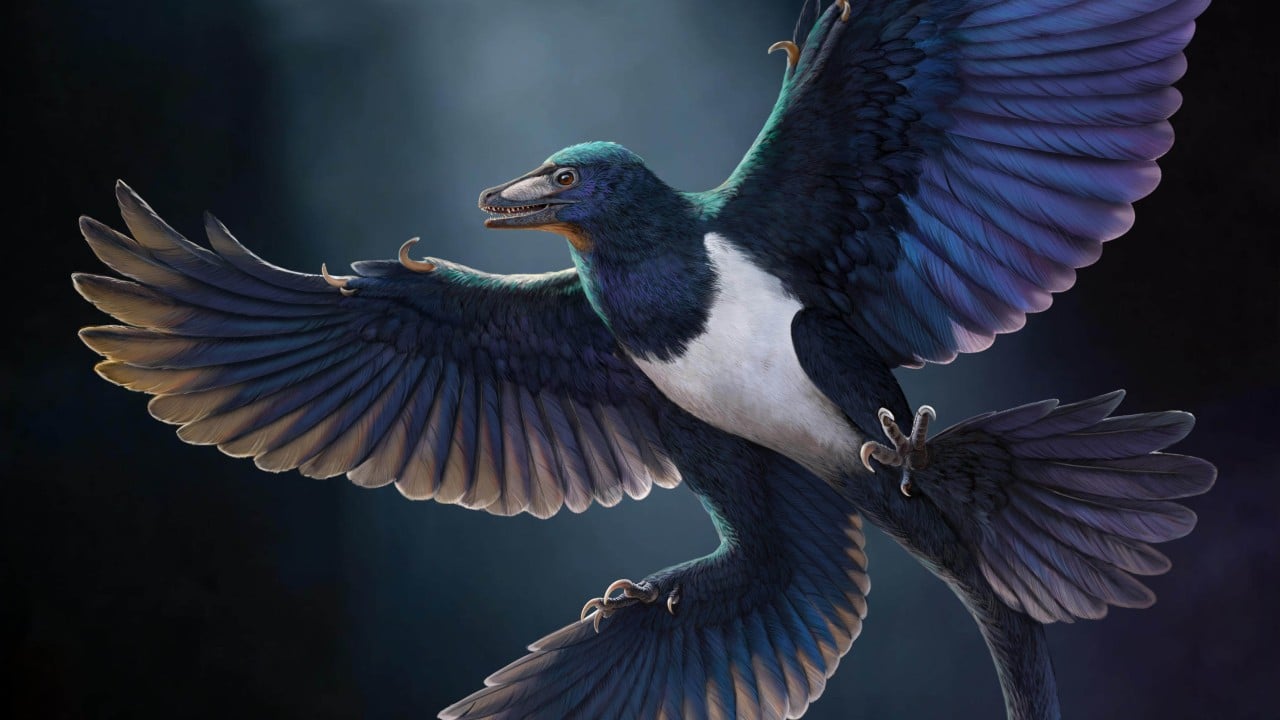
Classical aerodynamic theory assumes lift generation is an exclusive property of the pectoral girdle. The identification of preserved rear-wing surfaces in genera such as Microraptor forces an architectural update to this model.
- The primary pectoral wing operates at a higher span loading, optimized for stroke-plane efficiency and thrust vectoring.
- The secondary pelvic wing introduces a staggered chord-line geometry, altering downwash dynamics over the trailing edge.
- Intertarsal flexion angles restrict the sweepback envelope of the pelvic feathers, binding aerodynamic performance directly to kinematic joint mobility.
When a tetrapteryx morphology executes a glide, the rear wing operates within the turbulent wake shed by the leading aerofoil. This positioning creates a localized pressure differential. To maintain stability, the organism must modulate angle of attack across two distinct spatial planes simultaneously. This bifurcated lift-generation mechanism increases control surface complexity while lowering the stalling speed threshold at low Reynolds numbers.
[Forelimb Airfoil] ---> Generates Primary Lift / Wake Shedding
        |
        v
[Downwash Interaction] ---> Impinges on Pelvic Biplane Surface
        |
        v
[Hindlimb Airfoil] ---> Stabilizes Pitch Moment / Increases Total Lift-to-Drag Ratio
The Kinetic Energy Budget of Multi-Plane Gliding
Transitioning from passive parachuting to controlled aerial descent imposes strict metabolic and structural overheads. Every square centimeter of pennaceous feather attached to the metatarsus represents a trade-off between terrestrial locomotive efficiency and aerial drag.
- Mass Distribution Penalty: Distal limb feathers shift the center of mass away from the hip joint, increasing the inertial moment required for bipedal striding.
- Parasitic Drag Factor: On the ground, trailing feathers on the legs generate frictional resistance, penalizing high-speed running acceleration.
- Control Authority Gain: In an aerial medium, the same surface area functions as a variable-geometry pitch and yaw stabilizer, reducing the muscular energy required for recovery from wind gusts.
Organisms occupying the Liaoning ecosystem faced a multivariable optimization problem. If the cost of ground-locomotion penalties exceeded the energetic savings of arboreal descent or predator evasion, the morphology collapsed under natural selection pressure. The survival of multi-winged configurations indicates that micro-habitats within the Jehol forests—characterized by dense canopy structures—rewarded vertical drop maneuverability over sustained horizontal sprint velocity.
Resolving the Phylogenetic Branching Mechanics
The presence of four-winged morphologies across multiple divergent lineages within Paraves complicates monophyletic flight evolution. The distribution of asymmetric rear feathers points toward two structural interpretations:
- Homoplastic Adaptation: Independent lineages converged on hindlimb airfoils as a consequence of scaling laws acting on small-bodied, arboreal theropods with dense integumentary coverage.
- Basal Exaptation: The ancestral paravian node possessed functional leg feathers utilized for display or thermal regulation, which were subsequently co-opted for aerodynamic duty.
Resolving this distinction requires decoupling skeletal adaptations from integumentary traces. Skeletal markers of aerial capability, such as hyper-elongated deltopectoral crests and semilunate carpal bones, do not map linearly onto pelvic feather retention. Specimens from Liaoning demonstrate that feather complexity outpaced skeletal specialization. The aerodynamic machinery evolved before the structural skeletal frame was fully optimized for a flapping stroke cycle.
The Aerodynamic Efficiency Frontier
Evaluating the utility of dual-plane lifting surfaces requires analyzing the lift-to-drag ratio under varying airspeeds. Single-wing models achieve stability through tail-length variation and pygostyle reduction. The addition of a pelvic wing alters the pitching moment coefficient, requiring an expanded neural control loop for stabilization.
Flight Mode              | Primary Lift Source | Stability Mechanism   | Drag Penalty
-------------------------|---------------------|-----------------------|-------------
Cursorial Biped          | None                | Inertial Balance      | Low
Parachuting Tetrapteryx  | Forelimb + Hindlimb | Staggered Planform    | Moderate
Active Flapping Paravian | Pectoral Girdle     | Caudal & Pelvic Vanes | High (Ground)
In low-velocity gliding scenarios, the biplane configuration prevents tip stalling by staggering the stall progression between the forelimbs and hindlimbs. As angle of attack increases past the critical threshold, the forward wing sheds lift first, dropping the nose and allowing recovery before a catastrophic spin occurs. This passive safety mechanism compensates for underdeveloped neurological reaction times in primitive avians.
Strategic Implementation for Biomechanical Reconstruction
When analyzing fossil specimens exhibiting complex integumentary preservation, researchers must avoid teleological assumptions regarding the end-state of avian evolution.
- Quantify skeletal moment arms independently of feather impressions to isolate locomotive function from aerodynamic capability.
- Model multi-surface interactions using computational fluid dynamics rather than scaling modern avian parameters onto archaic theropod geometries.
- Map stratigraphic distribution against micro-environmental proxies to determine whether four-winged morphotypes occupied distinct ecological niches compared to their contemporary single-wing relatives.
The fossil data from Liaoning confirms that the pathway to the modern avian bauplan was not a straight highway, but a broad adaptive radiation filled with dead ends, parallel trials, and structural experiments. Understanding how these organisms balanced the competing demands of terrestrial locomotion and aerial physics provides the baseline framework for all modern aerodynamic modeling in vertebrate paleontology.