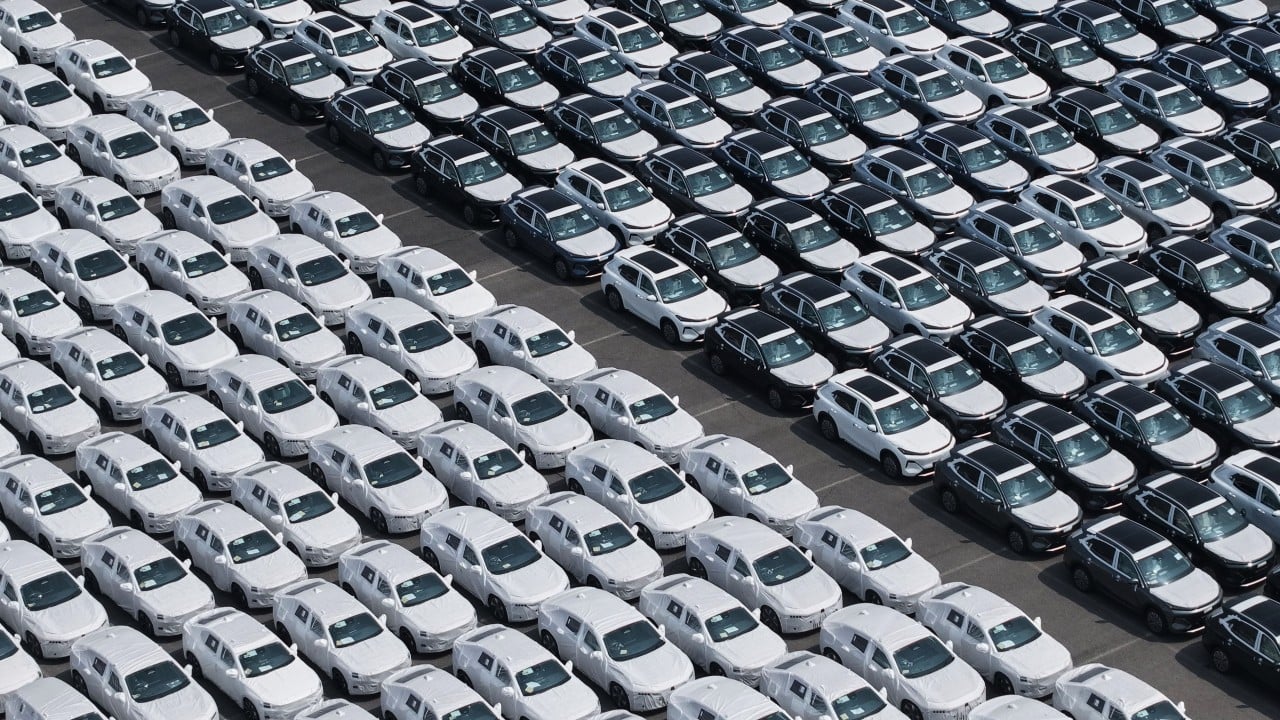
The headlines are popping champagne over a single cargo hold packed to the gills with electric vehicles steaming out of Shanghai toward Europe. The lazy consensus screams triumph. Global logistics are healing, Chinese manufacturing dominance is accelerating, and consumers win through efficient trade routes.
It is a complete misreading of reality.
I have watched logistics desks burn millions of dollars chasing headline metrics while their underlying unit economics bled out on the deck plates. That record-breaking vessel is not a symbol of unstoppable market conquest. It is a desperate pressure release valve for an overbuilt, margin-starved domestic industrial machine with nowhere else left to put its inventory. When you understand how automotive overcapacity actually works, that floating parking lot looks less like an armada and more like a distress flare.
Let us dismantle the prevailing narrative piece by piece.
The Overcapacity Trap Nobody Wants to Name
Every mainstream commentator looks at a massive roll-on, roll-off vessel carrying thousands of battery-electric vehicles and focuses on the wrong variable. They look at volume. They measure success by the sheer mass of metal moving across oceans.
That is rookie math.
The domestic market inside China is locked in a suicidal price war. Local manufacturers overproduced to capture state subsidies, hit local growth targets, and satisfy regional government vanity metrics. Now, domestic yards are overflowing with unsold inventory. Dealership lots are choked. Storage yards look like automotive graveyards before the cars even find a first owner.
Chartering massive, specialized carriers to dump excess inventory into European ports is not a sign of healthy organic demand. It is liquidating surplus at the margins just to keep factory lines moving and avoid the catastrophic credit default that happens when production lines freeze.
The Dangerous Illusion of Scale Economics
Here is where the conventional wisdom shatters against the rocks of maritime reality. Executives love to talk about economies of scale. Pack more units onto a single hull, drive down the per-unit shipping cost, and win the margin game.
It sounds brilliant in a corporate slide deck. It fails utterly in practice.
Concentrating thousands of high-density lithium-ion battery packs into a single steel box floating on salt water introduces exponential risk profiles that shipowners and port authorities are quietly terrified of. Marine insurers are waking up to the thermal runaway reality. If one cell goes rogue mid-ocean, the cascading thermal event on a mega-capacity vessel creates a catastrophe that standard maritime suppression systems are simply not built to handle.
When you cram seven thousand electric vehicles into an enclosed cargo deck, you are not maximizing efficiency. You are concentrating systemic risk. The logistics insurance premiums alone are beginning to eat whatever cost advantages operators thought they gained by supersizing the haul.
The Regulatory Brick Wall Waiting at the Dock
The media loves to track the ship until it hits the European coastline, as if unlading is the finish line.
It is actually where the real nightmare begins.
Europe is not an open sponge waiting to absorb unlimited waves of heavily subsidized imports. Brussels has ramped up anti-subsidy investigations, provisional tariffs, and compliance hurdles that treat incoming vehicle shipments with microscopic legal hostility. Dumping inventory onto foreign shores without established, localized service networks, spare parts pipelines, and recycling compliance infrastructure is an expensive exercise in terminal friction.
You can float ten thousand cars across the sea, but if they sit on dockside holding lots for six months because of customs disputes, regulatory holds, and lack of dealer network throughput, your capital is trapped. Cargo sitting in a foreign port is not trade. It is dead money bleeding storage fees.
The Real Question You Should Be Asking
People look at these megaships and ask: How fast can Chinese automakers scale up their export fleet to flood Western markets?
It is the wrong question entirely.
The question you should be asking is: How long can domestic balance sheets sustain manufacturing cars at a loss just to export them into an increasingly hostile regulatory fortress?
The answer is not very long.
When capital controls tighten, export margins compress under retaliatory tariffs, and domestic credit markets demand actual profitability instead of unit volume theater, these giant floating experiments will stop overnight.
Stop looking at the record-breaking cargo counts as a sign of permanent structural dominance. Watch the cash burn. Watch the inventory aging reports. Watch the insurance rates climb.
The era of shipping your way out of a domestic glut is hitting its hard mathematical limit.