The scent of cheap lager and burnt flares clings to the concrete outside the Fontaines de Belleville. It is a Tuesday night, but time has lost its meaning in the northeastern corners of Paris. A man named Jean-Christophe—JC to anyone who has shared a terrace with him over the last twenty years—is staring at his hands. They are stained with a faint, stubborn smudge of blue ink from a handmade banner he spent forty-eight hours stitching together in his cramped apartment. His eyes are fixed on the tarmac. He is listening to the low, electric hum of a city holding its breath.
Paris does not wait quietly. It waits with a restless, agonizing friction.
For decades, French football fans carried a collective complex, a heavy chip on the shoulder when looking across the English Channel or toward the sun-drenched giants of Spain. They were the cultural capital of the world, yet footballing peasants in the European court. Then came the money, the superstars, and the suffocating pressure of expectation. But wealth cannot buy the specific, agonizing magic of a dynasty. It only buys the ticket to try.
Tonight, the city stands on the precipice of something that was deemed impossible just twenty-four hours ago. A back-to-back UEFA Champions League victory.
To the casual observer scrolling through a sports ticker in New York or Tokyo, Paris Saint-Germain winning another trophy looks like an inevitability, a corporate juggernaut fulfilling its financial destiny. They see the Jordan logos, the glittering lights of the Parc des Princes, and the metadata of success. They see a cold machine.
They do not see JC’s hands. They do not understand that a football club in Paris is not a business venture to the people who inhabit its streets; it is an emotional ledger where decades of heartbreak are waiting to be balanced.
The Ghost of 2020 and the Weight of Gold
To understand why the crowd gathering along the Champs-Élysées feels less like a carnival and more like a collective exorcism, you have to look backward. Go back to the empty, ghostly stadiums of the pandemic era. When PSG finally reached their first Champions League final in 2020, the world was fractured. The streets of Paris were quiet, locked down, subdued by a global catastrophe. The loss to Bayern Munich that night did not just sting; it felt like a cruel joke. Success had come when no one was allowed to touch it.
For years, the critique of the club was simple, sharp, and devastating: they had no soul. Critics pointed to the revolving door of managers, the mercenary attitude of global icons who treated the pitch like a fashion runway, and the predictable dominance in a domestic league that offered no real resistance. The Champions League was the only metric that mattered, and it became a psychological prison. Every spring brought a new, spectacular collapse. The collapses became memes. The memes became identity.
Then, something shifted.
The club stopped trying to buy the world and started looking at its own backyard. The banlieues of Paris produce the finest football talent on the planet, raw diamond after raw diamond, previously exported to London, Madrid, and Munich. By anchoring the squad in local blood, the connection between the grandstands and the pitch was restored. The cold machine grew a pulse.
When the whistle blew on last year’s continental triumph, it felt like a dam breaking. The city dissolved into a chaotic, beautiful madness that lasted until the sun came up over the Seine. But that was the first time. The first time is sweet, a relief that washes away the ghosts of past failures.
The second time is about dominance. It is about validation.
The Invisible Pressure of the Second Act
Consider the mechanics of human desire. When you have starved for a lifetime, a single meal is a miracle. But once you have eaten, you immediately begin to fear the return of the hunger.
The atmosphere in the bars around the Place de la République is thick with this specific anxiety. Winning once can be dismissed as a fluke, a alignment of the stars, a favorable draw, or a moment of individual genius. Winning twice in succession establishes a regime. It elevates a club from a mere champion to an era-defining empire.
The numbers back up the historical weight of this moment. Since the tournament was rebranded in 1992, only a select brotherhood of clubs has managed to retain the big-eared trophy. Real Madrid did it with an almost supernatural arrogance; AC Milan managed it in the twilight of the twentieth century. For a club founded in 1970—a literal infant compared to the centuries-old institutions of European football—to join that pantheon is an act of historical revisionism.
"We used to go to places like Chelsea or Barcelona just hoping not to get embarrassed," JC says, his voice a gravelly rasp from a week of singing. He lights a cigarette, the ember glowing against the darkening Parisian sky. "We were tourists. Even when we had the best players, we felt like guests in someone else’s house. Last year changed how we looked at them. Tonight changes how they look at us."
This is the psychological shift that sports science cannot quantify. The tracking data, the expected goals ($xG$), the tactical shifts from a low block to a high press—none of it captures the terrifying momentum of a team that has forgotten how to lose on the big stage.
A City Divided by Its Own Greatness
Yet, beneath the anticipation, there is a strange, uniquely Parisian melancholy. The city is gentrifying, changing, pushing the working-class supporters who built the club's mythos further out into the suburbs. The tickets at the Parc des Princes are now luxury items, competed for by tech executives and influencers who view a football match as content rather than a communion.
The migration of the soul is happening in real-time. While the VIP lounges are filling with champagne flutes, the real tension is being held in the working-class pockets of the capital—in Belleville, in Saint-Denis, in the bars where the screens are slightly fuzzy and the beer is served in plastic cups.
There is an underlying fear that a second consecutive European title will permanently seal the club behind a wall of corporate exclusivity. If PSG becomes global property, what happens to the kids from the housing projects who look at the stadium as their secular cathedral?
This is the paradox of modern football. To achieve the ultimate success, a club must become a global brand. But in becoming a global brand, it risks alienating the very people who gave it a voice when it was nothing. JC knows this. Every older supporter outside the cafe knows this. They are cheering for a victory that might eventually price them out of their own passion.
But tonight, that dilemma is tabled. The stakes are too high for nuance.
The Waiting is the Cruelest Part
The clock ticks toward midnight. The match is over, the trophy secured on foreign soil, but the team has not yet arrived. They are in the air, flying back to a city that has already begun to burn through its supply of red and blue flares.
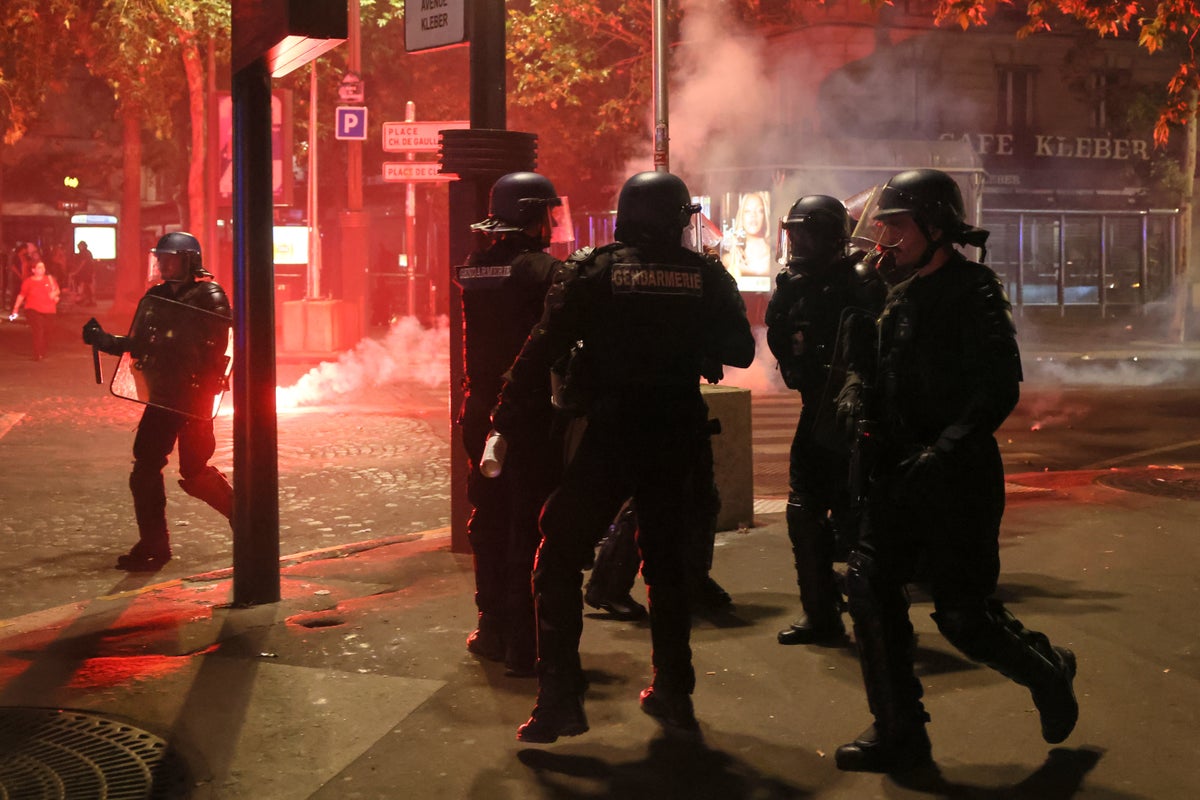
The police vans line the avenues, their blue lights strobing against the stone facades of Hausmann buildings. The officers stand with their arms crossed, watching the crowds swell. There is no violence yet, just an overwhelming buildup of kinetic energy. People are climbing lampposts. Flares are struck, casting a thick, sulfurous fog over the boulevards, turning the Arc de Triomphe into a silhouette floating in a crimson cloud.
A group of teenagers, none of them old enough to remember the dark days of the mid-2000s when the club was fighting relegation, are singing a chant that has been passed down through generations. Their voices are clean and loud, slicing through the rumble of traffic. They do not carry the trauma of the older generation. To them, Paris winning is normal. It is the natural order of things.
That generational divide is where the true narrative of the night lives. The older fans watch the younger ones with a mixture of envy and pride. Envy for their innocence, pride that they will never have to know the humiliation of being the laughingstock of Europe.
The Arrival
A roar begins at the edge of the avenue. It travels like a wave, growing in volume as it rolls toward the center of the crowd. The team bus is coming.
It moves at a walking pace, a massive dark hull cutting through a sea of humanity. Inside, the players are pressed against the glass, their faces illuminated by the screens of their phones, recording the madness outside. They are young, wealthy beyond imagination, and famous across the globe. But in this specific moment, looking out at the thousands of upturned faces in the Parisian night, they look small. They look like witnesses to a force greater than themselves.
JC moves toward the curb. He doesn't scream. He doesn't reach for his phone to take a blurry video that will sit in a cloud drive forever. He just raises his stained hands, the blue ink vivid under the streetlights, holding his banner high against the smoky air.
The bus rolls past, the silver trophy visible for a fraction of a second through the tinted windows, catching the glare of a stray flare. It glints, cold and perfect, amidst the warm, chaotic mess of the street.
The city has its second dawn. The empire is real. And tomorrow, the hunger will start all over again.