The wind off the Pearl River Delta carries a thick, metallic humidity that clings to wool suits within seconds of stepping off a plane. For anyone who has ever stood on an airport tarmac in southern China during a diplomatic arrival, the sensory overload is immediate. Jet fuel hangs heavy in the air. The glare of concrete reflects the subtropical sun. And then there is the silence that falls right before a heavy fuselage door swings open.
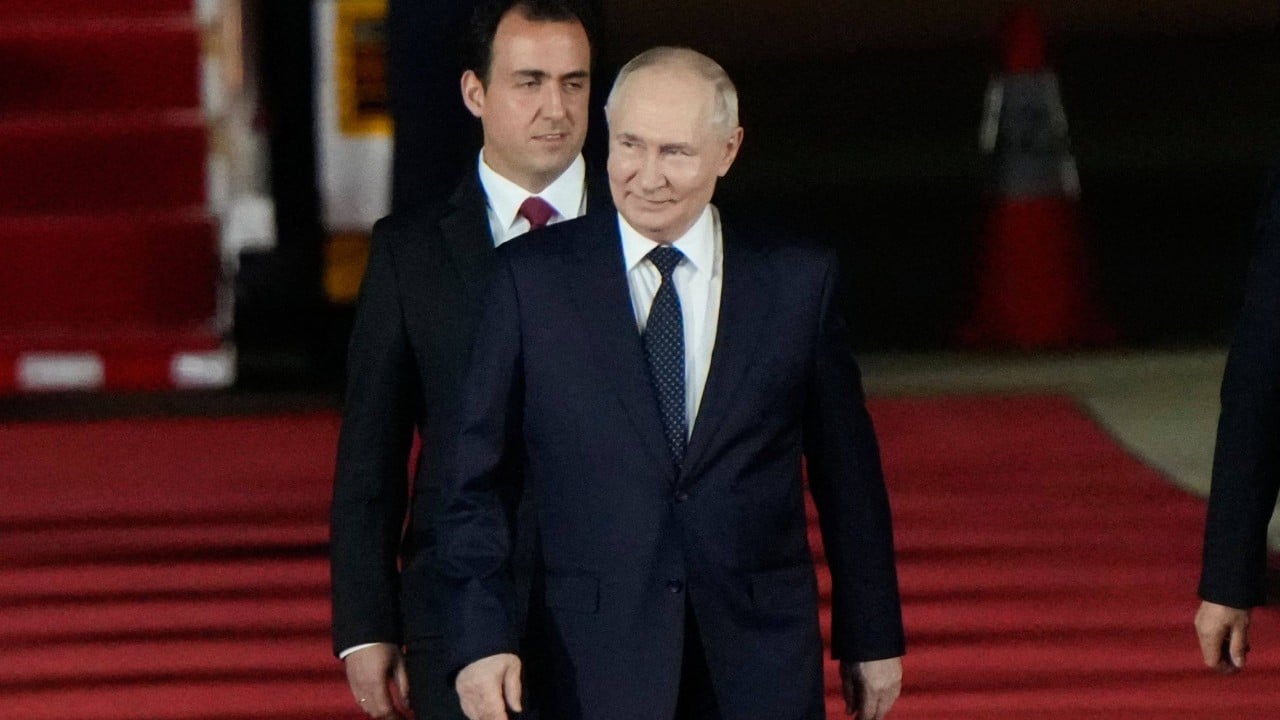
When Russian President Vladimir Putin touched down in Shenzhen ahead of the Asia-Pacific Economic Cooperation summit in late 2026, news wires immediately recorded the protocol details. According to official state media reports from both Moscow and Beijing, he received the highest-level airport welcome available for a visiting head of state. An honor guard stood in rigid formation. Senior Chinese officials waited at the base of the stairs. A red carpet stretched across the gray asphalt like a bold brushstroke across a canvas of concrete. You might also find this connected story useful: What Most People Get Wrong About the Alaska Senate Flip and a 56-44 Majority.
Cold facts. Dry reporting. Easy to scroll past on a Tuesday morning while waiting for coffee to brew.
Yet anyone who has spent years watching international statecraft unfold knows that protocol is never just decoration. In diplomacy, choreography is the message. When a host nation rolls out its highest tier of ceremonial welcome for a leader isolated by Western sanctions and an International Criminal Court arrest warrant, every step down the airstairs carries the weight of shifting global alliances. As discussed in detailed coverage by TIME, the results are significant.
The Architecture of a Greeting
To understand why a thirty-second walk across an airport apron in Shenzhen matters to ordinary people thousands of miles away, it helps to strip away the geopolitical jargon and look at what is actually happening on the ground.
Consider a hypothetical logistics manager named Chen, working out of a cramped office overlooking the Yantian container port just east of Shenzhen. Chen does not read diplomatic cables. He reads bills of lading, freight insurance rates, and customs clearance times. Four years ago, most of his shipping manifests listed electronics bound for Rotterdam, Los Angeles, and Hamburg. Today, a growing share of his daily headaches involves rail manifests heading northwest toward Novosibirsk and Moscow, navigating payment bottlenecks between regional banks, and tracking dual-use export compliance rules.
For someone like Chen, the red carpet at Shenzhen Bao'an International Airport is not abstract theater. It is a weather vane.
When Beijing grants the highest-level airport reception to Moscow's leader at an APEC gathering—a forum originally conceived in 1989 to champion open trade across the Pacific Rim—it signals continuity to every customs official, bank compliance officer, and freight forwarder watching from the sidelines. According to trade data published by China's General Administration of Customs, bilateral trade between China and Russia surged past 240 billion dollars ahead of schedule in recent years, reshaping supply chains across Eurasia. That volume does not move on warm rhetoric alone. It moves because local officials and state-backed enterprises read the body language at the top and adjust their risk tolerance accordingly.
Protocol speaks louder than communiques.
Why Shenzhen Matters More Than Beijing
The choice of city adds another layer to the story that standard wire reports rarely unpack. Beijing is the seat of imperial history and formal bureaucracy. Shenzhen is something else entirely. Forty-six years ago, it was a cluster of fishing villages and rice paddies across the border from Hong Kong. Today, it is the beating heart of Chinese hardware manufacturing, telecommunications, and electric vehicle innovation.
Bringing the APEC summit—and specifically welcoming the Russian president—to Shenzhen places the diplomatic spotlight directly onto China's technological engine.
Think of international trade forums like a neighborhood dinner party where the seating chart tells you who is actually speaking to whom. For decades, APEC functioned as a bridge connecting the economies of East Asia, Oceania, and the Americas. The United States, Japan, South Korea, Australia, and China sat around the same table under the shared assumption that economic interdependence would soften political friction.
That assumption has frayed.
According to analysts at international policy institutes in both Washington and Singapore, the global economy has increasingly fractured into competing spheres of technological standards, energy corridors, and financial settlement systems. Western governments have tightened export controls on advanced semiconductors and industrial machinery, aiming to limit both Beijing's technological ascent and Moscow's military-industrial capacity. Meanwhile, Russia has pivoted its energy exports eastward, selling crude oil, natural gas, and coal to Asian buyers at discounted rates while importing Chinese vehicles, smartphones, and machine tools.
Standing on the tarmac in Shenzhen, surrounded by cranes and glass towers built on high-tech manufacturing, the Russian leader was stepping into the exact ecosystem his country's economy now depends on most.
The Invisible Friction Behind the Smiles
It would be easy—and dangerously inaccurate—to view that airport welcome as proof of a frictionless alliance. Anyone who tells you the relationship between Moscow and Beijing is simple is either selling a narrative or hasn't looked closely at the numbers.
Beneath the ceremonial warmth lies a quiet, persistent asymmetry.
Let us look at a second hypothetical scenario to see how this imbalance plays out in real life. Imagine Elena, a mid-sized industrial equipment importer in Yekaterinburg who needs specialized bearings and CNC machinery components once sourced from Germany. After European suppliers withdrew, she turned to manufacturers in Guangdong province. On paper, the trade boom looks triumphant. In practice, Elena spends weeks trying to find a regional Chinese bank willing to process cross-border yuan payments without freezing the transaction out of fear of secondary sanctions from the U.S. Treasury Department.
Western financial pressure has created an invisible ceiling over even the warmest diplomatic greetings. According to reporting by financial outlets tracking Sino-Russian trade flows, smaller Chinese lenders have repeatedly delayed or rejected Russian transactions when Washington expanded sanctions enforcement mechanisms. Major state banks tread carefully, acutely aware that their exposure to dollar-denominated global markets dwarfs their business with Moscow.
Beijing wants strategic alignment with Russia as a counterweight to American influence in the Indo-Pacific. At the same time, China's economy still relies heavily on consumer markets in North America and Europe to absorb its manufactured exports. Balancing those two realities requires extraordinary diplomatic footwork.
The highest-level airport welcome in Shenzhen gives Moscow the public prestige and legitimacy it craves on the world stage. Yet behind closed doors, Chinese negotiators remain notoriously unsentimental about pricing, pipeline terms, and financial risk. Prestige on the tarmac does not automatically translate into blank checks in the boardroom.
A Different Kind of APEC
For veterans who have covered Asia-Pacific diplomacy since the 1990s, the atmosphere surrounding an APEC arrival today feels almost unrecognizable.
Back then, the arrival of heads of state at an APEC host city carried a predictable rhythm of globalization optimism. Journalists crowded into press centers debating tariff reduction schedules, intellectual property harmonization, and trans-Pacific flight routes. Geopolitical rivalries existed, of course, but the shared vocabulary was commerce.
Today, the vocabulary is security, resilience, and sovereignty.
When Putin stepped off his aircraft in Shenzhen, his arrival immediately complicated the diplomatic choreography for every other delegation attending the summit. Leaders from U.S. treaty allies—including Japan, South Korea, and Australia—must navigate the optics of sharing a multilateral venue with the Russian president while continuing to support Ukraine and enforce sanctions regimes. Officials from Southeast Asian nations, such as Vietnam, Indonesia, and Malaysia, face a different calculation. Many of those governments have resisted choosing sides between Washington and Beijing, preferring to keep trade channels open with every major power.
For Beijing, hosting Putin with full ceremonial honors on the eve of the summit sets the tone before a single plenary session begins. It demonstrates to the broader Asia-Pacific region that China will not allow external pressure to dictate whom it welcomes or how it conducts diplomacy on its own soil.
What History Tells Us About Tarmac Theater
History offers plenty of reminders that airport receptions often serve as deliberate signals to third parties rather than mere courtesy to the guest.
In February 1972, when Richard Nixon landed in Beijing, Chinese Premier Zhou Enlai famously extended his hand across the gap at the bottom of the aircraft stairs—a conscious gesture meant to erase the memory of Secretary of State John Foster Dulles refusing to shake Zhou's hand in Geneva eighteen years earlier. That single handshake reshaped the Cold War balance of power.
In July 2018, when Saudi Crown Prince Mohammed bin Salman welcomed Chinese President Xi Jinping in Riyadh with fighter jet escorts and purple carpets, the message was directed as much toward Washington as toward Beijing—a visual declaration that Gulf energy producers were diversifying their strategic partnerships.
The Shenzhen arrival belongs to this same lineage of visual statecraft. Every detail—the rank of the welcoming official, the length of the red carpet, the placement of state media cameras—is calibrated to be broadcast globally within minutes. For domestic audiences in Russia, those images counter the narrative of international isolation, showing their president greeted as an honored statesman in one of the world's most dynamic economic hubs. For audiences in the Global South, the footage reinforces the image of a multipolar order where Western diplomatic norms no longer hold a monopoly on legitimacy.
The Human Weight of Geopolitical Shifts
It is tempting to watch clips of motorcades gliding down palm-lined boulevards in Shenzhen and treat them as distant theater, detached from daily life. That distance is an illusion.
When major powers redraw their diplomatic and economic alignments, the ripples eventually reach grocery bills, fuel prices, factory shifts, and interest rates around the world. A shift in how Russian crude oil is priced and shipped through Asian ports affects global energy benchmarks from Rotterdam to Houston. A decision by tech hubs in southern China to deepen industrial integration with Eurasian markets alters the competitive landscape for manufacturers in Stuttgart, Detroit, and Seoul.
We live in an era where the old rules of global integration are being rewritten in real time, often without a clear blueprint of what comes next. Even seasoned diplomats admit privately that managing a world split between overlapping economic blocs and geopolitical rivalries carries risks nobody has fully mapped out.
And that brings us back to that humid stretch of concrete in Shenzhen.
The cameras captured the crisp salute of the honor guard, the firm handshake at the foot of the stairs, and the black limousine pulling away toward the city skyline. Within hours, the news cycle moved on to plenary speeches, bilateral readouts, and market tickers. Yet long after the red carpet was rolled up and stored away, the real work began in quiet conference rooms, shipping terminals, and bank compliance offices across two continents—where thousands of ordinary people must figure out how to live, trade, and build a future inside the world those handshakes are shaping.