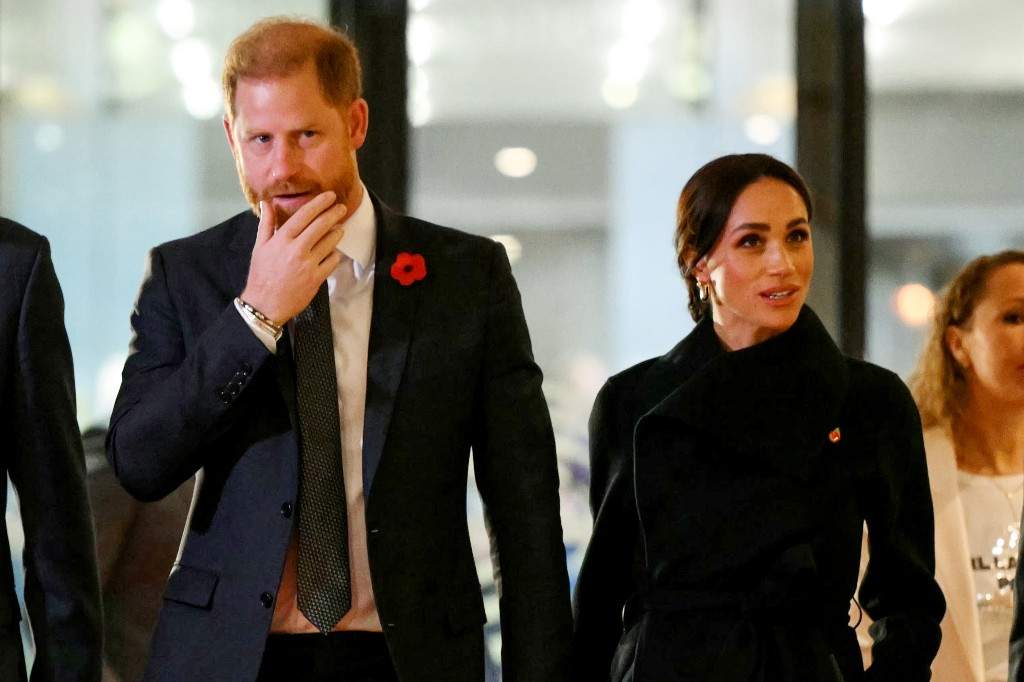
Public appearances during acute family legal crises function as calibrated risk-mitigation exercises rather than routine ceremonial duties. When Meghan, the Duchess of Sussex, attended the European Parliament in Brussels on November 10, 2026—four days after the FBI arrested her estranged father, Thomas Markle Sr., on federal charges related to possessing child sexual abuse material—the event demonstrated a deliberate split between physical presence and vocal engagement. By arriving alongside Prince Harry for the unveiling of the Lost Screen Memorial while abruptly withdrawing from her scheduled keynote address, the Sussex communications apparatus executed a containment strategy designed to separate institutional advocacy from personal reputational contagion.
Standard entertainment journalism frames this appearance through emotional heuristics, reducing a complex public relations maneuver to a binary narrative of personal distress. That framing misses the structural mechanics of high-stakes crisis management. In institutional communications, when a principal’s core brand equity—here, child safety and online harm prevention—collides directly with the criminal allegations facing an estranged relative, total absence signals retreat, while full participation invites hostile juxtaposition. The Brussels appearance resolved this tension through asymmetric deployment: maintaining visual solidarity to validate the institutional cause while eliminating unscripted or scripted verbal exposure that media outlets could splice against federal court filings.
The Anatomy of the Crisis Trigger
To evaluate the communications response, the underlying legal timeline and evidentiary mechanisms must be separated from tabloid speculation. The crisis did not emerge from a routine public relations dispute; it originated from a multi-jurisdictional federal criminal investigation.
- The Arrest and Custody Mechanism: On November 6, 2026, FBI agents arrested 82-year-old Thomas Markle Sr. at a senior care facility in Lakeland, Florida. Following an initial release under house arrest by a federal court in Tampa, authorities jailed him after he severed his court-ordered ankle monitor.
- The Evidentiary Basis: Federal prosecutors initiated the case after Thomas Markle Jr. discovered suspected child abuse imagery among his father’s belongings and alerted law enforcement in both the Philippines and the United States. Subsequent FBI raids on two Los Angeles storage units rented by Markle Sr. for nearly twenty years yielded physical media—specifically 35mm film negatives, slides, and books—containing alleged child sexual abuse material.
- Jurisdictional Escalation: Following a November 19 competency evaluation confirming Markle Sr. was mentally fit to stand trial, a federal grand jury in Los Angeles indicted him on two counts of possessing child sexual abuse material on November 24, doubling the initial charges. A Florida magistrate judge subsequently ordered his transfer to California to face federal prosecution.
This legal trajectory created an acute thematic collision. For years, the Duke and Duchess of Sussex have anchored their philanthropic brand—specifically through the Archewell Foundation—around digital safety and the protection of minors from online exploitation. When a direct biological relative is indicted on federal charges involving the abuse of minors, the overlap between the principal's public mission and the relative's alleged criminality creates maximum vulnerability to reputational spillover.
The Three Pillars of Asymmetric Visibility
In crisis communications, reputational contagion occurs when audiences transfer the negative attributes of a peripheral actor onto a primary brand. Because Meghan Markle and Thomas Markle Sr. have maintained a publicly documented estrangement since 2018—and because Meghan had reportedly severed all contact after learning of the allegations—the Sussex team did not face a question of complicity. Instead, they faced a problem of visual and thematic association.
Their Brussels deployment relied on three operational pillars to neutralize that association without abandoning a major institutional commitment.
1. Physical Presence Without Rhetorical Exposure
Canceling the Brussels trip entirely would have ceded the news cycle to the Florida arrest, signaling institutional paralysis and allowing the criminal proceedings to dictate the Sussex calendar. Attending the European Parliament demonstrated operational continuity. However, delivering a keynote speech on child safety while a father awaits federal arraignment on child exploitation charges creates an inescapable soundbite trap. Media editors inevitably pair clips of a speaker advocating for child protection with chyrons detailing the arrest. Withdrawing from the speaking slot while remaining physically present neutralized the soundbite risk while preserving the optics of solidarity.
2. Surrogate Amplification via Prince Harry
In dual-principal brand architectures, one principal can absorb rhetorical risk when the other is compromised by associative noise. Prince Harry assumed the entire speaking burden at the European Parliament, calling on technology firms to increase transparency regarding harms affecting children. Because Harry shares no biological link to Thomas Markle Sr. and possesses established institutional standing in European policy circles, his voice carried the policy message forward without triggering the immediate associative dissonance that Meghan’s voice would have generated at the podium.
3. Controlled Emotional Attribution
When a scheduled speaker withdraws hours before an event, communications teams must fill the informational vacuum immediately to prevent speculation of internal discord or legal entanglement. A source familiar with the Duchess's reasoning informed the Associated Press that she withdrew because she was not "strong enough emotionally" to deliver the remarks. In crisis management, attributing a tactical withdrawal to human vulnerability achieves two objectives: it establishes an unassailable boundary that discourages aggressive press questioning, and it implicitly signals moral revulsion toward the underlying allegations without requiring an official legal statement that could interfere with ongoing federal proceedings.
The Cost Function of Strategic Silence
A recurring question in public relations analysis is why high-profile figures do not issue comprehensive, point-by-point condemnations when estranged relatives face severe criminal charges. Observers often mistake silence for hesitation. In reality, issuing a formal statement in this scenario carries a negative expected value due to three structural constraints.
- Sub Judice and Prosecutorial Friction: Federal prosecutions involving child sexual abuse material rely on strict evidentiary chains and grand jury secrecy. Furthermore, prior reporting indicates that law enforcement authorities had previously advised the Duchess against speaking out publicly during active investigative phases. Public commentary from a high-profile witness or relative risks contaminating jury pools or handing defense attorneys grounds to argue prejudicial pretrial publicity.
- The Streisand Amplification Loop: An official statement from the Office of the Duke and Duchess of Sussex elevates a story from the crime and celebrity desks to global front-page political coverage. Every word of an official release is parsed, litigated in op-eds, and used to sustain a multi-day news cycle. Silence starves the media ecosystem of fresh quotes, forcing outlets to rely on dry procedural updates from federal court dockets in Tampa and Los Angeles.
- The Asymmetry of Estrangement: When two parties have been estranged for eight years, issuing a formal disavowal paradoxically re-establishes a public link between them. By declining to comment on the arrest while quietly maintaining the pre-existing boundary—evidenced by her prior decision to bar her father from any contact with her children, Archie and Lilibet—Meghan reinforced the reality that Thomas Markle Sr. operates entirely outside her personal and institutional sphere.
Visual Semiotics and Institutional Anchoring
The physical staging of the Brussels appearance illustrates how visual semiotics compensate for verbal restraint. Held at the European Parliament, the event centered on the Lost Screen Memorial—an installation featuring oversized smartphone replicas displaying the home-screen photographs of children who died following social media harm.
By anchoring her first post-arrest appearance inside a supranational legislative body rather than a commercial or entertainment venue, the Sussex team leveraged institutional authority to insulate her public image. Walking through the entrance hall holding Prince Harry's hand, dressed in a severe, understated dark coat, Meghan projected gravity and alignment with grieving families. The setting dictated the behavioral norms of the press corps; journalists covering a memorial for deceased children at the European Parliament operate under stricter decorum constraints than paparazzi or entertainment reporters at a commercial premiere.
This environment functioned as a protective buffer. It allowed Meghan to re-enter the public frame under controlled lighting, surrounded by European lawmakers and bereaved parents, ensuring the visual record of her return was tied to legislative advocacy rather than criminal court sketches from Florida.
Structural Limitations of the Containment Model
While the Brussels strategy successfully prevented immediate reputational collapse during the initial arrest phase, asymmetric visibility is not a permanent solution. As the federal case transitions from Florida detention to active trial proceedings in the Central District of California, the containment model faces three predictable failure points.
- Trial Calendar Collision: Federal criminal trials operate on rigid judicial schedules independent of external public relations calendars. As pretrial motions, evidentiary hearings regarding the Los Angeles storage units, and potential testimony unfold in 2027, major Sussex philanthropic initiatives or commercial launches will inevitably collide with damaging courtroom headlines.
- The Witness and Subpoena Variable: Because Thomas Markle Sr. publicly claimed during his psychiatric evaluation that his son fabricated the allegations, defense counsel may attempt to subpoena family communications or records to construct an alternative narrative. Any legal compulsion drawing the Duchess's correspondence into the public docket would breach the firewall between her brand and the criminal case.
- Cumulative Associative Fatigue: Even when audiences rationally understand that an adult child bears zero responsibility for an estranged parent's crimes, repeated algorithmic pairing of the names "Meghan Markle" and "Thomas Markle" alongside severe criminal keywords degrades search-engine sentiment and complicates corporate partnerships. Brand sponsors evaluate risk based on keyword adjacency rather than moral culpability.
Strategic Execution for Prolonged Legal Escalation
To prevent the upcoming California federal prosecution from eroding long-term institutional equity, the Sussex communications operation must transition from reactive event management to structural decoupling. First, all upcoming public engagements involving child safety and digital harm should shift toward institutional coalition formats—placing regulatory experts, lawmakers, and affected parents at the center of the visual frame while positioning the Duke and Duchess as conveners rather than solo keynote figures. Second, the Archewell Foundation must decouple its calendar announcements from predictable federal court dates in Los Angeles, establishing a minimum 72-hour buffer around scheduled hearings to avoid algorithmic headline collisions. Finally, the Office of the Duke and Duchess of Sussex should maintain absolute rhetorical discipline: issue zero reactive statements to press inquiries regarding the indictment, route all media queries strictly to federal court records, and allow the physical and legal reality of the eight-year estrangement to stand without commentary.