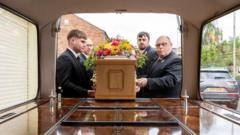
Traditional funerary practices are frequently dismissed as antiquated relics of religious dogma or expensive social theater, yet their absence creates a quantifiable void in the human psychological recovery process. When an individual bypasses the formal ritual of a funeral, they are not merely "saving money" or "avoiding fuss"; they are opting out of a biological and sociological synchronization mechanism designed to process acute trauma. The resulting "painful memories" cited by many are not accidental—they are the direct byproduct of a breakdown in the structural transition from acute grief to integrated loss.
The Cognitive Architecture of Ritual
To understand why the absence of a funeral causes lasting psychological friction, one must define the funeral not as a ceremony, but as a cognitive anchor. Human memory is associative. Without a definitive, high-stakes event to mark the cessation of a life, the brain struggles to categorize the "before" and "after" states. This creates a state of ambiguous loss, a condition where the lack of closure prevents the standard neurological pruning of attachments.
The funeral serves three specific structural functions:
- Sensory Integration of Fact: The presence of a casket, a gathering, or a specific site provides the sensory data required for the brain to accept the biological reality of death. Without this, the mind often maintains "ghost loops"—habitual thoughts of calling the deceased or planning for their presence—which trigger a fresh cortisol spike every time the reality is rediscovered.
- Social Externalization: Grief is inherently isolating. Rituals force the externalization of internal states. By speaking or being seen in a state of mourning, the survivor validates their internal reality through social feedback.
- The Liminal Boundary: Funerals act as a "rite of passage," moving the survivor from the status of "caregiver" or "partner" to "mourner." Skipping this step leaves the individual in a state of role-confusion, where they lack the social permission to begin the rebuilding phase.
The Cost Function of Deferred Mourning
The "painful memories" associated with improper funerals usually stem from a phenomenon known as disenfranchised grief. This occurs when a loss is not openly acknowledged, socially validated, or publicly observed. The cost of this deferment is not linear; it compounds over time through several distinct mechanisms.
The Feedback Loop of Regret
When a survivor chooses an abbreviated or non-existent service, they often do so under the influence of decision fatigue or acute avoidance. In the immediate aftermath of death, the prefrontal cortex is compromised by stress. The decision to "skip the service" is frequently an attempt to minimize immediate pain. However, this creates a long-term deficit. The brain eventually seeks to fulfill the ritual requirement, but since the opportunity has passed, it replaces the ritual with rumination. The survivor revisits the choice repeatedly, turning a single event into a perpetual source of guilt.
Social Support Erosion
A funeral is a coordination signal. It tells the community exactly when and how to provide support. Without a designated time and place for condolences, the social network remains fragmented. Friends and extended family, unsure of the "rules" for a non-funeral scenario, often retreat to avoid awkwardness. The primary survivor interprets this retreat as abandonment, further complicating the trauma. The "cost" here is the permanent weakening of the survivor's support system at the exact moment it requires reinforcement.
The Three Pillars of Restorative Ritual
For an intervention to successfully replace or elevate a standard funeral, it must address the three pillars of psychological transition. Failure to hit all three leads to the "incomplete" feeling that characterizes painful bereavement.
1. Spatial Permanence
The brain requires a physical location to "deposit" grief. This is why gravesites or memorial benches are effective. They allow for the segregation of mourning; the survivor can visit the site to engage with the loss and leave the site to engage with life. Without a dedicated space, grief becomes "homeless," bleeding into every room of a shared house or every daily routine.
2. Narrative Aggregation
A standard funeral forces a chronological review of the deceased’s life. This is the Narrative Synthesis. It moves the survivor's focus from the "event of death" (which is usually traumatic) to the "totality of life." When this is skipped, the memory of the death event remains the dominant data point in the survivor's mind, leading to PTSD-style intrusive thoughts.
3. Communal Witnessing
There is a biological imperative to be seen in pain. Evolutionary psychology suggests that communal mourning signals a need for resource sharing and protection. By bypassing the funeral, the individual signals (falsely) that they do not require these resources. The resulting isolation is a primary driver of prolonged grief disorder (PGD).
The Mechanical Breakdown of "Simple" Options
The trend toward "direct cremation" or "no-service" options is driven by an economic logic that ignores psychological externalities. From a strategy perspective, these options are "low-friction" in the short term but "high-maintenance" in the long term.
- The Closure Fallacy: "Closure" is not a destination but a process of metabolic integration. You do not "get" closure; you build it through repetitive social and physical actions. A direct cremation provides zero actions for the survivor to perform, leaving the "grief metabolism" at a standstill.
- The Minimalist Trap: Minimalism in death is often a mask for emotional avoidance. Avoidance is a primary maintainer of anxiety. By refusing to engage with the body or the ceremony, the survivor reinforces the brain's fear response to death, ensuring that future thoughts of the deceased remain tethered to fear rather than affection.
Structural Recommendations for the Bereaved and Professionals
To mitigate the damage of a missed ritual or to design a restorative "post-facto" event, one must apply the following logical framework.
Identify the Deficit
Determine which pillar was missed. Was it the lack of social support (Communal)? The lack of a final goodbye (Spatial)? Or the focus on the manner of death over the life lived (Narrative)?
Implement Proxy Rituals
If a funeral did not happen, the survivor must initiate a Proxy Ritual. This is not a "celebration of life" months later, which often lacks the necessary gravity. Instead, it must be a high-stakes, intentional act.
- Action: Establish a physical boundary. This could be the scattering of ashes at a specific, difficult-to-reach location. The physical exertion required provides the "weight" the brain expects from a transition ritual.
- Action: Curate a physical archive. In the absence of a casket or service, the survivor should create a physical representation of the life—a book, a collection, or a digital repository—that requires active categorization and "sorting" of memories.
Reclaim the Narrative
The "painful memories" are often a result of the last few days of illness or the shock of the passing dominating the mental landscape. The strategic fix is the Active Biography. The survivor must intentionally write or record the biography of the deceased, focusing on the decades of life rather than the hours of death. This re-indexes the brain’s search results for that person, moving the traumatic memories to the "back of the file."
The psychological trauma of an "improper" funeral is a systemic failure to provide the brain with the necessary data to update its reality. Recovery requires the manual construction of these data points. One must move away from the "event" and toward the "system" of mourning. If the system was not provided by a funeral home or a religious institution, the survivor must become the architect of their own transition, or they will remain indefinitely in the liminal space between the life that was and the life that must now be lived.
The objective is to transform a static, painful memory into a dynamic, integrated history. This requires a move from passive avoidance to active, structured engagement with the physical and social realities of loss. Any strategy that prioritizes "getting it over with" will inevitably result in a higher long-term emotional tax. The most efficient path through grief is the one that accepts the necessity of the burden.