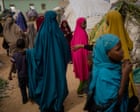
The rain in southern Somalia does not arrive like a gentle afternoon shower in a temperate suburb. It falls with the heavy, percussive violence of stones thrown against corrugated tin, turning red dust into slick, impassable clay within twenty minutes.
I still remember the smell of the Shabelle River when it swells past its banks. It is a thick, metallic scent of churned silt, drowned acacia roots, and sewage washed out of low-lying trenches. When you stand on a muddy embankment watching brown water swallow the only dirt road out of a district, geography stops being an abstract concept on a military briefing map. Geography becomes a cage.
In late 2023 and into 2024, as a historic El Niño weather system battered the Horn of Africa, more than two million people across Somalia were driven from their homes by catastrophic flooding. Bridges snapped. Entire agricultural basins vanished beneath stagnant inland seas.
Yet amid that climatic catastrophe, a far darker accusation surfaced from the mud and the rubble of southern Somalia—an allegation that turns the rules of modern warfare inside out.
Human rights investigators, local elders, and survivor testimonies began pointing toward a chilling intersection between extreme weather and counterterrorism operations. According to detailed accounts compiled by researchers and reported by investigative outlets, Somali special forces trained, funded, and closely advised by the United States military—specifically the elite Danab Brigade—conducted raids and established containment cordons that effectively trapped civilians, predominantly women and children, inside rising floodwaters while denying them safe passage or humanitarian relief.
Pause and let that sink in.
Water. The oldest weapon in human history, now allegedly synchronized with satellite intelligence, drone surveillance, and American-backed counterinsurgency tactics.
The Architecture of an Invisible Trap
To understand how a flood becomes a military instrument, you first have to abandon the Hollywood image of modern combat. There are no trenches here, no neat front lines drawn in ink. In Somalia’s Lower Shabelle and Jubba regions, the war against the militant group al-Shabaab is fought across a shifting patchwork of rural villages, clan territories, and seasonal waterways.
Consider a hypothetical scenario, grounded directly in the documented patterns reported by human rights monitors on the ground.
Picture a mother—let us call her Halima—living in a farming settlement a few kilometers from the Juba River. For weeks, the elders have watched the upstream gauges. Everyone knows the river is going to breach. Under normal circumstances, survival in the riverine valleys relies on a centuries-old choreography of movement: you pack your cooking pots, gather your children, herd whatever goats remain, and walk toward higher ground before the low roads dissolve into knee-deep mire.
Now, introduce a military cordon.
In late 2023, as El Niño rains turned the region into an archipelago of isolated mud islands, Danab units—operating within a security architecture heavily reliant on U.S. Africa Command (AFRICOM) training, logistical support, and air cover—moved through contested villages suspected of harboring or paying taxes to al-Shabaab. According to witnesses and advocacy groups, civilians attempting to flee the rising waters were blocked at checkpoints, ordered back into low-lying zones, or subjected to raids just as the floodwaters peaked.
Halima does not care about the geopolitical acronyms dictating the operation. She does not know what "force multiplication" or "partner-led counterterrorism" means in a Pentagon press release. What she knows is that behind her, brown water is rising past the ankles of her four-year-old son, carrying waterborne disease and venomous snakes flushed from their burrows. Ahead of her, armed men in modern tactical gear—wearing patches and carrying rifles financed by American taxpayers—are firing warning shots into the mud, telling her that the road to higher ground is closed.
When you block the only elevated exit during a flash flood, you do not need to pull a trigger to inflict mass suffering. Gravity and hydrology do the work for you.
Why Counterinsurgency Fails When the Water Rises
Why would disciplined, foreign-trained forces allegedly trap non-combatants in a natural disaster? The answer lies in a grim military logic that has haunted counterinsurgency campaigns from Vietnam to the Sahel.
Think of a rural insurgency like dye spilled into a glass of water. To an outside military planner, the militants and the civilian population appear hopelessly mixed together. In southern Somalia, al-Shabaab governs rural areas through taxation, courts, and coercion. When floodwaters inundate the countryside, militant fighters lose mobility just like everyone else; their vehicles bog down, their supply lines snap, and they are forced onto the few remaining strips of dry land.
From a purely cold, tactical standpoint, a flood is an operational opportunity. It corrals the enemy.
But in that tactical calculus, every villager living under militant control is treated with reflexive suspicion. Men of fighting age are assumed to be insurgents. Women and children are viewed not as disaster victims requiring urgent evacuation, but as potential human shields, logistics networks, or populations that must be isolated to starve the militants of cover and resources.
Here is where the moral compass spins off its axis.
When military forces seal off an area during an El Niño deluge—restricting movement, burning shelters during clearing operations, or blocking aid convoys from entering flooded districts—they transform a meteorological event into collective punishment. International humanitarian law is unambiguous on this point: warring parties cannot use the starvation, displacement, or natural devastation of a civilian population as a method of warfare. You cannot weaponize an act of God.
Yet in the fog of remote warfare, accountability evaporates faster than rainwater on hot tarmac.
The Distance Between Washington and the Mud
I have spent years examining how modern superpowers fight wars by proxy, and the most unsettling truth is not malice—it is insulation.
In the architecture of U.S. counterterrorism in East Africa, American boots rarely touch the flooded clay of remote river villages during ground sweeps. Instead, Washington relies on what defense officials call "by, with, and through" operations. The United States recruits, vets, equips, pays, and mentors the Danab Brigade. American drones orbit silently above the cloud cover, feeding real-time thermal imagery to tactical operations centers. American medical evacuation helicopters stand ready if an advisor is wounded.
This arrangement is engineered to minimize American casualties and domestic political blowback. It also creates a convenient hall of mirrors whenever accusations of abuse emerge.
When investigators and journalists confronted U.S. officials with allegations that American-backed forces had trapped women and children in the path of El Niño floods and carried out abusive raids amid the crisis, the response followed a familiar, well-worn script. AFRICOM stated that it takes all allegations of civilian harm seriously, noted that it reviews credible reports, and emphasized that Somali forces are sovereign partners responsible for their own conduct—even while acknowledging ongoing training in the laws of armed conflict.
Read those words carefully. They are a masterclass in institutional deflection.
If you build the engine, supply the fuel, map the route via satellite, and pay the driver, can you truly claim you had nothing to do with where the truck goes?
That question is not merely philosophical. Under U.S. law—specifically the Leahy Law—the American government is legally prohibited from providing assistance to foreign security force units credibly implicated in gross violations of human rights. On paper, it is a bright red line. In practice, inside a sprawling, decades-long shadow war where tactical intelligence is prized above all else, that red line blurs into grey.
What El Niño Actually Does to a Human Body
To grasp the true stakes of these allegations, strip away the policy debates and look closely at what happens when a family is pinned down by floodwater.
Floods do not kill like bombs. Bombs are instantaneous, loud, and photogenic enough to make the evening news. Floods kill slowly, quietly, and through compounding indignities.
First comes the cold. Even near the equator, sitting for days in wet clothes with no dry wood for a fire drains body heat from infants and the elderly. Next comes the hunger. Granaries dug into the earth—the traditional bakaar pits used by Somali farmers to store sorghum and maize—fill with water, rotting an entire year’s harvest in forty-eight hours.
Then comes the water itself.
When latrines overflow and mix with drinking supplies, cholera and acute watery diarrhea sweep through trapped populations like wildfire. Imagine trying to keep a dehydrated toddler alive while surrounded by an ocean of water you cannot drink, unable to walk three miles to a clinic because an armed checkpoint blocks the embankment.
During the 2023–2024 El Niño emergency, the United Nations warned of catastrophic spikes in cholera, malaria, and severe acute malnutrition across southern Somalia. Hundreds of thousands of children were already teetering on the edge of famine following five consecutive failed rainy seasons just a year earlier. Somalia had barely survived a historic drought before being drowned by a historic flood—a climate whiplash that left communities with zero reserves of money, food, or physical resilience.
To trap people inside that vise for military advantage is not a mere tactical misstep. It is an assault on the bare minimum of human survival.
The Lie of the Clean War
We like to believe that modern warfare has grown smarter, cleaner, and more surgical. We are shown high-definition videos of precision-guided munitions striking a single vehicle in an empty desert, and we are told that technology has finally separated the guilty from the innocent.
That narrative is a comforting fiction.
On the ground in places like Somalia, war remains stubbornly, brutally physical. It is still fought at roadblocks in the pouring rain, by exhausted, terrified young soldiers who cannot tell a farmer from a fighter, operating under immense pressure to show progress against an elusive insurgency. When those forces are backed by the overwhelming technological and financial might of the world’s richest military, every mistake, every abuse, and every callous decision is amplified.
Worse still, tactics that trap and terrorize civilians achieve the exact opposite of their stated strategic goal.
Al-Shabaab does not survive because it has better weapons than the United States or the Somali National Army. It survives because it exploits grievance. Every time a mother is prevented from carrying her children away from rising floodwaters by government troops wearing American-funded gear, militant recruiters do not even need to make a speech. The water makes their argument for them. You cannot bomb an ideology out of existence while simultaneously teaching the population that the state and its foreign patrons view their drowning as acceptable collateral damage.
What Accountability Actually Looks Like
If there is a way out of this moral quagmire, it does not begin with another lofty Pentagon directive on civilian harm mitigation. It begins with radical transparency and real consequences.
First, independent international investigators—not internal military review boards grading their own homework—must be granted unrestricted access to the riverine districts affected by both the floods and the military operations. Survivor testimonies cannot be dismissed simply because they come from areas contested by militants; in asymmetric wars, those are the only places where victims live.
Second, security assistance must carry immediate, automatic conditions. When credible evidence emerges that a partner unit has obstructed humanitarian aid or trapped civilians during a climate disaster, funding, intelligence sharing, and operational support must freeze until the commanders responsible are investigated and held accountable. Without teeth, human rights training is just expensive theater.
Finally, military planners must confront a reality that climate scientists have been shouting about for a decade: extreme weather is no longer an occasional backdrop to conflict. In the Horn of Africa, droughts and floods are now permanent features of the battlefield. Any military doctrine that fails to prioritize civilian evacuation and humanitarian corridors during climate emergencies is not a counterterrorism strategy—it is a blueprint for atrocity.
The Water Always Remembers
Eventually, the El Niño rains stopped. Under the fierce East African sun, the brown waters of the Shabelle and the Juba slowly receded, leaving behind cracked mud, bleached animal bones, and the skeletal remains of washed-out homes.
Satellite maps updated. Briefing slides moved on to new crises in other hemispheres. In Washington, the war in Somalia slipped back into the quiet margins of foreign policy, mentioned only in brief press releases tallying airstrikes and militant casualties.
But down in the river valleys, the people who survived the high water have not forgotten who stood on the dry ground with rifles, and who was left standing in the dark as the river rose around their knees.