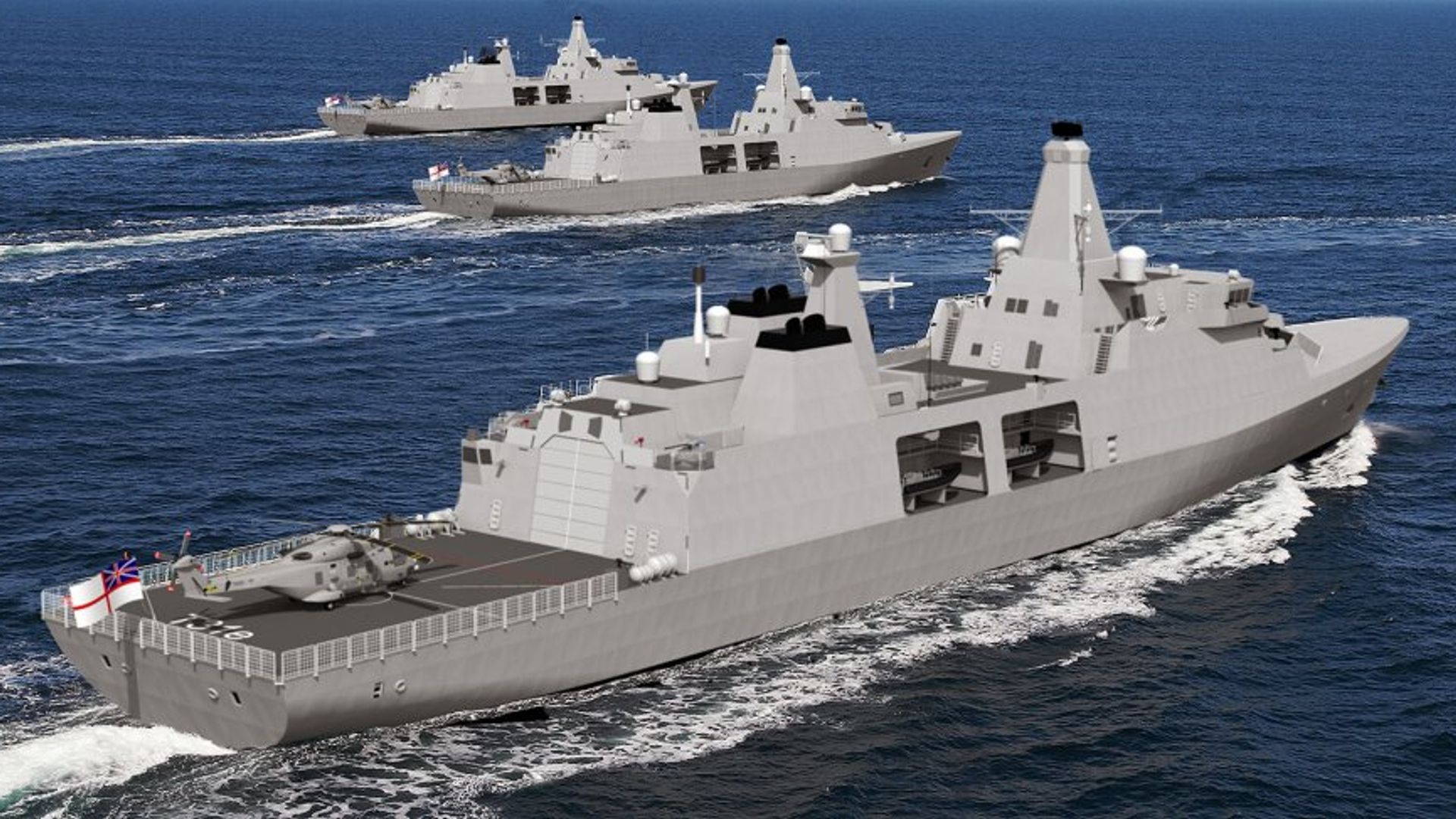
The British Ministry of Defence has abruptly canceled its long-gestating Type 83 destroyer program, permanently altering the trajectory of the Royal Navy. Rather than building a fleet of multi-billion-pound, crewed surface combatants to replace the aging Type 45 anti-air destroyers, the government is shifting its entire surface fleet strategy. The UK will instead procure at least six Common Combat Vessels (CCVs). These new platforms are specifically designed to operate as low-cost, hybrid control hubs for uncrewed aerial, surface, and subsurface systems.
This decision, formalised within the newly unveiled Defence Investment Plan, stops the Type 83 project before it could exit the concept phase. For a decade, the plan was to build a traditional, heavily armed successor to ensure blue-water air defense into the mid-century. Instead, the Treasury and defense planners opted for a cheaper, distributed architecture. Critics will label this a retreat toward budget warships. In reality, it represents a calculated gamble on an entirely different philosophy of naval mass.
The Financial Reality of Global Air Dominance
The cancellation of the Type 83 project exposes the structural friction inside the defense budget. Senior military planners previously estimated that fully funding the Type 83 alongside the five planned Type 32 frigates would require a defense investment settlement close to £28 billion. The actual allocation secured under Defence Secretary Dan Jarvis amounted to £14.5 billion. While this includes a late £1 billion uplift, it remains a massive shortfall.
Building modern, high-end guided-missile destroyers has become a financial impossibility for mid-sized nations. A single modern air-defense destroyer, packed with active electronically scanned array radars and over 90 vertical launch missile cells, regularly exceeds £2 billion in construction costs alone. When life-cycle maintenance, crew retention, and mid-life upgrades are factored in, a fleet of eight traditional destroyers can easily swallow an entire decade's worth of surface shipbuilding capital.
By pivoting to the Common Combat Vessel framework, defense planners are attempting to decouple capability from hull size. The goal is to build a simpler, highly automated mothership that relies on modular software rather than permanent, gold-plated hardware.
Inside the Uncrewed Mothership
The proposed Common Combat Vessels are not traditional warships stripped of their guns to save cash. They represent an entirely different asset class designed to project power through automation.
Instead of carrying massive, organic missile magazines beneath the deck, a CCV acts as a network orchestrator. It will feature an open software architecture designed to coordinate dozens of autonomous systems simultaneously. This includes off-the-shelf surveillance drones in the air, autonomous subsurface gliders for mine hunting, and large uncrewed surface vessels carrying modular missile modules.
This shift relies heavily on automation to lower human overhead. A standard Type 45 destroyer requires a core crew of roughly 190 personnel, a figure that strains the Royal Navy's chronic recruitment and retention pipelines. The CCV aims to slash that human footprint dramatically by automating basic ship functions and damage control systems. The personnel on board will not be turning wrenches or manually loading weapon systems; they will be data managers monitoring algorithmic combat networks.
+-------------------------------------------------------------------+
|                     COMMON COMBAT VESSEL (CCV)                    |
|                        [Network Orchestrator]                     |
+-------------------------------------------------------------------+
                                  |
         +------------------------+------------------------+
         |                        |                        |
         v                        v                        v
+------------------+     +------------------+     +------------------+
|   AIR DOMAIN     |     |  SURFACE DOMAIN  |     | SUBSURFACE DOMAIN|
|  Strike & Recon  |     |   Modular VLS    |     |  Mine Hunting &  |
|      Drones      |     |  Missile Boats   |     |  Recon Gliders   |
+------------------+     +------------------+     +------------------+
The Single Point of Failure
The primary vulnerability of a distributed, drone-centric fleet does not lie in the steel of the hull, but in the spectrum of the airwaves. Traditional destroyers are designed as self-contained fortresses. If their satellite communications are cut, they can still detect targets with their own radars and fire missiles from their own vertical launch cells.
A hybrid drone fleet operates on an entirely different logic. If a CCV relies on forward-deployed drone boats to spot targets and remote missile barges to fire interceptors, it requires an un-jammable, resilient data link to stitch the system together.
In a high-intensity conflict against an adversary possessing advanced electronic warfare capabilities, those data links will be the primary target. If the command signals between the mothership and its uncrewed appendages are severed, or if the sensor feeds are blinded by sophisticated jamming, the entire network degrades instantly. A multi-billion-pound destroyer might be hard to hide, but it cannot be disconnected by a software exploit or an electronic warfare block. The Royal Navy is trading the physical vulnerability of a single large target for the digital vulnerability of a dispersed network.
A Legacy of Shrinking Fleet Numbers
History suggests that when the Ministry of Defence promises to replace high-end capabilities with cheaper, more numerous alternatives, the fleet shrinks anyway. The Type 26 frigate program was initially meant to deliver 13 advanced anti-submarine warships. Skyrocketing costs forced that number down to eight, with the cheaper, less capable Type 31 frigate brought in to plug the numerical deficit.
The danger with the Common Combat Vessel is that it becomes a convenient mechanism for managing decline rather than exploiting a tactical revolution. Six hulls remain the absolute bare minimum required to maintain a single destroyer or primary surface combatant on permanent forward deployment while accounting for training, transit, and deep-maintenance cycles. If the CCV design experiences the type of cost overruns common to novel naval programs, that number of six will face immediate pressure.
Furthermore, the existing Type 45 destroyers must now be kept alive via extensive life-extension packages well into the 2030s. The integration of 24 additional Sea Ceptor missile cells across the existing fleet between 2026 and 2032 is no longer just a mid-life upgrade. It is a critical bridge to prevent a total collapse of the UK's maritime air defense umbrella before the first CCVs are delivered.
The Iron Law of Naval Mass
The conflict in the Black Sea demonstrated that cheap, uncrewed surface vessels can successfully cripple traditional naval assets in confined waters. However, operating autonomous systems across the vast distances of the North Atlantic or the Indo-Pacific is an entirely different engineering challenge. Small drone boats lack the endurance, sea-keeping ability, and range to operate alongside a carrier strike group in heavy seas.
To make this strategy work, the uncrewed systems cannot be small, expendable targets. They will need to be substantial vessels in their own right, requiring their own maintenance, logistics, and propulsion systems.
This reality undercuts the core financial premise of the budget warship pivot. If the autonomous wingmen of the CCV must grow to thousands of tonnes to survive a blue-water environment, the cost savings begin to evaporate. The Royal Navy is betting its future on the assumption that software and automation can outpace the traditional, brutal requirements of displacement, steel, and human endurance at sea. It is a paradigm shift born out of financial necessity, and there is no backup plan.