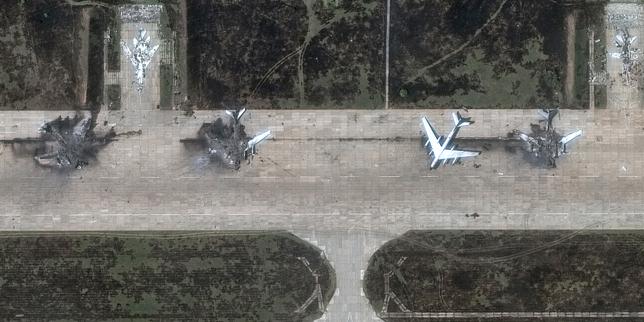
You can't hide a giant bomber forever. Russia just found that out the hard way at its Engels-2 air base, located a massive 800 kilometers away from the Ukrainian border.
Ukrainian President Volodymyr Zelensky confirmed that a special operation by the Security Service of Ukraine (SBU) successfully wiped out a Russian Tu-95 strategic bomber right on its home tarmac. Early field reports indicate the strike was devastating, literally tearing the tail section completely off the aircraft.
This isn't just a minor win or a random drone strike. It strikes at the core of Moscow's long-range terror campaign.
The Myth of Long Range Protection
For years, the Kremlin treated its strategic bomber bases like untouchable sanctuaries. They assumed that keeping their Tu-95 and Tu-160 fleets hundreds of miles deep inside Russian territory meant they could launch Kh-101 cruise missiles at Ukrainian infrastructure without facing any real consequences.
That illusion is officially dead.
The SBU used long-range kamikaze drones to bypass Russian air defenses on the night of July 16, sparking massive fires across the Engels airfield. If you look at the geography, hitting Engels means Ukraine can now reliably project force deep into the Russian heartland. Zelensky called these operations "long-range sanctions," and frankly, it's a brilliant way to phrase it. Instead of waiting for economic penalties to slowly grind down Russia's war machine, Ukraine is physically dismantling the tools used to attack its cities.
What makes this strike significant is the target itself. Russia doesn't build new Tu-95s. The global supply is strictly finite. Every single airframe lost is a permanent reduction in their capability to execute mass missile strikes.
A Black Week for the Russian Air Force
This latest strike isn't an isolated incident. If you track the data over the last ten days, the Russian air force is experiencing a catastrophic run of bad luck, or rather, incredibly precise Ukrainian targeting:
- On July 8, Ukraine brought down a modern Su-35 multirole fighter.
- On July 15, the Unmanned Systems Forces knocked out a Mi-28 attack helicopter in the Belgorod region.
- On July 16, special operators used drones to destroy a Su-24M frontline bomber at the Saky airbase in occupied Crimea.
Now, the Tu-95 at Engels crowns a highly coordinated campaign to blind, cripple, and deplete Russia's aviation assets.
The intelligence required to pull this off shouldn't be understated. Flying a slow, low-altitude kamikaze drone 800 kilometers through contested airspace requires perfect route planning, real-time electronic warfare suppression, and precise timing. The SBU operators are finding the gaps in Russian radar coverage and exploiting them ruthlessly.
What This Means for the Frontline
Don't expect Russia to stop launching missiles tomorrow. They still have operational bombers, and they will keep using them. However, the strategic math has fundamentally shifted.
The Russian command now faces a brutal dilemma. Do they keep their remaining bombers at Engels and risk losing more multi-million dollar assets? Or do they push them even further back, deep into the Arctic circles to bases like Olenya?
Moving them farther away means longer flight times, more wear and tear on aging engines, higher fuel consumption, and crucially, gives Ukraine hours of advance warning before missiles are actually launched. Every extra mile the bombers have to fly gives Ukrainian air defense teams more time to prepare, track, and intercept incoming threats.
The reality is that Russia's deep rear is no longer safe. Ukraine is forcing the conflict back onto Russian soil, targeting the oil facilities feeding the military budget and the airfields launching the attacks. If you want to track the real progress of this war, look past the stagnant trenches and watch the airfields deep inside Russia. That's where the real damage is being done.
Keep a close eye on satellite imagery updates from Engels over the coming days. The visual proof of that shattered tail section will tell us exactly how long that specific runway will remain out of commission.