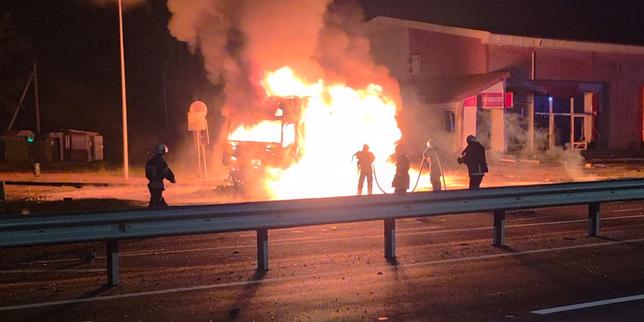
When the radar screens lit up with over three hundred incoming attack drones in a single twenty-four-hour span, air defense commanders didn't just see numbers. They saw a terrifying shift in modern aerial warfare. Russia's massive Sunday drone blitz targeting Ukrainian infrastructure wasn't just another escalation. It was a brutal stress test of Western-supplied missile batteries, electronic jamming arrays, and civilian survival grit.
If you think this was just another routine night of shelling, you're missing the entire strategic evolution playing out in the skies over Eastern Europe. Moscow is no longer just using drones for sporadic terror strikes. They are treating low-cost loitering munitions as a primary strategic instrument to drain expensive air defense stockpiles dry.
Let's look at how we got here and why this specific wave marks a dangerous turning point.
The Mathematics of Exhaustion
The core problem in modern air defense comes down to a brutal economic mismatch. Firing a multi-million-dollar Patriot or NASAMS interceptor missile at a Shahed-style kamikaze drone worth a fraction of that cost is a losing game. Moscow knows this. By scaling up single-day launch volumes past the three-hundred mark, Russian planners are forcing Kyiv into an impossible corner.
You have to shoot them down because they carry live high explosives headed for power plants, substations, and apartment blocks. But every interceptor spent on a swarm today is one less missile available for tomorrow's ballistic missile barrage.
Here is what happens on the ground when the sirens start wailing.
Mobile fire teams equipped with heavy machine guns mounted on pickup trucks roar into position. Electronic warfare units flick their emitters on, attempting to spoof the onboard guidance systems of the incoming swarms. It's chaotic, exhausting, and entirely dependent on split-second human decisions.
Beyond the Numbers
When headlines shout about hundreds of drones, people picture a sci-fi dark-sky scenario. The reality is far grittier. Many of these platforms are crude, loud, flying lawnmowers packed with explosives. They fly low, hugging terrain contours and following pre-programmed GPS waypoints.
Yet, numbers matter because scale creates saturation.
Even if anti-air units intercept eighty or ninety percent of an incoming swarm, the remaining fraction getting through is more than enough to cause catastrophic localized damage. That's precisely what happened during this recent Sunday assault. Electrical grids that took months to repair after previous winter campaigns absorbed fresh hits.
Military analysts often debate whether quantity beats quality. In this conflict, quantity has become a quality all its own. When you throw three hundred vectors at a defended airspace simultaneously, you create massive radar clutter. Operators struggle to prioritize targets. Communication lines jam with overlapping reports from spotters across multiple oblasts.
The Electronic Cat and Mouse Game
Missiles and machine guns only tell half the story. The real technological war is happening in the invisible spectrum of radio frequencies and satellite navigation.
Ukraine has gotten remarkably good at electronic countermeasures. They use spoofing gear to trick incoming drones into thinking they are miles off course, causing them to circle harmlessly or crash into empty fields. But electronic warfare is never static. Russian engineers keep tweaking flight computers, adding ruggedized cellular modems and inertial navigation backups to bypass localized jamming fields.
Sunday's attack proved that both sides have adapted. The sheer volume was designed to overwhelm not just kinetic interceptors, but also the digital shields guarding critical energy hubs.
What This Means for the Months Ahead
We are witnessing the industrialization of drone warfare. What started as an innovative tactical experiment has transformed into a high-volume manufacturing pipeline feeding a relentless attrition strategy.
For Ukraine, the challenge isn't bravery or tactical skill. Both are in endless supply. The bottleneck is the supply chain of interceptors and the sheer physical toll on personnel who haven't slept properly in years.
When you strip away the political posturing and the daily casualty reports, the fundamental dynamic remains brutally simple. Air defense is no longer about having the best single missile. It's about industrial capacity, supply chain resilience, and who can sustain the economic cost of the sky falling day after day.
Keep your eyes on the supply lines, because that's where this war will ultimately be decided.