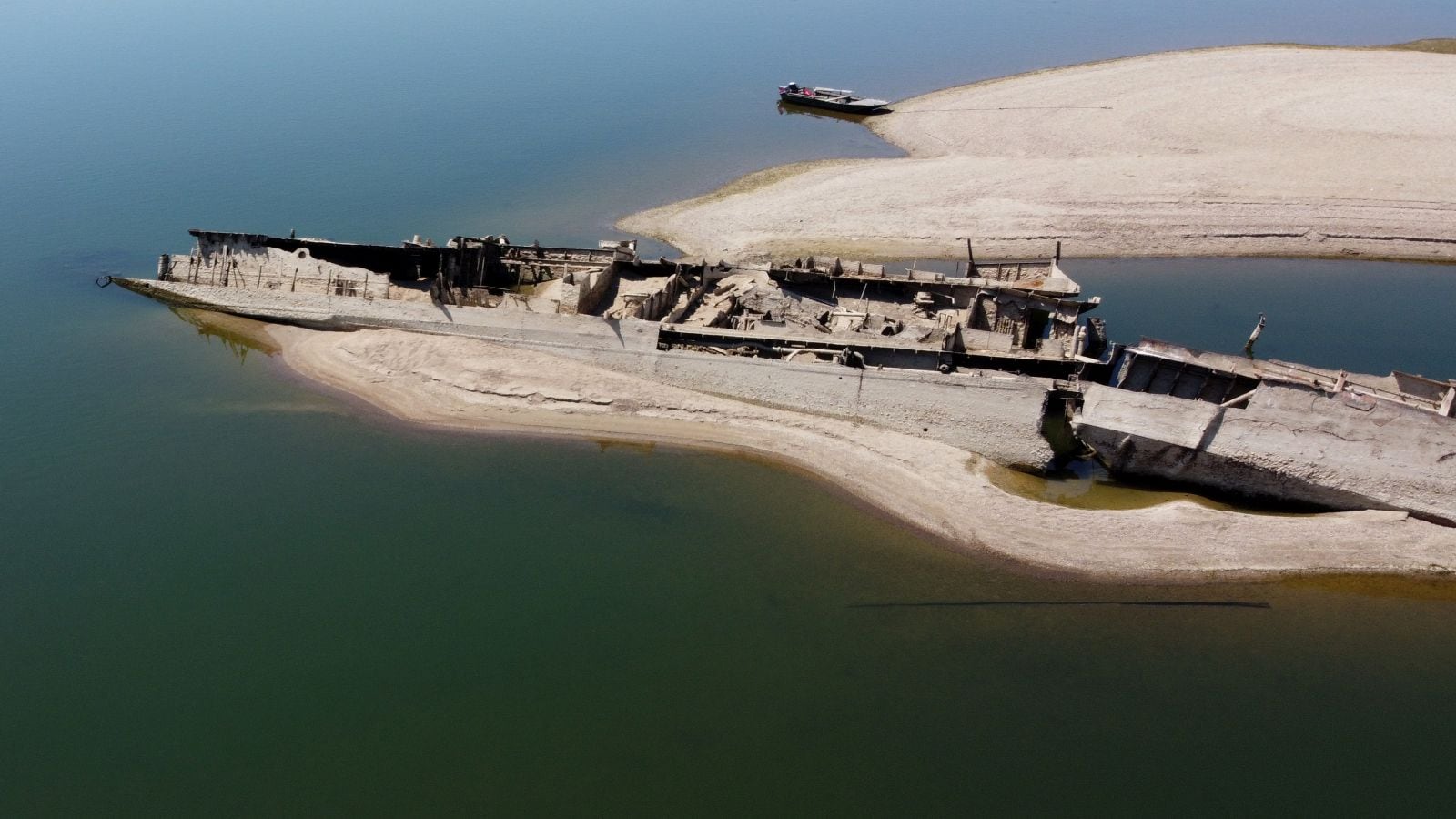
Droughts do not just lower water levels. They expose what empires tried desperately to bury. Across the shallow stretches of the Danube River near Prahovo, eastern Serbia, the brutal summer drops of recent years have dragged an invisible ghost fleet back into the harsh light of day. These are not mere wooden hulks or civilian barges. They are World War Two German warships, scuttled by Nazi forces in 1944 to block advancing Soviet troops, and they are now blocking modern shipping lanes while spilling decades of unexploded ordnance into the murky current.
For nearly eighty years, the sunken fleet rested beneath the silt, largely forgotten except by local fishermen and salvage historians. Climate change changed that equation. Severe hydrological droughts transformed the river into an archaeological excavation site, pushing rusted hulls, twisted anti-aircraft gun mounts, and tons of live ammunition to the surface. The river is talking back, and what it is saying carries explosive consequences for navigation, ecology, and regional security.
Anatomy of a Retreat The Black Sea Fleet Suicide Mission
To understand why dozens of Nazi warships lie rotting in a Serbian riverbed, you have to look at the chaotic military collapse of 1944. The Red Army was chewing through Eastern Europe at a terrifying pace. German forces operating in the Black Sea found themselves trapped. They could not sail back through the Bosporus due to Turkish neutrality and Allied naval dominance. Their only viable escape route led up the Danube, heading west toward Germany.
It was a desperate, failing gamble from the start. The Danube is narrow, winding, and prone to seasonal fluctuations in depth. Maneuvering heavy military craft upriver against a strong current under constant partisan harassment tested every limit of the German naval command.
By September 1944, the situation became untenable. The Red Army captured key strategic choke points along the riverbanks. Vice-Admiral Paul Brinkmann, commander of the German Black Sea naval forces, issued a sweeping, grim directive. Operation Donaueschiff was born. Instead of surrendering or allowing the vessels to fall into Soviet hands, the commanders ordered their own crews to blow up, scuttle, and sink their entire flotilla.
More than two hundred vessels went down near the Serbian port town of Prahovo. Destroyers, mine-sweepers, patrol boats, and landing craft settled into the mud, effectively creating an underwater iron dam. The operation successfully blocked Soviet navigation for a time, but it also created a lingering environmental and logistical nightmare that modern generations inherited.
The Ecological and Economic Toll of Forgotten Iron
The exposed warships are not empty shells. They remain packed with history's deadliest leftovers. Divers and explosive ordnance disposal teams face immense hazards whenever water levels drop. Thousands of tons of unexploded artillery shells, naval mines, and small arms ammunition sit inside the decaying hulls. The metal has degraded over eight decades, making the detonators dangerously unstable. A single miscalculated scrape against a rusted bulkhead could trigger a blast capable of leveling nearby riverbanks.
Beyond the immediate explosion hazard, the wrecks present a severe economic bottleneck. The Danube functions as one of Europe's most critical commercial corridors, connecting the North Sea to the Black Sea via canal systems. When the river shrinks and the wrecks emerge, the navigable width of the channel shrinks from over one hundred meters to a hazardous single-lane bottleneck.
Barges carrying grain, oil, and manufactured goods routinely run aground on the submerged hulls. The financial cost to international shipping companies runs into the millions annually. Delays ripple across supply chains throughout Central Europe, proving that a war fought eighty years ago still has the power to disrupt modern commerce.
The Politics of Salvage Why Cleanup Stalled for Decades
Removing a sunken fleet of this magnitude requires enormous capital, specialized engineering, and intense political cooperation. For decades, none of those elements aligned.
After the war, the new communist government of Yugoslavia lacked the heavy marine salvage technology required to lift massive steel warships out of the deep silt. Later, during the turbulent breakup of Yugoslavia in the 1990s and subsequent economic transitions, domestic infrastructure priorities shifted elsewhere. The wrecks simply sat there, sinking deeper into the sediment, treated as an unfortunate geographical quirk rather than an urgent crisis.
International funding finally materialized recently, driven largely by European Union infrastructure security initiatives and Serbian state tenders. The Serbian government awarded substantial contracts to specialized marine salvage firms equipped with heavy-lift cranes and specialized underwater cutting torches.
Yet the removal process moves at a glacial pace. Every single ton of metal retrieved from the riverbed must be checked for live explosives before it can be hoisted onto barges. Archaeologists also demand time to document artifacts before they are melted down or hauled away. History refuses to be rushed, even when it is rusting away in plain sight.
Climate Change as an Archaeological Accelerator
The sudden reappearance of the Prahovo fleet highlights a broader, unsettling trend across the globe. Climate shifts are rewriting the geography of historical preservation. Glaciers retreat in the Alps, revealing frozen World War One boots and weapons. Reservoirs dry up in the American West, exposing ghost towns and forgotten car wrecks. Rivers shrink in Europe, unearthing centuries-old hunger stones and Nazi warships.
Nature is acting as an unsparing archivist. The extreme weather patterns of the twenty-first century are systematically stripping away the protective layers of sediment, water, and ice that kept these historical artifacts hidden.
For historians, this provides a rare window into the physical reality of past conflicts. For engineers and environmentalists, it is an emergency response scenario. Each exposed wreck represents a compounding risk of chemical leakage, fuel seepage, and explosive detonation. The fuel tanks of these warships still hold residual bunker oil, slowly bleeding hydrocarbons into an ecosystem that supplies drinking water and fisheries to millions of people along its banks.
The Final Reckoning at Prahovo
The rusty snouts of anti-aircraft guns piercing the summer surface of the Danube are more than tourist curiosities or viral social media backdrops. They are physical reminders of a regime that chose total destruction over surrender, leaving a toxic inheritance for generations unborn.
Cranes are finally biting into the old steel. Divers are descending into the dark, cold water to disarm the legacy of 1944. Piece by piece, the iron dam at Prahovo is being dismantled, dragged from the mud, and hauled away to scrap yards.
Yet the work is far from finished. As long as the river continues to fluctuate under volatile weather patterns, other forgotten hulls may yet break the surface, reminding everyone that the past is never truly dead, and sometimes, it is waiting just beneath the current.