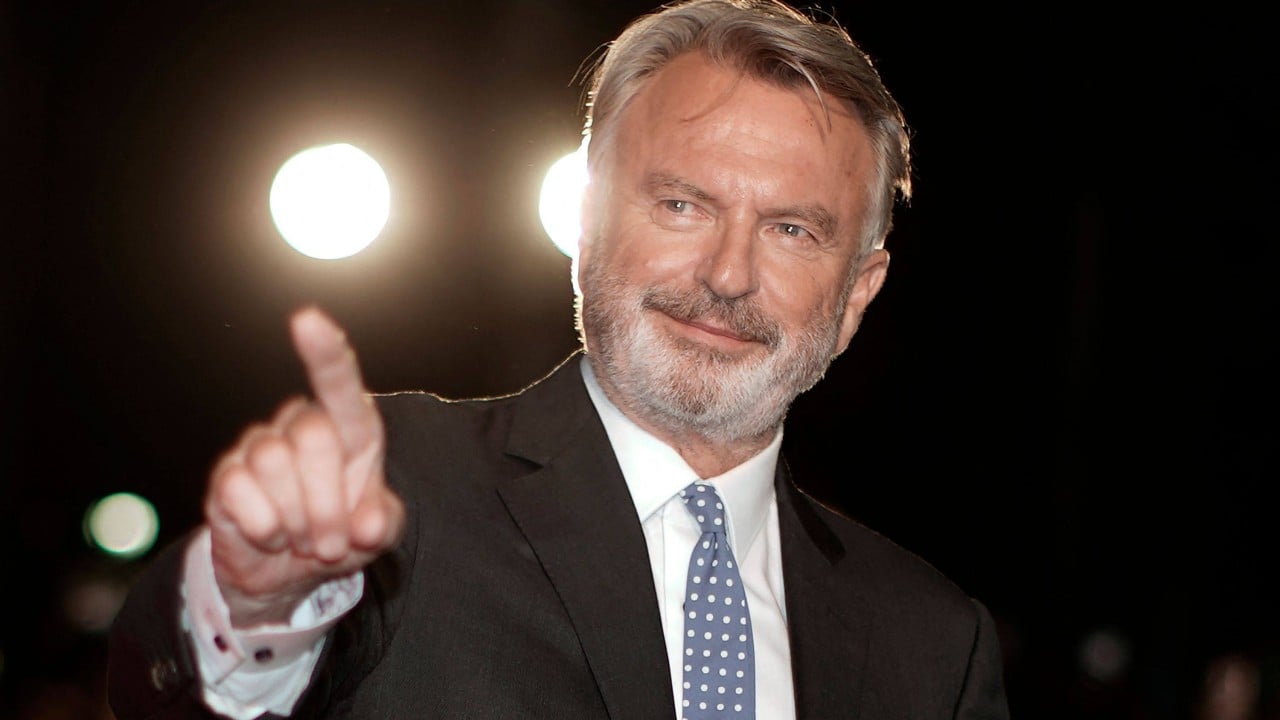
The world lost a titan today, but he would have hated that kind of grand, self-important title. Sam Neill died suddenly on Monday, July 13, 2026, in Sydney, Australia. He was 78. His family confirmed the news, noting that his passing was completely unexpected but that he died surrounded by those he loved.
The biggest twist in a life full of them? He was completely cancer-free when he died.
After a public battle with stage-three angioimmunoblastic T-cell lymphoma that started in 2022, Neill had fought his way into remission using an experimental drug. He was excited to get back to work. He wanted to make more movies. Then, out of nowhere, the curtain came down.
Most people hear the name Sam Neill and immediately picture a man in a fedora, holding a flare, staring down a Tyrannosaurus rex. That makes sense. Jurassic Park was a global phenomenon, and his Dr. Alan Grant became an permanent icon of pop culture. But reducing Sam Neill to a single blockbuster misses the entire point of one of the most versatile, eccentric, and enduring acting careers of the last fifty years. He was an international leading man who refused to play by Hollywood's rules, a gentleman farmer, an environmental activist, and a beautifully weird creative force.
The Sudden Shock in Sydney
The statement from his family hit the internet with a heavy weight. They shared that the loss was sudden. They expressed deep gratitude to the medical team at St Vincent's Private Hospital. But they also made sure to mention that he passed with the dignity that defined his entire existence.
Tributes poured in immediately from world leaders and Hollywood elite alike. New Zealand Prime Minister Christopher Luxon pointed out that Neill essentially helped build the country's modern film industry from scratch. Australian Prime Minister Anthony Albanese called him wry, dry, thoughtful, and laconic. They were both right. Neill belonged to the world, but his roots were firmly planted in the soil of the South Pacific.
People who followed his cancer journey closely were stunned. When he published his memoir, Did I Ever Tell You This?, he didn't mince words about his diagnosis. He hated the grueling chemotherapy sessions. He called it a miserable business. Yet, he kept laughing. He told journalists he wasn't afraid of dying, just that it would be annoying because he had a lot left to do. That lack of pretension was his superpower.
Building a Cinematic Movement From Scratch
He wasn't actually born in New Zealand. Nigel John Dermot Neill came into the world on September 14, 1947, in Omagh, Northern Ireland. His father was a New Zealand army major, and his mother was English. The family moved to the South Island city of Dunedin when he was seven.
School was tough. He had a severe stutter. To cope, he turned to theater, discovering that the stutter vanished the moment he stepped onto a stage and spoke someone else's words. He also dropped the name Nigel. He thought it sounded too effete for a Kiwi playground and started calling himself Sam. It stuck.
Opportunities for actors in 1970s New Zealand were virtually nonexistent. There was no industry. Neill spent years working for the National Film Unit, directing and editing documentary shorts just to stay close to the medium.
Then came 1977. He starred in Sleeping Dogs, a dystopian political thriller that became the first major New Zealand feature film made in decades. It changed everything. It proved that Kiwi stories could be dark, complex, and commercially viable.
Shortly after, Australian director Gillian Armstrong cast him opposite Judy Davis in My Brilliant Career. Playing a wealthy, handsome suitor with a quiet intensity, Neill caught the eye of international critics. Renowned British actor James Mason took notice and personally mentored him, helping him bridge the gap between regional theater and global cinema.
The Master of Quiet Intensity
Neill never felt like a traditional movie star. He lacked the loud, aggressive ego that dominated the 1980s and 1990s multiplexes. Instead, he specialized in characters who kept their secrets locked behind guarded eyes.
Consider his work in Dead Calm (1989). Standing opposite a young Nicole Kidman, Neill played a grieving husband trapped on a yacht with a psychopath. He didn't need to scream to convey terror or determination. You saw it in the set of his jaw.
That same year, he married Noriko Watanabe, a brilliant makeup artist he met on set. Though they separated decades later, they raised a family together, blending their lives across borders.
His mainstream breakthrough happened in 1993, a year that perfectly illustrated his staggering range. On one hand, he was Dr. Alan Grant in Steven Spielberg's Jurassic Park, anchoring a massive special-effects spectacle with pure human skepticism and warmth. He made us believe the dinosaurs were real because his reaction to them felt completely authentic.
On the other hand, that very same year, he starred in Jane Campion's The Piano. He played Alisdair Stewart, a rigid, emotionally repressed frontier husband who buys a bride and ends up consumed by jealousy. Film critic Roger Ebert noted that Neill concealed a universe of fear and sadness behind his clouded eyes. It remains one of the most chilling, heartbreaking performances of modern cinema.
He moved between these worlds without a single hitch. He could do high-octane blockbusters like The Hunt for Red October or cult horror classics like Event Horizon and John Carpenter's In the Mouth of Madness. He never looked down on genre filmmaking. He treated every script with the same respect.
Playing the Villain With a Twinkle in His Eye
As he grew older, Neill found a second life playing complicated, often sinister authority figures. He discovered that his natural charm could be weaponized on screen.
His performance as Chief Inspector Chester Campbell in the hit series Peaky Blinders was a revelation. He played a corrupt, sadistic lawman sent to clean up Birmingham. He was terrifying because he believed he was righteous. The Belfast accent he brought to the role was a nod to his birthplace, thick and menacing.
He brought a similar gravitas to The Tudors as Cardinal Thomas Wolsey. He played the ultimate political survivor until the political machine finally chewed him up.
Yet, he never lost his sense of fun. He popped up in the Marvel Cinematic Universe in Thor: Ragnarok and Thor: Love and Thunder, playing an Asgardian actor who portrays Odin in a cheesy community theater production. He was completely willing to poke fun at his own serious image.
Pinot Noir and the Art of Staying Grounded
If you want to understand the real Sam Neill, you have to look away from Hollywood entirely. You have to look at Central Otago, New Zealand.
In 1993, the same year his acting career went into orbit, Neill established Two Paddocks, a boutique vineyard. He started with just a small plot of land and a desire to grow great Pinot Noir for his friends. Over thirty years, it grew into a highly respected, multi-vineyard organic operation.
He took winemaking seriously. He didn't just slap his celebrity name on a bottle. He worked the land.
He also turned his farm into a sanctuary for a bizarre collection of animals. He had pigs, chickens, ducks, and sheep. He famously named them after his famous friends and co-stars. There was a pig named Taika Waititi, a duck named Magda Szubanski, and a hen named Meryl Streep. He routinely posted videos on social media talking to his animals, offering a delightful counterweight to the bleakness of the internet.
His love for the land wasn't just a hobby. Neill was a fierce, uncompromising environmentalist. He used his platform to campiagn aggressively against mining proposals in New Zealand and fought hard for marine conservation. The New Zealand Department of Conservation called him a legendary Kiwi who walked the talk, using his voice to protect the wild places he loved.
What Happens Next
We won't see another actor quite like Sam Neill. The industry doesn't make them like that anymore. He was a man who could command a room with a whisper, look completely at home in a muddy vineyard, and hold his own against a digital dinosaur.
If you want to honor his memory, don't just rewatch Jurassic Park tonight. Go deeper into the catalog.
Track down Hunt for the Wilderpeople and watch him play a grumpy, reluctant foster uncle bush-crafting through the New Zealand wilderness. Find a copy of The Piano and watch how he handles complex domestic tragedy. Or better yet, buy a bottle of good New Zealand Pinot Noir, pour a glass, and toast to a life incredibly well-lived. He left us plenty of stories to remember him by.