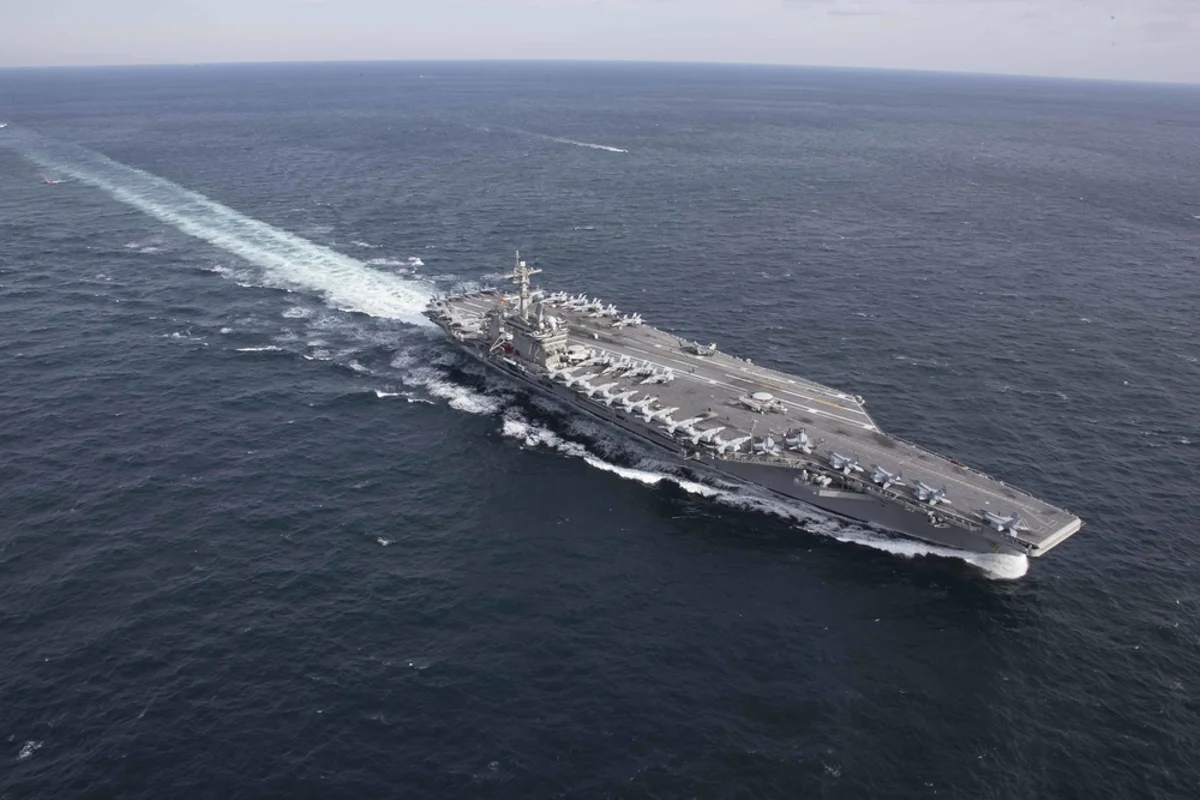
The calendar loses its teeth after month six. Days stop being Tuesdays or Fridays and turn into repetitions of gray steel, the ceaseless thrum of an aviation deck, and the smell of recycled air that tastes faintly of copper and sweat.
Imagine living inside a steel box with five thousand other people. Now, stretch that existence past two hundred and seventy days without once touching dry land.
This is the reality of the USS Abraham Lincoln. For over nine grueling months, the aircraft carrier and its strike group have churned through the waters of the Middle East, serving as a floating island of American power. But behind the official updates of thousands of aircraft launches and millions of pounds of ordnance expended, a quieter, heavier story unfolded in the berthing compartments below.
Consider a hypothetical nineteen-year-old machinist's mate stationed deep in the ship's bowels. When the Lincoln left San Diego in November, she expected a standard deployment. She packed light, said hurried goodbyes, and trusted the rotation. But the world shifted. Conflicts flared, orders changed, and the deployment stretched. By month eight, the letters from home arrived in erratic batches, the fresh rations dwindled into tight portions, and the ship's infrastructure began to fray under the relentless operational tempo.
When a machine runs past its maintenance window, gears strip. When a human mind runs past its breaking point, something far more fragile gives way.
Reports from the carrier began to leak past the watertight doors through hurried text messages and anxious family forums. Showars grew moldy. Basic hygiene supplies ran thin. Plumbing systems, taxed beyond endurance, backed up. To a civilian, these sound like inconveniences. To a sailor sleeping three-tier racks deep in an open-bay berthing with the constant vibration of jet blasts overhead, they are corrosive psychological weights.
The sea changes from an expanse into an enclosure.
Military leaders and defense officials have pushed back against descriptions of dire conditions, pointing out the extraordinary resilience of service members who operate under combat conditions. And they are right about the resilience. Sailors are trained to endure the unendurable. They can patch a ruptured pipe in pitch darkness and launch an F-35 off a pitching deck on three hours of sleep.
Yet resilience is not an infinite resource. It is a finite battery, and when you drain it without ever plugging it back into the shore, the system shorts out.
The human cost of these marathon deployments reveals itself in the quietest, most devastating ways. When mental health strains reach a critical pitch, the distance between the flight deck and the dark water below shrinks. Multiple reports surfaced of desperate crew members attempting to jump overboard—cracks in the armor that emergency recoveries and official statements cannot entirely seal.
We talk endlessly about hardware, about carrier strike groups, about strategic deterrence in volatile regions. We measure military might in hulls and tonnage. But a navy is not made of steel plate. It is made of nineteen-year-olds eating questioned rations under flickering fluorescent lights, staring at a phone screen that won't load a video from home because the bandwidth is choked and the ocean is too wide.
The Lincoln's marathon deployment highlights a dangerous mathematical reality for modern defense. The United States maintains a limited number of active aircraft carriers to project global stability. When one ship is held on station indefinitely because regional supply hubs are disrupted and replacement cycles stutter, the burden falls squarely on the shoulders of the crew.
There is a profound difference between a deployment and an isolation.
Consider what happens next. As replacement vessels like the USS George Washington move to relieve the strain, the institutional reflex will be to categorize the Lincoln's ordeal as an anomaly, a byproduct of sudden geopolitical storms. But the wear and tear on the human element points to a deeper systemic friction.
The horizon used to mean relief. For the crew of the Lincoln, after nine months of salt, steel, and silence, it simply means finding out whether home still remembers them the way they left it.